

Governance, Risk and Compliance: Concerns in Sustainability …
311
or depleting irreplaceable natural resources, preserving natural wealth and ecological
systems, and promoting the reduction of social inequalities (De Simone and Popoff
2000), which is a challenge that requires new tools and new approaches (Hoffren
and Apajalahti 2009).
4 Methods
The methodological approach followed a rigorous and systematic procedure. The
most appropriate method to meet the research objective was the Systematic Review
technique, since it uses systematically designed procedures to search and evaluate studies, in order to bring the content consolidation and main evidence of the
researched field. A research protocol was developed in which data collection, data
processing and results analysis were systematized using a sequential structure, based
on the propositions of Biolchini, Mian, Genc-Nayebi and Abran (2017), Tranfield
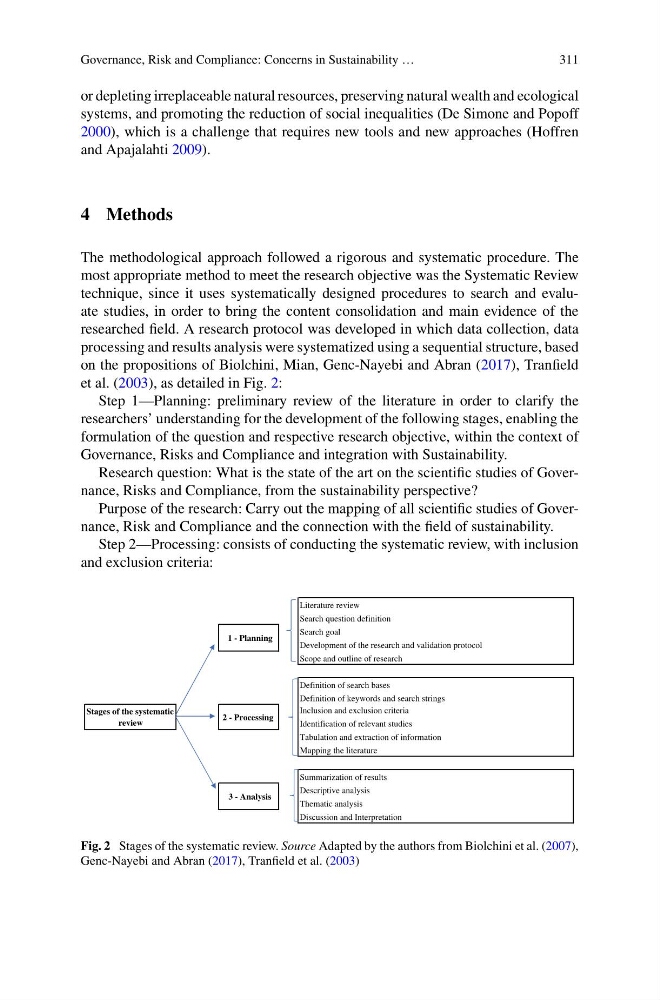
et al. (2003), as detailed in Fig. 2:
Step 1—Planning: preliminary review of the literature in order to clarify the
researchers’ understanding for the development of the following stages, enabling the
formulation of the question and respective research objective, within the context of
Governance, Risks and Compliance and integration with Sustainability.
Research question: What is the state of the art on the scientific studies of Governance, Risks and Compliance, from the sustainability perspective?
Purpose of the research: Carry out the mapping of all scientific studies of Governance, Risk and Compliance and the connection with the field of sustainability.
Step 2—Processing: consists of conducting the systematic review, with inclusion
and exclusion criteria:
Literature review
Search question definition
Search goal
Development of the research and validation protocol
Scope and outline of research
Definition of search bases
Definition of keywords and search strings
Inclusion and exclusion criteria
Identification of relevant studies
Tabulation and extraction of information
Mapping the literature
Summarization of results
Descriptive analysis
Thematic analysis
Discussion and Interpretation
1 - Planning
Stages of the systematic
review
2 - Processing
3 - Analysis
Fig. 2 Stages of the systematic review. Source Adapted by the authors from Biolchini et al. (2007),
Genc-Nayebi and Abran (2017), Tranfield et al. (2003)
311
or depleting irreplaceable natural resources, preserving natural wealth and ecological
systems, and promoting the reduction of social inequalities (De Simone and Popoff
2000), which is a challenge that requires new tools and new approaches (Hoffren
and Apajalahti 2009).
4 Methods
The methodological approach followed a rigorous and systematic procedure. The
most appropriate method to meet the research objective was the Systematic Review
technique, since it uses systematically designed procedures to search and evaluate studies, in order to bring the content consolidation and main evidence of the
researched field. A research protocol was developed in which data collection, data
processing and results analysis were systematized using a sequential structure, based
on the propositions of Biolchini, Mian, Genc-Nayebi and Abran (2017), Tranfield
et al. (2003), as detailed in Fig. 2:
Step 1—Planning: preliminary review of the literature in order to clarify the
researchers’ understanding for the development of the following stages, enabling the
formulation of the question and respective research objective, within the context of
Governance, Risks and Compliance and integration with Sustainability.
Research question: What is the state of the art on the scientific studies of Governance, Risks and Compliance, from the sustainability perspective?
Purpose of the research: Carry out the mapping of all scientific studies of Governance, Risk and Compliance and the connection with the field of sustainability.
Step 2—Processing: consists of conducting the systematic review, with inclusion
and exclusion criteria:
Literature review
Search question definition
Search goal
Development of the research and validation protocol
Scope and outline of research
Definition of search bases
Definition of keywords and search strings
Inclusion and exclusion criteria
Identification of relevant studies
Tabulation and extraction of information
Mapping the literature
Summarization of results
Descriptive analysis
Thematic analysis
Discussion and Interpretation
1 - Planning
Stages of the systematic
review
2 - Processing
3 - Analysis
Fig. 2 Stages of the systematic review. Source Adapted by the authors from Biolchini et al. (2007),
Genc-Nayebi and Abran (2017), Tranfield et al. (2003)