

310
J. G. M. C. da Amarante et al.
established by Elkington (2012), called the triple bottom line (TBL) or tripod of
sustainability, constituted by the economic, social and environmental pillars.
The economic pillar is related to the organizational financial expectation, in order
to align responsibly the operations and activities of the company and their respective
generation of wealth. The social aspect implies that the company has responsibilities
with society and these go beyond its economic and legal liabilities (Carroll 1979).
Finally, the environmental pillar, is directly related to the reduction of environmental
impacts, adequate management and conservation of natural resources (Lorenzetti
et al. 2008).
Since the dissemination of the concept of sustainability, it has been used within
multiple fields of research and action; that is, the same denomination comprises different concepts and practices (Claro et al. 2008). However, according to the authors,
all definitions carry the notion that sustainable development is composed of the three
dimensions mentioned above.
In this way, the three pillars of sustainability became part of the companies’ communication and transparency reports to the market, as well as their interrelationships
dynamics (Isenmann et al. 2007). In addition to the discussions and structuring of
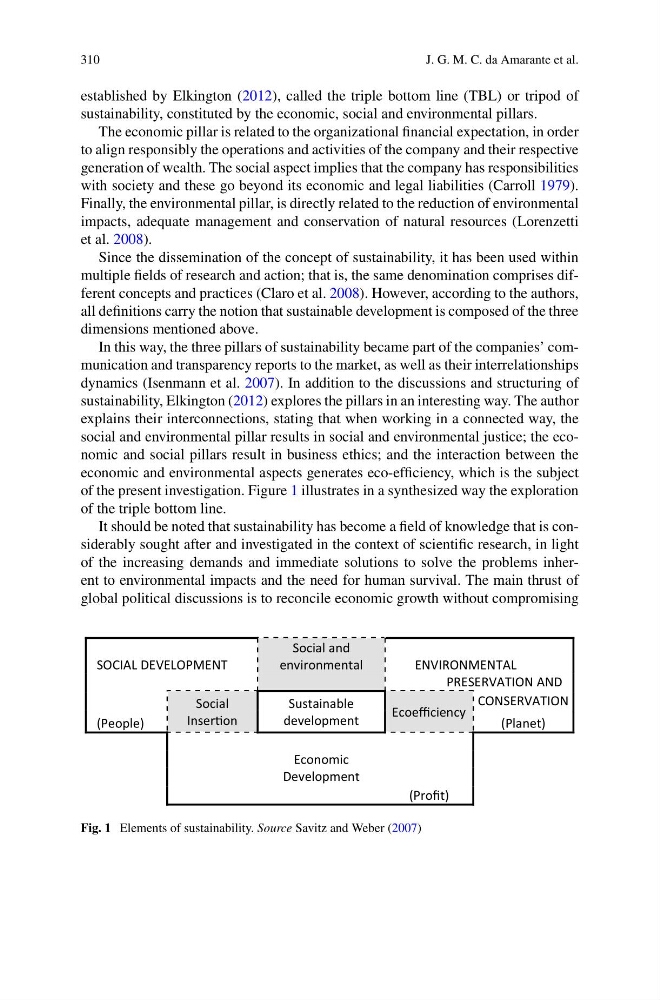
sustainability, Elkington (2012) explores the pillars in an interesting way. The author
explains their interconnections, stating that when working in a connected way, the
social and environmental pillar results in social and environmental justice; the economic and social pillars result in business ethics; and the interaction between the
economic and environmental aspects generates eco-efficiency, which is the subject
of the present investigation. Figure 1 illustrates in a synthesized way the exploration
of the triple bottom line.
It should be noted that sustainability has become a field of knowledge that is considerably sought after and investigated in the context of scientific research, in light
of the increasing demands and immediate solutions to solve the problems inherent to environmental impacts and the need for human survival. The main thrust of
global political discussions is to reconcile economic growth without compromising
SOCIAL DEVELOPMENT
Social and
environmental
ENVIRONMENTAL
PRESERVATION AND
Social
InserƟon
Sustainable
development
Ecoefficiency
CONSERVATION
(People)
(Planet)
Economic
Development
(Profit)
Fig. 1 Elements of sustainability. Source Savitz and Weber (2007)
J. G. M. C. da Amarante et al.
established by Elkington (2012), called the triple bottom line (TBL) or tripod of
sustainability, constituted by the economic, social and environmental pillars.
The economic pillar is related to the organizational financial expectation, in order
to align responsibly the operations and activities of the company and their respective
generation of wealth. The social aspect implies that the company has responsibilities
with society and these go beyond its economic and legal liabilities (Carroll 1979).
Finally, the environmental pillar, is directly related to the reduction of environmental
impacts, adequate management and conservation of natural resources (Lorenzetti
et al. 2008).
Since the dissemination of the concept of sustainability, it has been used within
multiple fields of research and action; that is, the same denomination comprises different concepts and practices (Claro et al. 2008). However, according to the authors,
all definitions carry the notion that sustainable development is composed of the three
dimensions mentioned above.
In this way, the three pillars of sustainability became part of the companies’ communication and transparency reports to the market, as well as their interrelationships
dynamics (Isenmann et al. 2007). In addition to the discussions and structuring of
sustainability, Elkington (2012) explores the pillars in an interesting way. The author
explains their interconnections, stating that when working in a connected way, the
social and environmental pillar results in social and environmental justice; the economic and social pillars result in business ethics; and the interaction between the
economic and environmental aspects generates eco-efficiency, which is the subject
of the present investigation. Figure 1 illustrates in a synthesized way the exploration
of the triple bottom line.
It should be noted that sustainability has become a field of knowledge that is considerably sought after and investigated in the context of scientific research, in light
of the increasing demands and immediate solutions to solve the problems inherent to environmental impacts and the need for human survival. The main thrust of
global political discussions is to reconcile economic growth without compromising
SOCIAL DEVELOPMENT
Social and
environmental
ENVIRONMENTAL
PRESERVATION AND
Social
InserƟon
Sustainable
development
Ecoefficiency
CONSERVATION
(People)
(Planet)
Economic
Development
(Profit)
Fig. 1 Elements of sustainability. Source Savitz and Weber (2007)