

218
G. M. Oliveira et al.
to potable water, but rather linked to equal access to education, healthcare, income
and general wellbeing conditions. Therefore, SDGs were defined globally, considering our planet the home for humanity, offering the appropriate conditions for the
wellbeing and flourishing of societies, while assuming that the planet resources and
ecosystems’ preservation should guaranty the sustainability of Earth for future generations (United Nations General Assembly 2015). The UN Agenda is so inclusive
that touches every country’s ambition regarding sustainable development, however,
each country’s trajectory, efforts and targets are not necessarily similar, depending
on its development level and pathway (Salvia et al. 2019).
Regarding the measure of SDGs, when considering the local scale, or the communities inserted in the municipality, some SDGI (SDG Indicators) may not apply
because of territories’ geographical conditions (absence of marine resources, for
example), or may be extremely difficult to evaluate due to the lack of reliable and
appropriate information from official databases. The sustainable development dimensions considered in the WeGIx are aligned with the seventeen SDGs but the process
of variables selection took into consideration the development level of the country
as well as data availability.
WeGIx period of analysis is from 2009 to 2017 and the study target area is Portugal
(92,212 km
2 ) a country located on the south-eastern region of Europe. Portugal has
two Atlantic archipelagos: Açores and Madeira and the mainland is part of the Iberian
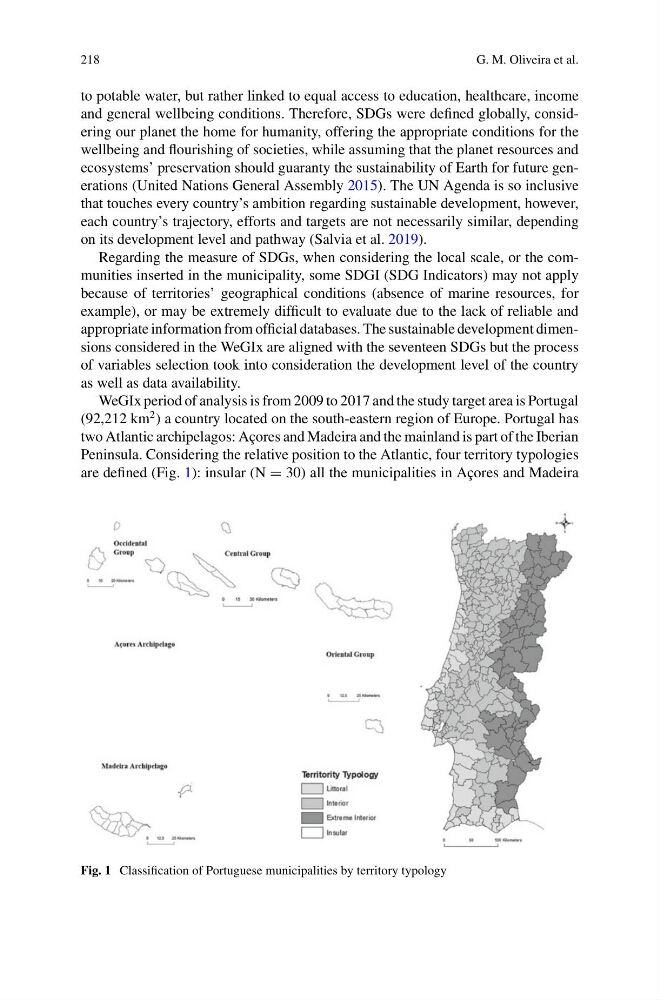
Peninsula. Considering the relative position to the Atlantic, four territory typologies
are defined (Fig. 1): insular (N = 30) all the municipalities in Açores and Madeira
Fig. 1 Classification of Portuguese municipalities by territory typology
G. M. Oliveira et al.
to potable water, but rather linked to equal access to education, healthcare, income
and general wellbeing conditions. Therefore, SDGs were defined globally, considering our planet the home for humanity, offering the appropriate conditions for the
wellbeing and flourishing of societies, while assuming that the planet resources and
ecosystems’ preservation should guaranty the sustainability of Earth for future generations (United Nations General Assembly 2015). The UN Agenda is so inclusive
that touches every country’s ambition regarding sustainable development, however,
each country’s trajectory, efforts and targets are not necessarily similar, depending
on its development level and pathway (Salvia et al. 2019).
Regarding the measure of SDGs, when considering the local scale, or the communities inserted in the municipality, some SDGI (SDG Indicators) may not apply
because of territories’ geographical conditions (absence of marine resources, for
example), or may be extremely difficult to evaluate due to the lack of reliable and
appropriate information from official databases. The sustainable development dimensions considered in the WeGIx are aligned with the seventeen SDGs but the process
of variables selection took into consideration the development level of the country
as well as data availability.
WeGIx period of analysis is from 2009 to 2017 and the study target area is Portugal
(92,212 km
2 ) a country located on the south-eastern region of Europe. Portugal has
two Atlantic archipelagos: Açores and Madeira and the mainland is part of the Iberian
Peninsula. Considering the relative position to the Atlantic, four territory typologies
are defined (Fig. 1): insular (N = 30) all the municipalities in Açores and Madeira
Fig. 1 Classification of Portuguese municipalities by territory typology