

174
S. da Silva Neiva et al.
crises, political instabilities, food instability and terrorist attacks (Zhang and Li 2018).
Sustainable urbanization is not only about converting unmodified environments or
agricultural land to build cities (Pickett et al. 2013); but involves radical changes in
form, metabolism, economy and demography in urban ecosystems (Pan et al. 2016).
Radical changes happening in each environment may be characterized as urbanization, as restructuring settlements or converting agricultural land into urban centers
(Meijering et al. 2018). Planning sustainability in a city level allows cities to elaborate
visions for the future in an affordable and sustainable manner, considering all aspects
involving economy, society and environment and interacting in different geographic
scales than their own (Bibri 2018; Bai et al. 2016).
As of 2010s, the concept of sustainable cities has gained much more recognition and interest from international society than before (de Andrade et al. 2016).
It is increasingly considered as crucial for sustainability goals to be achieved and
assure the well-being of all population, assuring that this topic is discussed in many
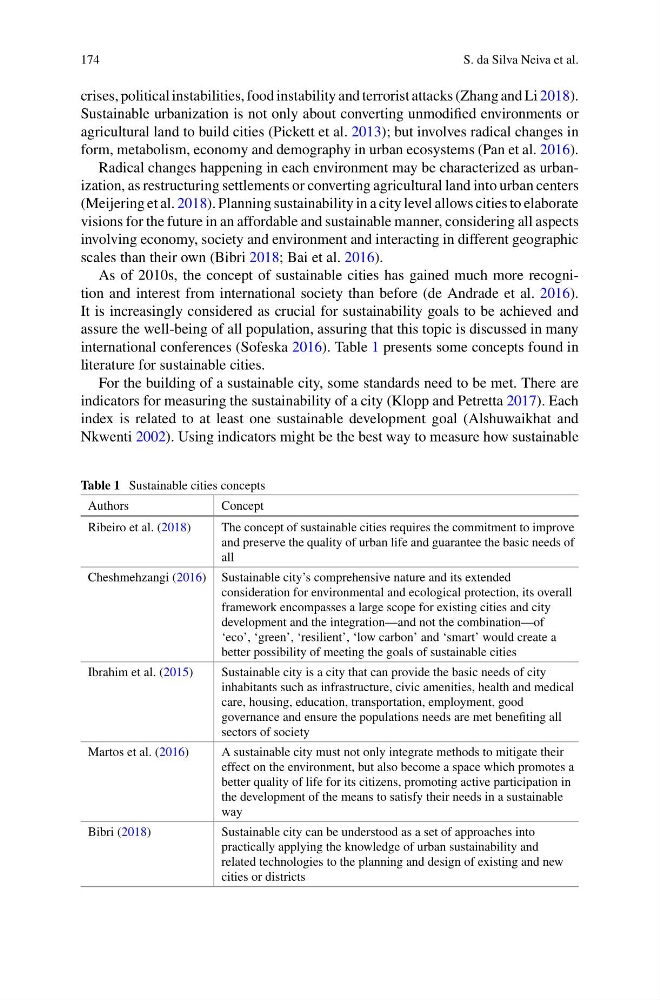
international conferences (Sofeska 2016). Table 1 presents some concepts found in
literature for sustainable cities.
For the building of a sustainable city, some standards need to be met. There are
indicators for measuring the sustainability of a city (Klopp and Petretta 2017). Each
index is related to at least one sustainable development goal (Alshuwaikhat and
Nkwenti 2002). Using indicators might be the best way to measure how sustainable
Table 1 Sustainable cities concepts
Authors
Concept
Ribeiro et al. (2018)
The concept of sustainable cities requires the commitment to improve
and preserve the quality of urban life and guarantee the basic needs of
all
Cheshmehzangi (2016) Sustainable city’s comprehensive nature and its extended
consideration for environmental and ecological protection, its overall
framework encompasses a large scope for existing cities and city
development and the integration—and not the combination—of
‘eco’, ‘green’, ‘resilient’, ‘low carbon’ and ‘smart’ would create a
better possibility of meeting the goals of sustainable cities
Ibrahim et al. (2015)
Sustainable city is a city that can provide the basic needs of city
inhabitants such as infrastructure, civic amenities, health and medical
care, housing, education, transportation, employment, good
governance and ensure the populations needs are met benefiting all
sectors of society
Martos et al. (2016)
A sustainable city must not only integrate methods to mitigate their
effect on the environment, but also become a space which promotes a
better quality of life for its citizens, promoting active participation in
the development of the means to satisfy their needs in a sustainable
way
Bibri (2018)
Sustainable city can be understood as a set of approaches into
practically applying the knowledge of urban sustainability and
related technologies to the planning and design of existing and new
cities or districts
S. da Silva Neiva et al.
crises, political instabilities, food instability and terrorist attacks (Zhang and Li 2018).
Sustainable urbanization is not only about converting unmodified environments or
agricultural land to build cities (Pickett et al. 2013); but involves radical changes in
form, metabolism, economy and demography in urban ecosystems (Pan et al. 2016).
Radical changes happening in each environment may be characterized as urbanization, as restructuring settlements or converting agricultural land into urban centers
(Meijering et al. 2018). Planning sustainability in a city level allows cities to elaborate
visions for the future in an affordable and sustainable manner, considering all aspects
involving economy, society and environment and interacting in different geographic
scales than their own (Bibri 2018; Bai et al. 2016).
As of 2010s, the concept of sustainable cities has gained much more recognition and interest from international society than before (de Andrade et al. 2016).
It is increasingly considered as crucial for sustainability goals to be achieved and
assure the well-being of all population, assuring that this topic is discussed in many
international conferences (Sofeska 2016). Table 1 presents some concepts found in
literature for sustainable cities.
For the building of a sustainable city, some standards need to be met. There are
indicators for measuring the sustainability of a city (Klopp and Petretta 2017). Each
index is related to at least one sustainable development goal (Alshuwaikhat and
Nkwenti 2002). Using indicators might be the best way to measure how sustainable
Table 1 Sustainable cities concepts
Authors
Concept
Ribeiro et al. (2018)
The concept of sustainable cities requires the commitment to improve
and preserve the quality of urban life and guarantee the basic needs of
all
Cheshmehzangi (2016) Sustainable city’s comprehensive nature and its extended
consideration for environmental and ecological protection, its overall
framework encompasses a large scope for existing cities and city
development and the integration—and not the combination—of
‘eco’, ‘green’, ‘resilient’, ‘low carbon’ and ‘smart’ would create a
better possibility of meeting the goals of sustainable cities
Ibrahim et al. (2015)
Sustainable city is a city that can provide the basic needs of city
inhabitants such as infrastructure, civic amenities, health and medical
care, housing, education, transportation, employment, good
governance and ensure the populations needs are met benefiting all
sectors of society
Martos et al. (2016)
A sustainable city must not only integrate methods to mitigate their
effect on the environment, but also become a space which promotes a
better quality of life for its citizens, promoting active participation in
the development of the means to satisfy their needs in a sustainable
way
Bibri (2018)
Sustainable city can be understood as a set of approaches into
practically applying the knowledge of urban sustainability and
related technologies to the planning and design of existing and new
cities or districts