

160
C. Skanavis et al.
A 73% of the participants were enrolled in an environmental education program
at their school, and the rest 27% who weren’t, expressed a strong desire to participate
in one in the near future.
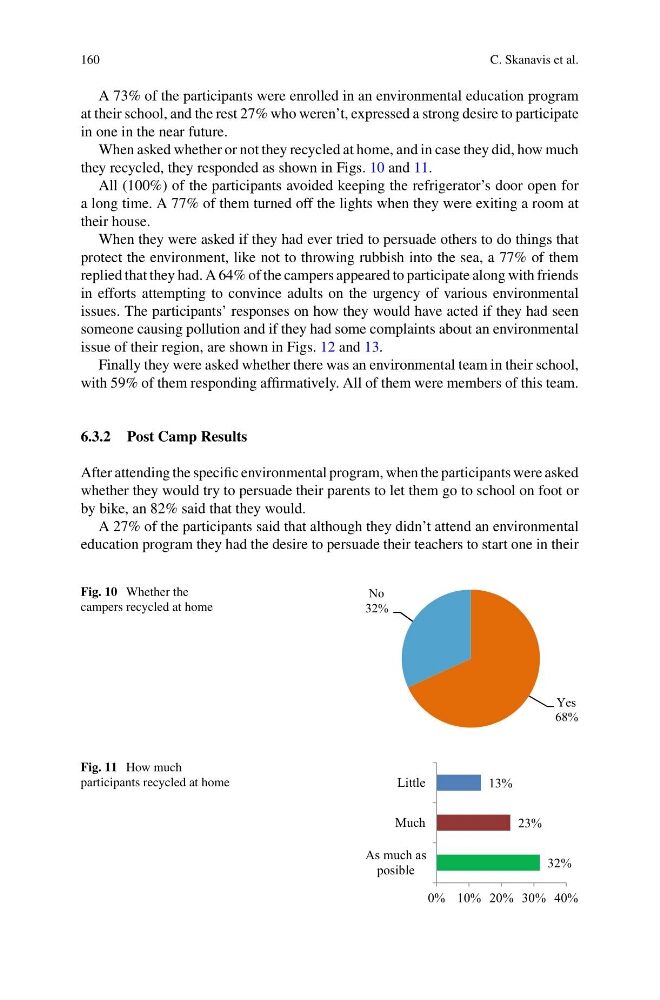
When asked whether or not they recycled at home, and in case they did, how much
they recycled, they responded as shown in Figs. 10 and 11.
All (100%) of the participants avoided keeping the refrigerator’s door open for
a long time. A 77% of them turned off the lights when they were exiting a room at
their house.
When they were asked if they had ever tried to persuade others to do things that
protect the environment, like not to throwing rubbish into the sea, a 77% of them
replied that they had. A 64% of the campers appeared to participate along with friends
in efforts attempting to convince adults on the urgency of various environmental
issues. The participants’ responses on how they would have acted if they had seen
someone causing pollution and if they had some complaints about an environmental
issue of their region, are shown in Figs. 12 and 13.
Finally they were asked whether there was an environmental team in their school,
with 59% of them responding affirmatively. All of them were members of this team.
6.3.2 Post Camp Results
After attending the specific environmental program, when the participants were asked
whether they would try to persuade their parents to let them go to school on foot or
by bike, an 82% said that they would.
A 27% of the participants said that although they didn’t attend an environmental
education program they had the desire to persuade their teachers to start one in their
Fig. 10 Whether the
campers recycled at home
Yes
68%
No
32%
Fig. 11 How much
participants recycled at home
32%
23%
13%
0% 10% 20% 30% 40%
As much as
posible
Much
Little
C. Skanavis et al.
A 73% of the participants were enrolled in an environmental education program
at their school, and the rest 27% who weren’t, expressed a strong desire to participate
in one in the near future.
When asked whether or not they recycled at home, and in case they did, how much
they recycled, they responded as shown in Figs. 10 and 11.
All (100%) of the participants avoided keeping the refrigerator’s door open for
a long time. A 77% of them turned off the lights when they were exiting a room at
their house.
When they were asked if they had ever tried to persuade others to do things that
protect the environment, like not to throwing rubbish into the sea, a 77% of them
replied that they had. A 64% of the campers appeared to participate along with friends
in efforts attempting to convince adults on the urgency of various environmental
issues. The participants’ responses on how they would have acted if they had seen
someone causing pollution and if they had some complaints about an environmental
issue of their region, are shown in Figs. 12 and 13.
Finally they were asked whether there was an environmental team in their school,
with 59% of them responding affirmatively. All of them were members of this team.
6.3.2 Post Camp Results
After attending the specific environmental program, when the participants were asked
whether they would try to persuade their parents to let them go to school on foot or
by bike, an 82% said that they would.
A 27% of the participants said that although they didn’t attend an environmental
education program they had the desire to persuade their teachers to start one in their
Fig. 10 Whether the
campers recycled at home
Yes
68%
No
32%
Fig. 11 How much
participants recycled at home
32%
23%
13%
0% 10% 20% 30% 40%
As much as
posible
Much
Little