

94
U. Awan et al.
4 Solution Methodology
AHP has been recognized as an important tool in sustainability decision making
for identifying and competing decisions objective. The use of AHP in the decisionmaking process can be found in various research studies and have previously been
applied in sustainability decision making. AHP has been used for complex decision
making and it organizes factors into categories and sub-categories (Saaty 2008). Analytical Hierarchy Process (AHP) has been recognized and applied in a wide of variety
of practical decision-making. Based on the literature review, AHP has been used in
evaluation, ranking and prediction of decision making (Luthra et al. 2015). AHP
was developed and was originated from the Wharton School of Business by (Saaty
1987). AHP is an appropriate decision-making tool for decomposing the relationship into objective, categories and sub-categories and alternatives. The use of AHP
in the present study allows for developing a hierarchy of goals and their criteria, subcriteria, and evaluation of alternatives. AHP not only help to assess the determining
the linkages between the selected barriers and corresponding to evaluate alternatives
but also helps to formulate policies and strategies to manage social sustainability initiatives. AHP has been widely used in different research fields due to its usefulness
in decision-making process, such as supply chain logistics, healthcare, engineering,
new product development and information technology management and many others
(Singh 2013; Luthra et al. 2011, 2015) In this study, a computational method was
used to determine the priority factor in decision making. This study uses the AHP to
evaluate and determine the barriers to the social sustainability decision making.
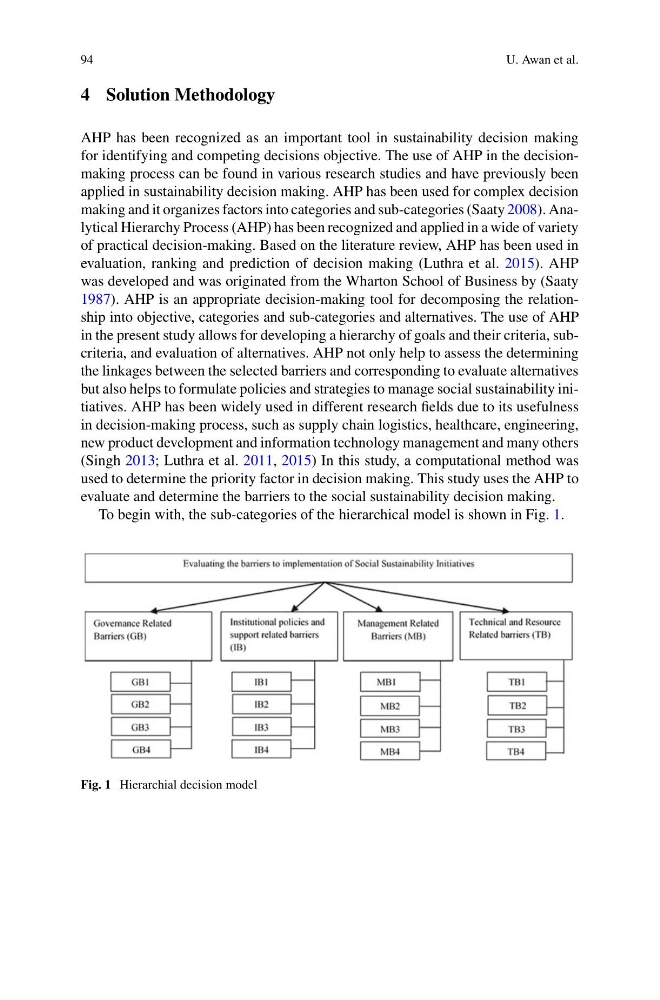
To begin with, the sub-categories of the hierarchical model is shown in Fig. 1.
Fig. 1 Hierarchial decision model
U. Awan et al.
4 Solution Methodology
AHP has been recognized as an important tool in sustainability decision making
for identifying and competing decisions objective. The use of AHP in the decisionmaking process can be found in various research studies and have previously been
applied in sustainability decision making. AHP has been used for complex decision
making and it organizes factors into categories and sub-categories (Saaty 2008). Analytical Hierarchy Process (AHP) has been recognized and applied in a wide of variety
of practical decision-making. Based on the literature review, AHP has been used in
evaluation, ranking and prediction of decision making (Luthra et al. 2015). AHP
was developed and was originated from the Wharton School of Business by (Saaty
1987). AHP is an appropriate decision-making tool for decomposing the relationship into objective, categories and sub-categories and alternatives. The use of AHP
in the present study allows for developing a hierarchy of goals and their criteria, subcriteria, and evaluation of alternatives. AHP not only help to assess the determining
the linkages between the selected barriers and corresponding to evaluate alternatives
but also helps to formulate policies and strategies to manage social sustainability initiatives. AHP has been widely used in different research fields due to its usefulness
in decision-making process, such as supply chain logistics, healthcare, engineering,
new product development and information technology management and many others
(Singh 2013; Luthra et al. 2011, 2015) In this study, a computational method was
used to determine the priority factor in decision making. This study uses the AHP to
evaluate and determine the barriers to the social sustainability decision making.
To begin with, the sub-categories of the hierarchical model is shown in Fig. 1.
Fig. 1 Hierarchial decision model