

66
4.2.3.2 Cultivation on Raised Beds
In this assessment, we assumed that cultivation of Egyptian clover on raised beds
will increase its yield by 15% and save 20% of its water requirements in the old
lands only (Abouelenein et al. 2010) and no irrigation water saving will practice in
the new lands. Thus, the saved irrigation water could be used to cultivate more lands
with Egyptian clover and increase the its total production without using any more
irrigation water than its value under traditional cultivation.
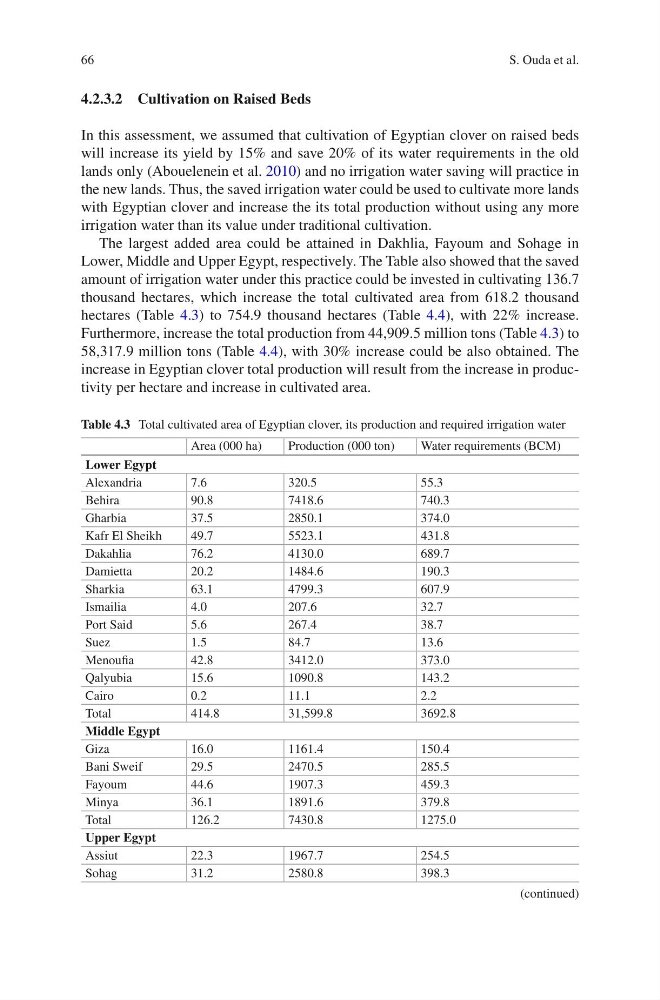
The largest added area could be attained in Dakhlia, Fayoum and Sohage in
Lower, Middle and Upper Egypt, respectively. The Table also showed that the saved
amount of irrigation water under this practice could be invested in cultivating 136.7
thousand hectares, which increase the total cultivated area from 618.2 thousand
hectares (Table 4.3) to 754.9 thousand hectares (Table 4.4), with 22% increase.
Furthermore, increase the total production from 44,909.5 million tons (Table 4.3) to
58,317.9 million tons (Table 4.4), with 30% increase could be also obtained. The
increase in Egyptian clover total production will result from the increase in productivity per hectare and increase in cultivated area.
Table 4.3 Total cultivated area of Egyptian clover, its production and required irrigation water
Area (000 ha)
Production (000 ton)
Water requirements (BCM)
Lower Egypt
Alexandria
7.6
320.5
55.3
Behira
90.8
7418.6
740.3
Gharbia
37.5
2850.1
374.0
Kafr El Sheikh
49.7
5523.1
431.8
Dakahlia
76.2
4130.0
689.7
Damietta
20.2
1484.6
190.3
Sharkia
63.1
4799.3
607.9
Ismailia
4.0
207.6
32.7
Port Said
5.6
267.4
38.7
Suez
1.5
84.7
13.6
Menoufia
42.8
3412.0
373.0
Qalyubia
15.6
1090.8
143.2
Cairo
0.2
11.1
2.2
Total
414.8
31,599.8
3692.8
Middle Egypt
Giza
16.0
1161.4
150.4
Bani Sweif
29.5
2470.5
285.5
Fayoum
44.6
1907.3
459.3
Minya
36.1
1891.6
379.8
Total
126.2
7430.8
1275.0
Upper Egypt
Assiut
22.3
1967.7
254.5
Sohag
31.2
2580.8
398.3
(continued)
S. Ouda et al.
4.2.3.2 Cultivation on Raised Beds
In this assessment, we assumed that cultivation of Egyptian clover on raised beds
will increase its yield by 15% and save 20% of its water requirements in the old
lands only (Abouelenein et al. 2010) and no irrigation water saving will practice in
the new lands. Thus, the saved irrigation water could be used to cultivate more lands
with Egyptian clover and increase the its total production without using any more
irrigation water than its value under traditional cultivation.
The largest added area could be attained in Dakhlia, Fayoum and Sohage in
Lower, Middle and Upper Egypt, respectively. The Table also showed that the saved
amount of irrigation water under this practice could be invested in cultivating 136.7
thousand hectares, which increase the total cultivated area from 618.2 thousand
hectares (Table 4.3) to 754.9 thousand hectares (Table 4.4), with 22% increase.
Furthermore, increase the total production from 44,909.5 million tons (Table 4.3) to
58,317.9 million tons (Table 4.4), with 30% increase could be also obtained. The
increase in Egyptian clover total production will result from the increase in productivity per hectare and increase in cultivated area.
Table 4.3 Total cultivated area of Egyptian clover, its production and required irrigation water
Area (000 ha)
Production (000 ton)
Water requirements (BCM)
Lower Egypt
Alexandria
7.6
320.5
55.3
Behira
90.8
7418.6
740.3
Gharbia
37.5
2850.1
374.0
Kafr El Sheikh
49.7
5523.1
431.8
Dakahlia
76.2
4130.0
689.7
Damietta
20.2
1484.6
190.3
Sharkia
63.1
4799.3
607.9
Ismailia
4.0
207.6
32.7
Port Said
5.6
267.4
38.7
Suez
1.5
84.7
13.6
Menoufia
42.8
3412.0
373.0
Qalyubia
15.6
1090.8
143.2
Cairo
0.2
11.1
2.2
Total
414.8
31,599.8
3692.8
Middle Egypt
Giza
16.0
1161.4
150.4
Bani Sweif
29.5
2470.5
285.5
Fayoum
44.6
1907.3
459.3
Minya
36.1
1891.6
379.8
Total
126.2
7430.8
1275.0
Upper Egypt
Assiut
22.3
1967.7
254.5
Sohag
31.2
2580.8
398.3
(continued)
S. Ouda et al.