

64
simulation of the application of 90% of full irrigation to Egyptian clover in clay soil
under surface system using Yield-Stress model (Ouda 2006) was done. The results
indicated that in 5% yield losses can be attained under this practice (Ouda et al. 2010).
4.2.3 Irrigation Water Savings Techniques for Egyptian Clover
4.2.3.1 Traditional Cultivation of Egyptian Clover
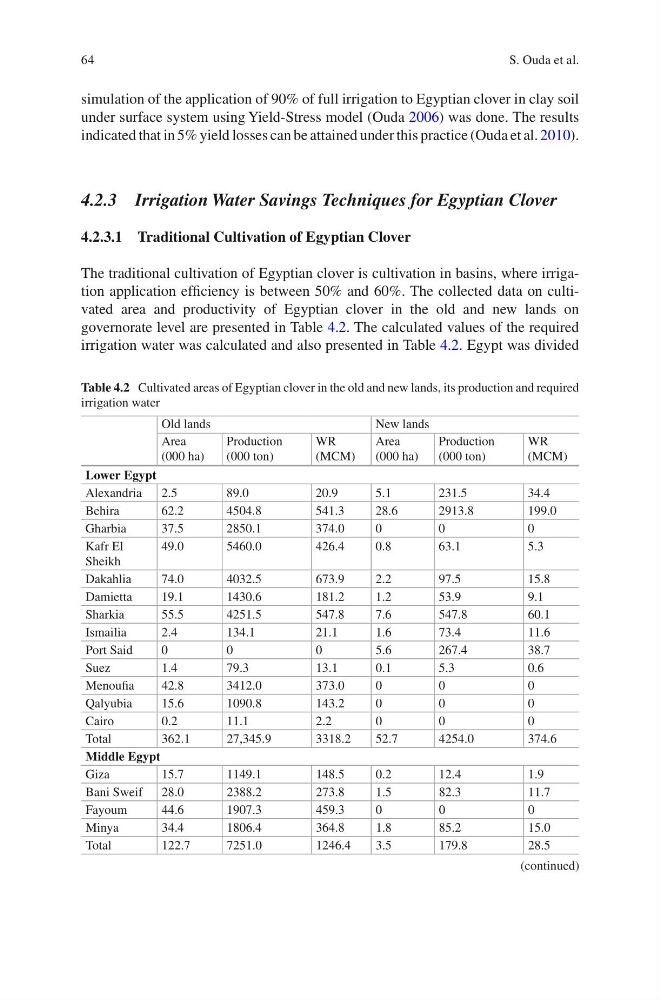
The traditional cultivation of Egyptian clover is cultivation in basins, where irrigation application efficiency is between 50% and 60%. The collected data on cultivated area and productivity of Egyptian clover in the old and new lands on
governorate level are presented in Table 4.2. The calculated values of the required
irrigation water was calculated and also presented in Table 4.2. Egypt was divided
Table 4.2 Cultivated areas of Egyptian clover in the old and new lands, its production and required
irrigation water
Old lands
New lands
Area
(000 ha)
Production
(000 ton)
WR
(MCM)
Area
(000 ha)
Production
(000 ton)
WR
(MCM)
Lower Egypt
Alexandria
2.5
89.0
20.9
5.1
231.5
34.4
Behira
62.2
4504.8
541.3
28.6
2913.8
199.0
Gharbia
37.5
2850.1
374.0
0
0
0
Kafr El
Sheikh
49.0
5460.0
426.4
0.8
63.1
5.3
Dakahlia
74.0
4032.5
673.9
2.2
97.5
15.8
Damietta
19.1
1430.6
181.2
1.2
53.9
9.1
Sharkia
55.5
4251.5
547.8
7.6
547.8
60.1
Ismailia
2.4
134.1
21.1
1.6
73.4
11.6
Port Said
0
0
0
5.6
267.4
38.7
Suez
1.4
79.3
13.1
0.1
5.3
0.6
Menoufia
42.8
3412.0
373.0
0
0
0
Qalyubia
15.6
1090.8
143.2
0
0
0
Cairo
0.2
11.1
2.2
0
0
0
Total
362.1
27,345.9
3318.2
52.7
4254.0
374.6
Middle Egypt
Giza
15.7
1149.1
148.5
0.2
12.4
1.9
Bani Sweif 28.0
2388.2
273.8
1.5
82.3
11.7
Fayoum
44.6
1907.3
459.3
0
0
0
Minya
34.4
1806.4
364.8
1.8
85.2
15.0
Total
122.7
7251.0
1246.4
3.5
179.8
28.5
(continued)
S. Ouda et al.
simulation of the application of 90% of full irrigation to Egyptian clover in clay soil
under surface system using Yield-Stress model (Ouda 2006) was done. The results
indicated that in 5% yield losses can be attained under this practice (Ouda et al. 2010).
4.2.3 Irrigation Water Savings Techniques for Egyptian Clover
4.2.3.1 Traditional Cultivation of Egyptian Clover
The traditional cultivation of Egyptian clover is cultivation in basins, where irrigation application efficiency is between 50% and 60%. The collected data on cultivated area and productivity of Egyptian clover in the old and new lands on
governorate level are presented in Table 4.2. The calculated values of the required
irrigation water was calculated and also presented in Table 4.2. Egypt was divided
Table 4.2 Cultivated areas of Egyptian clover in the old and new lands, its production and required
irrigation water
Old lands
New lands
Area
(000 ha)
Production
(000 ton)
WR
(MCM)
Area
(000 ha)
Production
(000 ton)
WR
(MCM)
Lower Egypt
Alexandria
2.5
89.0
20.9
5.1
231.5
34.4
Behira
62.2
4504.8
541.3
28.6
2913.8
199.0
Gharbia
37.5
2850.1
374.0
0
0
0
Kafr El
Sheikh
49.0
5460.0
426.4
0.8
63.1
5.3
Dakahlia
74.0
4032.5
673.9
2.2
97.5
15.8
Damietta
19.1
1430.6
181.2
1.2
53.9
9.1
Sharkia
55.5
4251.5
547.8
7.6
547.8
60.1
Ismailia
2.4
134.1
21.1
1.6
73.4
11.6
Port Said
0
0
0
5.6
267.4
38.7
Suez
1.4
79.3
13.1
0.1
5.3
0.6
Menoufia
42.8
3412.0
373.0
0
0
0
Qalyubia
15.6
1090.8
143.2
0
0
0
Cairo
0.2
11.1
2.2
0
0
0
Total
362.1
27,345.9
3318.2
52.7
4254.0
374.6
Middle Egypt
Giza
15.7
1149.1
148.5
0.2
12.4
1.9
Bani Sweif 28.0
2388.2
273.8
1.5
82.3
11.7
Fayoum
44.6
1907.3
459.3
0
0
0
Minya
34.4
1806.4
364.8
1.8
85.2
15.0
Total
122.7
7251.0
1246.4
3.5
179.8
28.5
(continued)
S. Ouda et al.