

46
They also indicated that applying the improved management package and intercropping systems for faba bean increased faba bean national production and could
attain self-sufficiency of faba bean. The suggested faba bean intercropping systems
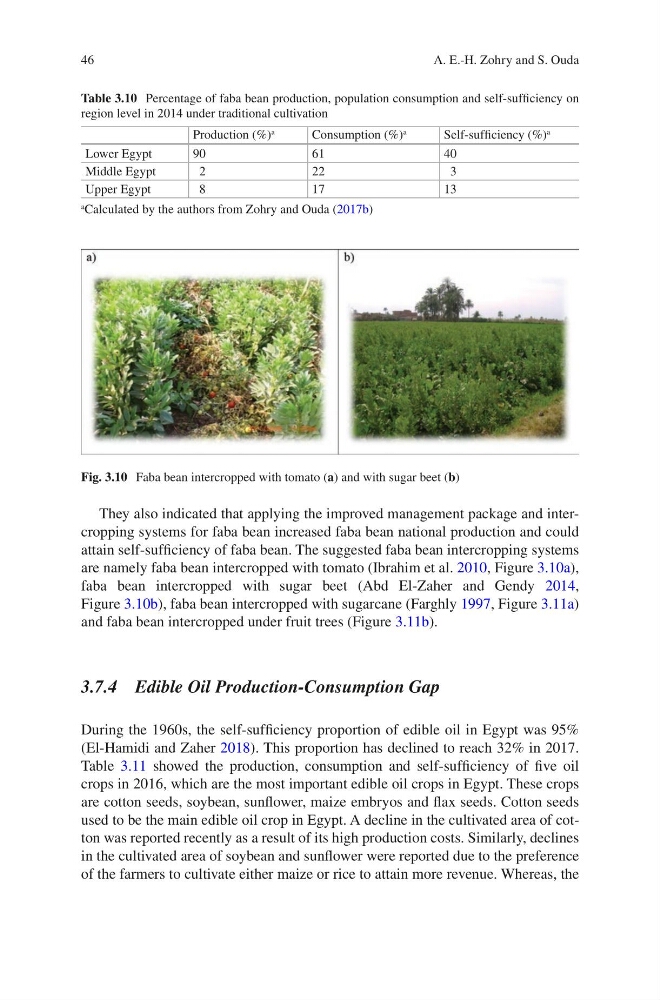
are namely faba bean intercropped with tomato (Ibrahim et al. 2010, Figure 3.10a),
faba bean intercropped with sugar beet (Abd El-Zaher and Gendy 2014,
Figure 3.10b), faba bean intercropped with sugarcane (Farghly 1997, Figure 3.11a)
and faba bean intercropped under fruit trees (Figure 3.11b).
3.7.4 Edible Oil Production-Consumption Gap
During the 1960s, the self-sufficiency proportion of edible oil in Egypt was 95%
(El-Hamidi and Zaher 2018). This proportion has declined to reach 32% in 2017.
Table 3.11 showed the production, consumption and self-sufficiency of five oil
crops in 2016, which are the most important edible oil crops in Egypt. These crops
are cotton seeds, soybean, sunflower, maize embryos and flax seeds. Cotton seeds
used to be the main edible oil crop in Egypt. A decline in the cultivated area of cotton was reported recently as a result of its high production costs. Similarly, declines
in the cultivated area of soybean and sunflower were reported due to the preference
of the farmers to cultivate either maize or rice to attain more revenue. Whereas, the
Table 3.10 Percentage of faba bean production, population consumption and self-sufficiency on
region level in 2014 under traditional cultivation
Production (%)
a
Consumption (%)
a
Self-sufficiency (%)
a
Lower Egypt
90
61
40
Middle Egypt
2
22
3
Upper Egypt
8
17
13
a
Calculated by the authors from Zohry and Ouda (2017b)
Fig. 3.10 Faba bean intercropped with tomato (a) and with sugar beet (b)
A. E.-H. Zohry and S. Ouda
They also indicated that applying the improved management package and intercropping systems for faba bean increased faba bean national production and could
attain self-sufficiency of faba bean. The suggested faba bean intercropping systems
are namely faba bean intercropped with tomato (Ibrahim et al. 2010, Figure 3.10a),
faba bean intercropped with sugar beet (Abd El-Zaher and Gendy 2014,
Figure 3.10b), faba bean intercropped with sugarcane (Farghly 1997, Figure 3.11a)
and faba bean intercropped under fruit trees (Figure 3.11b).
3.7.4 Edible Oil Production-Consumption Gap
During the 1960s, the self-sufficiency proportion of edible oil in Egypt was 95%
(El-Hamidi and Zaher 2018). This proportion has declined to reach 32% in 2017.
Table 3.11 showed the production, consumption and self-sufficiency of five oil
crops in 2016, which are the most important edible oil crops in Egypt. These crops
are cotton seeds, soybean, sunflower, maize embryos and flax seeds. Cotton seeds
used to be the main edible oil crop in Egypt. A decline in the cultivated area of cotton was reported recently as a result of its high production costs. Similarly, declines
in the cultivated area of soybean and sunflower were reported due to the preference
of the farmers to cultivate either maize or rice to attain more revenue. Whereas, the
Table 3.10 Percentage of faba bean production, population consumption and self-sufficiency on
region level in 2014 under traditional cultivation
Production (%)
a
Consumption (%)
a
Self-sufficiency (%)
a
Lower Egypt
90
61
40
Middle Egypt
2
22
3
Upper Egypt
8
17
13
a
Calculated by the authors from Zohry and Ouda (2017b)
Fig. 3.10 Faba bean intercropped with tomato (a) and with sugar beet (b)
A. E.-H. Zohry and S. Ouda