

44
3.7.2 Maize Production-Consumption Gap
Maize is a dual-purpose crop for food and feed. It has become a very vital component of global food security due to genetic and management practice improvements
that increased its yield over the past century (Grassini et al. 2017). There are three
main summer crops in Egypt competing for the available arable area, namely maize,
rice and cotton. The cultivated area of maize is the highest among these three crops.
Zohry and Ouda (2017a) studied maize production-consumption gap in 2013 in
three regions of Egypt under traditional maize cultivation. Table 3.8 revealed that
the highest percentage of maize production, and consumption existed in Lower
Egypt. On the contrary, the lowest percentage of maize production, and consumption existed in Upper Egypt. The average maize self-sufficiency ratio under these
conditions was 53%.
They also indicated that implementing improved production package, as well as
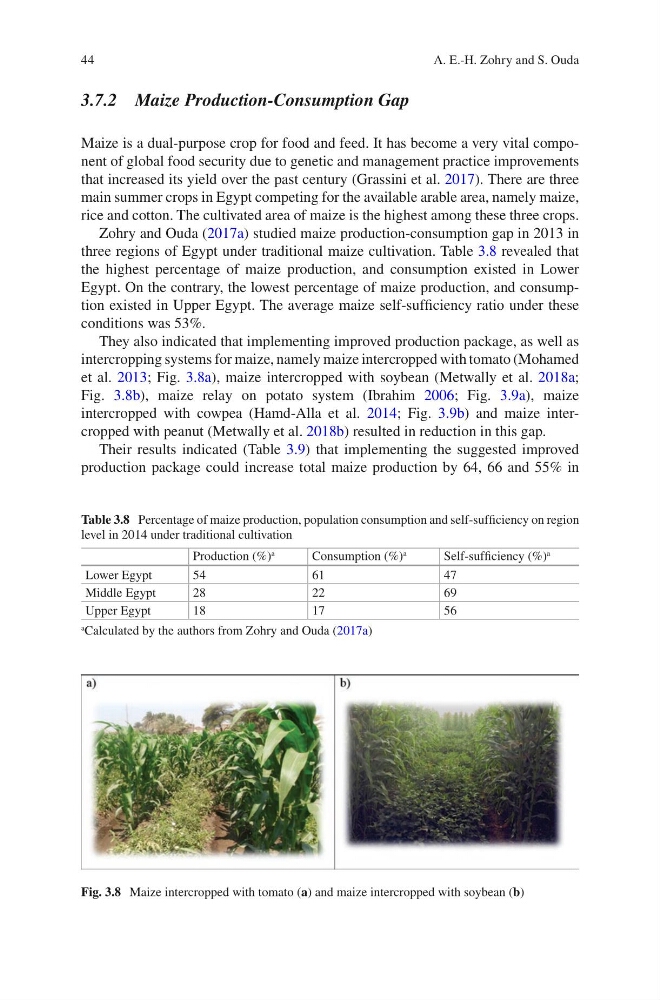
intercropping systems for maize, namely maize intercropped with tomato (Mohamed
et al. 2013; Fig. 3.8a), maize intercropped with soybean (Metwally et al. 2018a;
Fig. 3.8b), maize relay on potato system (Ibrahim 2006; Fig. 3.9a), maize
intercropped with cowpea (Hamd-Alla et al. 2014; Fig. 3.9b) and maize intercropped with peanut (Metwally et al. 2018b) resulted in reduction in this gap.
Their results indicated (Table 3.9) that implementing the suggested improved
production package could increase total maize production by 64, 66 and 55% in
Table 3.8 Percentage of maize production, population consumption and self-sufficiency on region
level in 2014 under traditional cultivation
Production (%)
a
Consumption (%)
a
Self-sufficiency (%)
a
Lower Egypt
54
61
47
Middle Egypt
28
22
69
Upper Egypt
18
17
56
a
Calculated by the authors from Zohry and Ouda (2017a)
Fig. 3.8 Maize intercropped with tomato (a) and maize intercropped with soybean (b)
A. E.-H. Zohry and S. Ouda
3.7.2 Maize Production-Consumption Gap
Maize is a dual-purpose crop for food and feed. It has become a very vital component of global food security due to genetic and management practice improvements
that increased its yield over the past century (Grassini et al. 2017). There are three
main summer crops in Egypt competing for the available arable area, namely maize,
rice and cotton. The cultivated area of maize is the highest among these three crops.
Zohry and Ouda (2017a) studied maize production-consumption gap in 2013 in
three regions of Egypt under traditional maize cultivation. Table 3.8 revealed that
the highest percentage of maize production, and consumption existed in Lower
Egypt. On the contrary, the lowest percentage of maize production, and consumption existed in Upper Egypt. The average maize self-sufficiency ratio under these
conditions was 53%.
They also indicated that implementing improved production package, as well as
intercropping systems for maize, namely maize intercropped with tomato (Mohamed
et al. 2013; Fig. 3.8a), maize intercropped with soybean (Metwally et al. 2018a;
Fig. 3.8b), maize relay on potato system (Ibrahim 2006; Fig. 3.9a), maize
intercropped with cowpea (Hamd-Alla et al. 2014; Fig. 3.9b) and maize intercropped with peanut (Metwally et al. 2018b) resulted in reduction in this gap.
Their results indicated (Table 3.9) that implementing the suggested improved
production package could increase total maize production by 64, 66 and 55% in
Table 3.8 Percentage of maize production, population consumption and self-sufficiency on region
level in 2014 under traditional cultivation
Production (%)
a
Consumption (%)
a
Self-sufficiency (%)
a
Lower Egypt
54
61
47
Middle Egypt
28
22
69
Upper Egypt
18
17
56
a
Calculated by the authors from Zohry and Ouda (2017a)
Fig. 3.8 Maize intercropped with tomato (a) and maize intercropped with soybean (b)
A. E.-H. Zohry and S. Ouda