

43
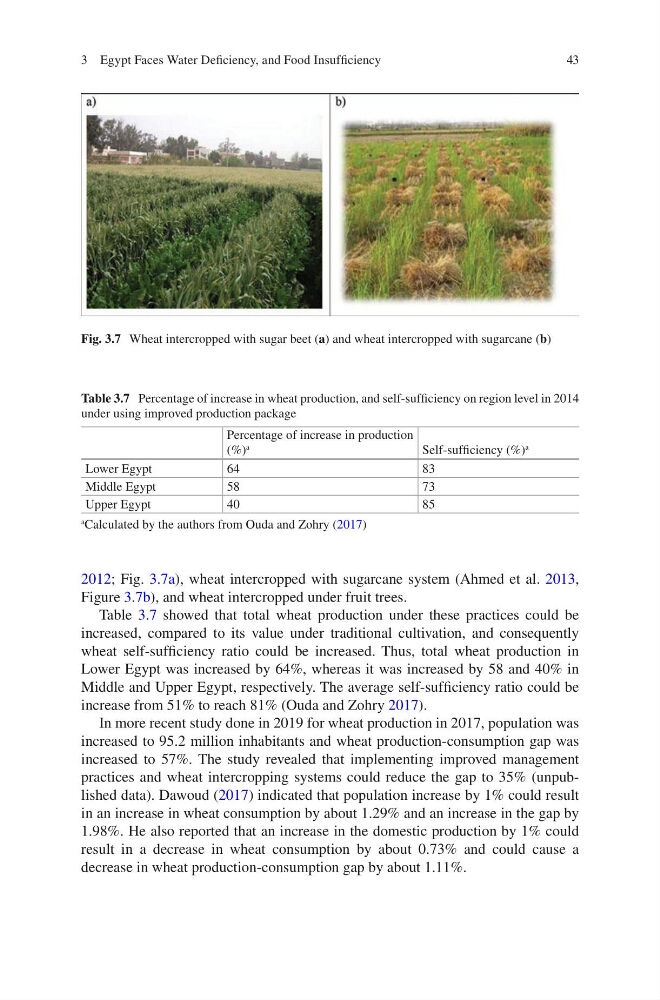
2012; Fig. 3.7a), wheat intercropped with sugarcane system (Ahmed et al. 2013,
Figure 3.7b), and wheat intercropped under fruit trees.
Table 3.7 showed that total wheat production under these practices could be
increased, compared to its value under traditional cultivation, and consequently
wheat self-sufficiency ratio could be increased. Thus, total wheat production in
Lower Egypt was increased by 64%, whereas it was increased by 58 and 40% in
Middle and Upper Egypt, respectively. The average self-sufficiency ratio could be
increase from 51% to reach 81% (Ouda and Zohry 2017).
In more recent study done in 2019 for wheat production in 2017, population was
increased to 95.2 million inhabitants and wheat production-consumption gap was
increased to 57%. The study revealed that implementing improved management
practices and wheat intercropping systems could reduce the gap to 35% (unpublished data). Dawoud (2017) indicated that population increase by 1% could result
in an increase in wheat consumption by about 1.29% and an increase in the gap by
1.98%. He also reported that an increase in the domestic production by 1% could
result in a decrease in wheat consumption by about 0.73% and could cause a
decrease in wheat production-consumption gap by about 1.11%.
Fig. 3.7 Wheat intercropped with sugar beet (a) and wheat intercropped with sugarcane (b)
Table 3.7 Percentage of increase in wheat production, and self-sufficiency on region level in 2014
under using improved production package
Percentage of increase in production
(%)
a
Self-sufficiency (%)
a
Lower Egypt
64
83
Middle Egypt
58
73
Upper Egypt
40
85
a
Calculated by the authors from Ouda and Zohry (2017)
3 Egypt Faces Water Deficiency, and Food Insufficiency
2012; Fig. 3.7a), wheat intercropped with sugarcane system (Ahmed et al. 2013,
Figure 3.7b), and wheat intercropped under fruit trees.
Table 3.7 showed that total wheat production under these practices could be
increased, compared to its value under traditional cultivation, and consequently
wheat self-sufficiency ratio could be increased. Thus, total wheat production in
Lower Egypt was increased by 64%, whereas it was increased by 58 and 40% in
Middle and Upper Egypt, respectively. The average self-sufficiency ratio could be
increase from 51% to reach 81% (Ouda and Zohry 2017).
In more recent study done in 2019 for wheat production in 2017, population was
increased to 95.2 million inhabitants and wheat production-consumption gap was
increased to 57%. The study revealed that implementing improved management
practices and wheat intercropping systems could reduce the gap to 35% (unpublished data). Dawoud (2017) indicated that population increase by 1% could result
in an increase in wheat consumption by about 1.29% and an increase in the gap by
1.98%. He also reported that an increase in the domestic production by 1% could
result in a decrease in wheat consumption by about 0.73% and could cause a
decrease in wheat production-consumption gap by about 1.11%.
Fig. 3.7 Wheat intercropped with sugar beet (a) and wheat intercropped with sugarcane (b)
Table 3.7 Percentage of increase in wheat production, and self-sufficiency on region level in 2014
under using improved production package
Percentage of increase in production
(%)
a
Self-sufficiency (%)
a
Lower Egypt
64
83
Middle Egypt
58
73
Upper Egypt
40
85
a
Calculated by the authors from Ouda and Zohry (2017)
3 Egypt Faces Water Deficiency, and Food Insufficiency