

166
8.4.2 Projection of Wheat Cultivated Area and Total
Production
The cultivated area and productivity of wheat in 2017 were collected for both old
and new lands on governorate level from the Ministry of Agriculture and Land
Reclamation in Egypt and used as a base for comparison (see Chap. 6 for full
details). We calculated the potential cultivated area of wheat, which is negatively
affected by increasing wheat water requirements as a result fixed amount of irrigation assigned to agriculture. We assumed that wheat breeding programs will be able
to produce cultivars tolerant to water and heat stresses that climate change will
cause. Thus, wheat productivity will be the same as its recorded value in 2017 on
governorate level. As we stated earlier wheat production-consumpation gap was
assessed using five production alternatives as followed:
1. Traditional cultivation: the cultivated area of wheat in 2030 on governorate
level in both the old and the new lands were calculated by dividing total water
requirements on governorate level by wheat water requirements per hectare.
Then, it was multiply by its productivity per hectare to calculate total production.
Wheat consumption by the population was calculated as well as the productionconsumption gap.
2. Raised beds cultivation: We assumed that cultivation on raised beds will
increase productivity per hectare by 15%, and then the increase in the total production was calculated. We also assumed that 20% of the applied water under
surface irrigation will be saved. The saved irrigation water will be used to irrigate
new areas cultivated with wheat and this area will be added to the total cultivated
area of wheat to increase its total production. Wheat production-consumption
gap was calculated under this production alternative.
3. Application of deficit irrigation: The effect of application of deficit irrigation
wheat cultivated on raised beds was calculated, taking into account previous
research done in this matter. Because the amount of irrigation water resulted
from cultivation on raised beds produced higher yield than the traditional
0
100
200
300
400
500
600
700
800
WCU (mm)
WCU 2017
WCU 2030
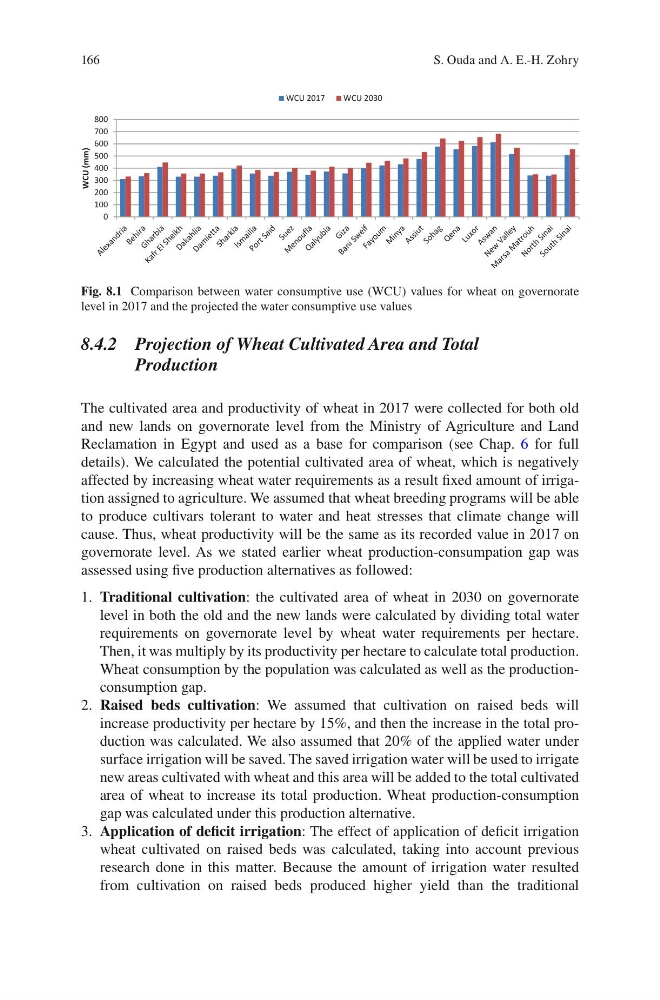
Fig. 8.1 Comparison between water consumptive use (WCU) values for wheat on governorate
level in 2017 and the projected the water consumptive use values
S. Ouda and A. E.-H. Zohry
8.4.2 Projection of Wheat Cultivated Area and Total
Production
The cultivated area and productivity of wheat in 2017 were collected for both old
and new lands on governorate level from the Ministry of Agriculture and Land
Reclamation in Egypt and used as a base for comparison (see Chap. 6 for full
details). We calculated the potential cultivated area of wheat, which is negatively
affected by increasing wheat water requirements as a result fixed amount of irrigation assigned to agriculture. We assumed that wheat breeding programs will be able
to produce cultivars tolerant to water and heat stresses that climate change will
cause. Thus, wheat productivity will be the same as its recorded value in 2017 on
governorate level. As we stated earlier wheat production-consumpation gap was
assessed using five production alternatives as followed:
1. Traditional cultivation: the cultivated area of wheat in 2030 on governorate
level in both the old and the new lands were calculated by dividing total water
requirements on governorate level by wheat water requirements per hectare.
Then, it was multiply by its productivity per hectare to calculate total production.
Wheat consumption by the population was calculated as well as the productionconsumption gap.
2. Raised beds cultivation: We assumed that cultivation on raised beds will
increase productivity per hectare by 15%, and then the increase in the total production was calculated. We also assumed that 20% of the applied water under
surface irrigation will be saved. The saved irrigation water will be used to irrigate
new areas cultivated with wheat and this area will be added to the total cultivated
area of wheat to increase its total production. Wheat production-consumption
gap was calculated under this production alternative.
3. Application of deficit irrigation: The effect of application of deficit irrigation
wheat cultivated on raised beds was calculated, taking into account previous
research done in this matter. Because the amount of irrigation water resulted
from cultivation on raised beds produced higher yield than the traditional
0
100
200
300
400
500
600
700
800
WCU (mm)
WCU 2017
WCU 2030
Fig. 8.1 Comparison between water consumptive use (WCU) values for wheat on governorate
level in 2017 and the projected the water consumptive use values
S. Ouda and A. E.-H. Zohry