

165
targets in terms of radiative forcing in 2100. The scenario is a stabilization scenario,
in which total radiative forcing is stabilized shortly after 2100, without overshoot,
by the application of a range of technologies and strategies for reducing greenhouse
gas emissions (Fujino et al. 2006, Hijioka et al. 2008).
The BISm model (Snyder et al. 2004) was used to calculate the values of ETo
using the data resulted RCP6.0 climate change scenario produced by MIROC5
model. The BISm model calculates ETo using Penman-Monteith equation (Allen
et al. 1998). Penman-Monteith equation is widely recommended because of its
detailed theoretical base and its accommodation of small time periods (Shahidian
et al. 2012). Wheat Kc values for each growing stage was calculated using planting
and harvest dates of wheat in 2030.
Under climate change in 2030 and as a result of the rise in air temperature, it is
expected that planting date will be earlier by 5–7 days. Morsy (2015) simulated the
effect of early planting for wheat under climate change in 2030 and found that early
planting resulted in reduction of wheat yield losses. Furthermore, it is also expected
that season length of wheat will be reduced under climate change. Khalil et al.
(2009) reported that wheat season length was reduced by 5 days in 2030, as a result
of acceleration in its growing season. According to the previous results, we assumed
that, in 2030, planting date of wheat will be 5 days earlier and season length will be
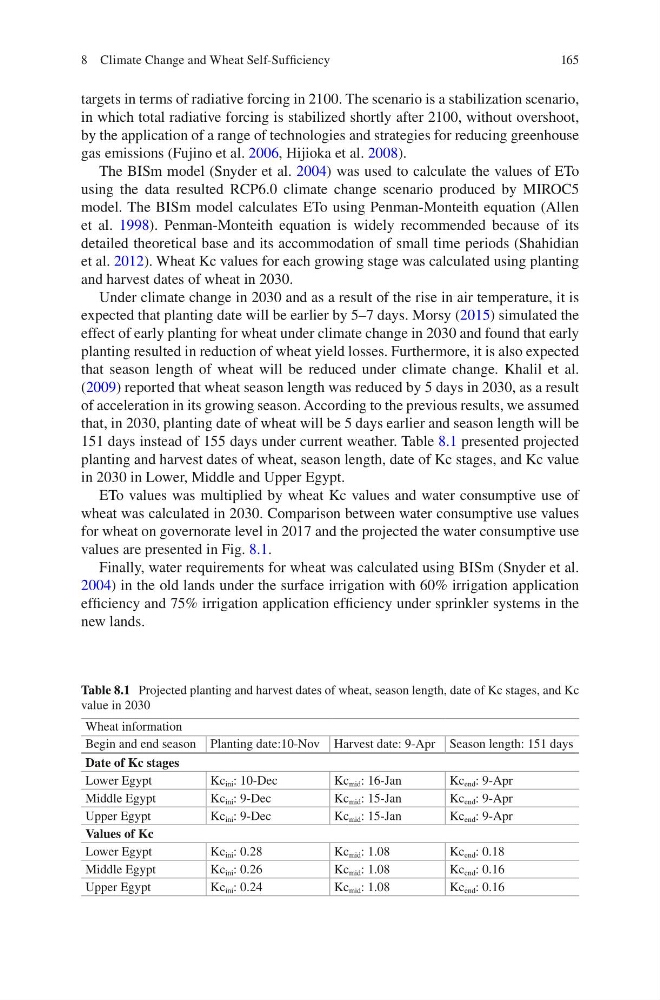
151 days instead of 155 days under current weather. Table 8.1 presented projected
planting and harvest dates of wheat, season length, date of Kc stages, and Kc value
in 2030 in Lower, Middle and Upper Egypt.
ETo values was multiplied by wheat Kc values and water consumptive use of
wheat was calculated in 2030. Comparison between water consumptive use values
for wheat on governorate level in 2017 and the projected the water consumptive use
values are presented in Fig. 8.1.
Finally, water requirements for wheat was calculated using BISm (Snyder et al.
2004) in the old lands under the surface irrigation with 60% irrigation application
efficiency and 75% irrigation application efficiency under sprinkler systems in the
new lands.
Table 8.1 Projected planting and harvest dates of wheat, season length, date of Kc stages, and Kc
value in 2030
Wheat information
Begin and end season Planting date:10-Nov Harvest date: 9-Apr Season length: 151 days
Date of Kc stages
Lower Egypt
Kc ini : 10-Dec
Kc mid : 16-Jan
Kc end : 9-Apr
Middle Egypt
Kc ini : 9-Dec
Kc mid : 15-Jan
Kc end : 9-Apr
Upper Egypt
Kc ini : 9-Dec
Kc mid : 15-Jan
Kc end : 9-Apr
Values of Kc
Lower Egypt
Kc ini : 0.28
Kc mid : 1.08
Kc end : 0.18
Middle Egypt
Kc ini : 0.26
Kc mid : 1.08
Kc end : 0.16
Upper Egypt
Kc ini : 0.24
Kc mid : 1.08
Kc end : 0.16
8 Climate Change and Wheat Self-Sufficiency
targets in terms of radiative forcing in 2100. The scenario is a stabilization scenario,
in which total radiative forcing is stabilized shortly after 2100, without overshoot,
by the application of a range of technologies and strategies for reducing greenhouse
gas emissions (Fujino et al. 2006, Hijioka et al. 2008).
The BISm model (Snyder et al. 2004) was used to calculate the values of ETo
using the data resulted RCP6.0 climate change scenario produced by MIROC5
model. The BISm model calculates ETo using Penman-Monteith equation (Allen
et al. 1998). Penman-Monteith equation is widely recommended because of its
detailed theoretical base and its accommodation of small time periods (Shahidian
et al. 2012). Wheat Kc values for each growing stage was calculated using planting
and harvest dates of wheat in 2030.
Under climate change in 2030 and as a result of the rise in air temperature, it is
expected that planting date will be earlier by 5–7 days. Morsy (2015) simulated the
effect of early planting for wheat under climate change in 2030 and found that early
planting resulted in reduction of wheat yield losses. Furthermore, it is also expected
that season length of wheat will be reduced under climate change. Khalil et al.
(2009) reported that wheat season length was reduced by 5 days in 2030, as a result
of acceleration in its growing season. According to the previous results, we assumed
that, in 2030, planting date of wheat will be 5 days earlier and season length will be
151 days instead of 155 days under current weather. Table 8.1 presented projected
planting and harvest dates of wheat, season length, date of Kc stages, and Kc value
in 2030 in Lower, Middle and Upper Egypt.
ETo values was multiplied by wheat Kc values and water consumptive use of
wheat was calculated in 2030. Comparison between water consumptive use values
for wheat on governorate level in 2017 and the projected the water consumptive use
values are presented in Fig. 8.1.
Finally, water requirements for wheat was calculated using BISm (Snyder et al.
2004) in the old lands under the surface irrigation with 60% irrigation application
efficiency and 75% irrigation application efficiency under sprinkler systems in the
new lands.
Table 8.1 Projected planting and harvest dates of wheat, season length, date of Kc stages, and Kc
value in 2030
Wheat information
Begin and end season Planting date:10-Nov Harvest date: 9-Apr Season length: 151 days
Date of Kc stages
Lower Egypt
Kc ini : 10-Dec
Kc mid : 16-Jan
Kc end : 9-Apr
Middle Egypt
Kc ini : 9-Dec
Kc mid : 15-Jan
Kc end : 9-Apr
Upper Egypt
Kc ini : 9-Dec
Kc mid : 15-Jan
Kc end : 9-Apr
Values of Kc
Lower Egypt
Kc ini : 0.28
Kc mid : 1.08
Kc end : 0.18
Middle Egypt
Kc ini : 0.26
Kc mid : 1.08
Kc end : 0.16
Upper Egypt
Kc ini : 0.24
Kc mid : 1.08
Kc end : 0.16
8 Climate Change and Wheat Self-Sufficiency