

154
temperature for sugarcane is above 38 °C, growth seizes (Bonnett et al. 2006). Their
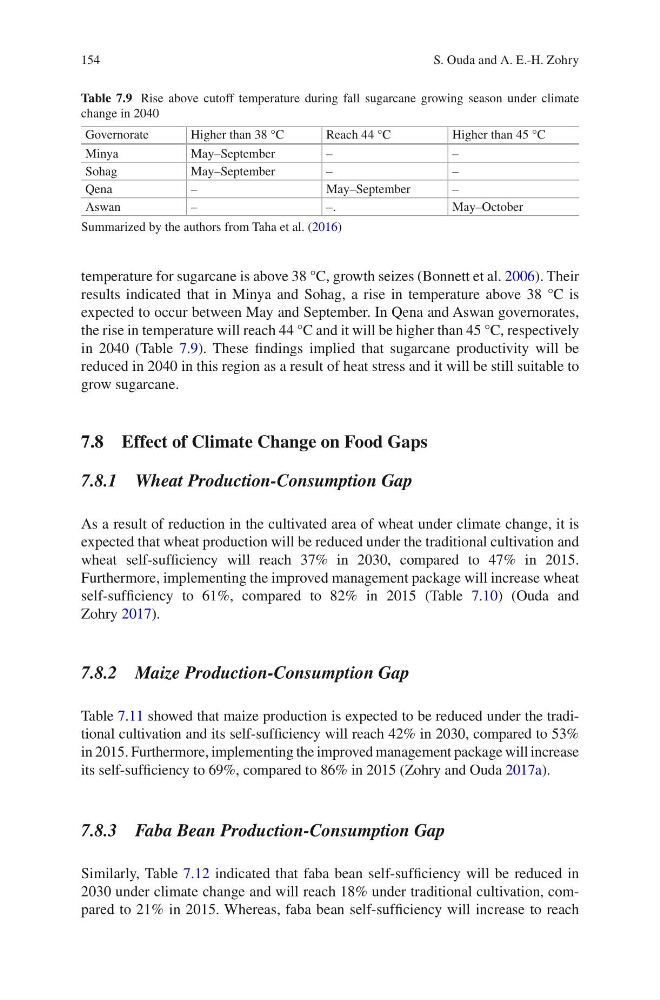
results indicated that in Minya and Sohag, a rise in temperature above 38 °C is
expected to occur between May and September. In Qena and Aswan governorates,
the rise in temperature will reach 44 °C and it will be higher than 45 °C, respectively
in 2040 (Table 7.9). These findings implied that sugarcane productivity will be
reduced in 2040 in this region as a result of heat stress and it will be still suitable to
grow sugarcane.
7.8 Effect of Climate Change on Food Gaps
7.8.1 Wheat Production-Consumption Gap
As a result of reduction in the cultivated area of wheat under climate change, it is
expected that wheat production will be reduced under the traditional cultivation and
wheat self-sufficiency will reach 37% in 2030, compared to 47% in 2015.
Furthermore, implementing the improved management package will increase wheat
self-sufficiency to 61%, compared to 82% in 2015 (Table 7.10) (Ouda and
Zohry 2017).
7.8.2 Maize Production-Consumption Gap
Table 7.11 showed that maize production is expected to be reduced under the traditional cultivation and its self-sufficiency will reach 42% in 2030, compared to 53%
in 2015. Furthermore, implementing the improved management package will increase
its self-sufficiency to 69%, compared to 86% in 2015 (Zohry and Ouda 2017a).
7.8.3 Faba Bean Production-Consumption Gap
Similarly, Table 7.12 indicated that faba bean self-sufficiency will be reduced in
2030 under climate change and will reach 18% under traditional cultivation, compared to 21% in 2015. Whereas, faba bean self-sufficiency will increase to reach
Table 7.9 Rise above cutoff temperature during fall sugarcane growing season under climate
change in 2040
Governorate
Higher than 38 °C
Reach 44 °C
Higher than 45 °C
Minya
May–September
–
–
Sohag
May–September
–
–
Qena
–
May–September
–
Aswan
–
–.
May–October
Summarized by the authors from Taha et al. (2016)
S. Ouda and A. E.-H. Zohry
temperature for sugarcane is above 38 °C, growth seizes (Bonnett et al. 2006). Their
results indicated that in Minya and Sohag, a rise in temperature above 38 °C is
expected to occur between May and September. In Qena and Aswan governorates,
the rise in temperature will reach 44 °C and it will be higher than 45 °C, respectively
in 2040 (Table 7.9). These findings implied that sugarcane productivity will be
reduced in 2040 in this region as a result of heat stress and it will be still suitable to
grow sugarcane.
7.8 Effect of Climate Change on Food Gaps
7.8.1 Wheat Production-Consumption Gap
As a result of reduction in the cultivated area of wheat under climate change, it is
expected that wheat production will be reduced under the traditional cultivation and
wheat self-sufficiency will reach 37% in 2030, compared to 47% in 2015.
Furthermore, implementing the improved management package will increase wheat
self-sufficiency to 61%, compared to 82% in 2015 (Table 7.10) (Ouda and
Zohry 2017).
7.8.2 Maize Production-Consumption Gap
Table 7.11 showed that maize production is expected to be reduced under the traditional cultivation and its self-sufficiency will reach 42% in 2030, compared to 53%
in 2015. Furthermore, implementing the improved management package will increase
its self-sufficiency to 69%, compared to 86% in 2015 (Zohry and Ouda 2017a).
7.8.3 Faba Bean Production-Consumption Gap
Similarly, Table 7.12 indicated that faba bean self-sufficiency will be reduced in
2030 under climate change and will reach 18% under traditional cultivation, compared to 21% in 2015. Whereas, faba bean self-sufficiency will increase to reach
Table 7.9 Rise above cutoff temperature during fall sugarcane growing season under climate
change in 2040
Governorate
Higher than 38 °C
Reach 44 °C
Higher than 45 °C
Minya
May–September
–
–
Sohag
May–September
–
–
Qena
–
May–September
–
Aswan
–
–.
May–October
Summarized by the authors from Taha et al. (2016)
S. Ouda and A. E.-H. Zohry