

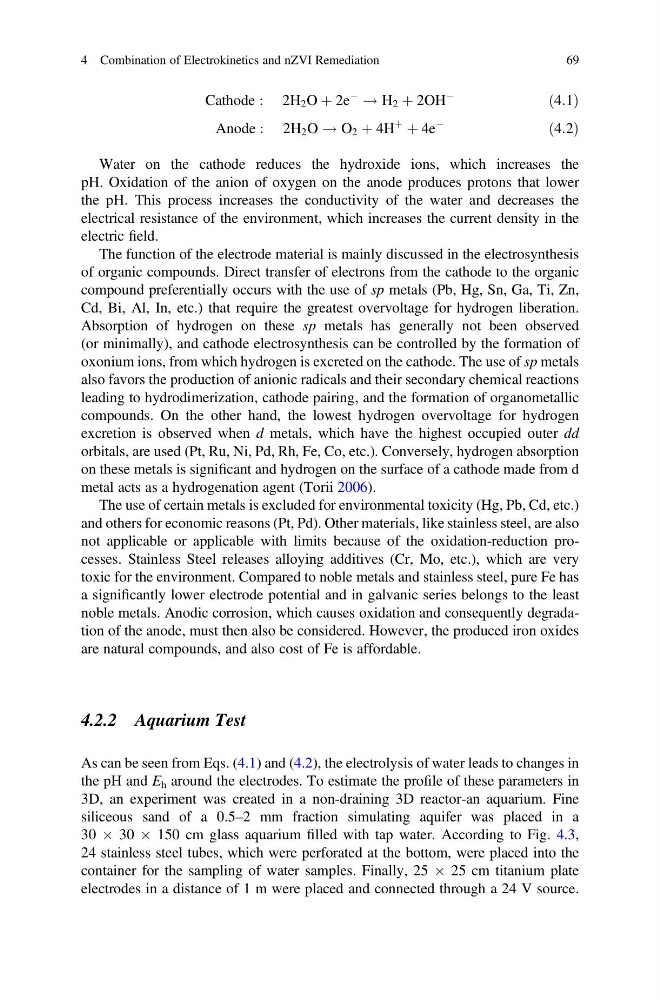
Cathode : 2H 2 O þ 2e
À
! H 2 þ 2OH
À
ð4:1Þ
Anode : 2H 2 O ! O 2 þ 4H
þ
þ 4e
À
ð4:2Þ
Water on the cathode reduces the hydroxide ions, which increases the
pH. Oxidation of the anion of oxygen on the anode produces protons that lower
the pH. This process increases the conductivity of the water and decreases the
electrical resistance of the environment, which increases the current density in the
electric field.
The function of the electrode material is mainly discussed in the electrosynthesis
of organic compounds. Direct transfer of electrons from the cathode to the organic
compound preferentially occurs with the use of sp metals (Pb, Hg, Sn, Ga, Ti, Zn,
Cd, Bi, Al, In, etc.) that require the greatest overvoltage for hydrogen liberation.
Absorption of hydrogen on these sp metals has generally not been observed
(or minimally), and cathode electrosynthesis can be controlled by the formation of
oxonium ions, from which hydrogen is excreted on the cathode. The use of sp metals
also favors the production of anionic radicals and their secondary chemical reactions
leading to hydrodimerization, cathode pairing, and the formation of organometallic
compounds. On the other hand, the lowest hydrogen overvoltage for hydrogen
excretion is observed when d metals, which have the highest occupied outer dd
orbitals, are used (Pt, Ru, Ni, Pd, Rh, Fe, Co, etc.). Conversely, hydrogen absorption
on these metals is significant and hydrogen on the surface of a cathode made from d
metal acts as a hydrogenation agent (Torii 2006).
The use of certain metals is excluded for environmental toxicity (Hg, Pb, Cd, etc.)
and others for economic reasons (Pt, Pd). Other materials, like stainless steel, are also
not applicable or applicable with limits because of the oxidation-reduction processes. Stainless Steel releases alloying additives (Cr, Mo, etc.), which are very
toxic for the environment. Compared to noble metals and stainless steel, pure Fe has
a significantly lower electrode potential and in galvanic series belongs to the least
noble metals. Anodic corrosion, which causes oxidation and consequently degradation of the anode, must then also be considered. However, the produced iron oxides
are natural compounds, and also cost of Fe is affordable.
4.2.2 Aquarium Test
As can be seen from Eqs. (4.1) and (4.2), the electrolysis of water leads to changes in
the pH and E h around the electrodes. To estimate the profile of these parameters in
3D, an experiment was created in a non-draining 3D reactor-an aquarium. Fine
siliceous sand of a 0.5–2 mm fraction simulating aquifer was placed in a
30 Â 30 Â 150 cm glass aquarium filled with tap water. According to Fig. 4.3,
24 stainless steel tubes, which were perforated at the bottom, were placed into the
container for the sampling of water samples. Finally, 25 Â 25 cm titanium plate
electrodes in a distance of 1 m were placed and connected through a 24 V source.
4 Combination of Electrokinetics and nZVI Remediation
69
À
! H 2 þ 2OH
À
ð4:1Þ
Anode : 2H 2 O ! O 2 þ 4H
þ
þ 4e
À
ð4:2Þ
Water on the cathode reduces the hydroxide ions, which increases the
pH. Oxidation of the anion of oxygen on the anode produces protons that lower
the pH. This process increases the conductivity of the water and decreases the
electrical resistance of the environment, which increases the current density in the
electric field.
The function of the electrode material is mainly discussed in the electrosynthesis
of organic compounds. Direct transfer of electrons from the cathode to the organic
compound preferentially occurs with the use of sp metals (Pb, Hg, Sn, Ga, Ti, Zn,
Cd, Bi, Al, In, etc.) that require the greatest overvoltage for hydrogen liberation.
Absorption of hydrogen on these sp metals has generally not been observed
(or minimally), and cathode electrosynthesis can be controlled by the formation of
oxonium ions, from which hydrogen is excreted on the cathode. The use of sp metals
also favors the production of anionic radicals and their secondary chemical reactions
leading to hydrodimerization, cathode pairing, and the formation of organometallic
compounds. On the other hand, the lowest hydrogen overvoltage for hydrogen
excretion is observed when d metals, which have the highest occupied outer dd
orbitals, are used (Pt, Ru, Ni, Pd, Rh, Fe, Co, etc.). Conversely, hydrogen absorption
on these metals is significant and hydrogen on the surface of a cathode made from d
metal acts as a hydrogenation agent (Torii 2006).
The use of certain metals is excluded for environmental toxicity (Hg, Pb, Cd, etc.)
and others for economic reasons (Pt, Pd). Other materials, like stainless steel, are also
not applicable or applicable with limits because of the oxidation-reduction processes. Stainless Steel releases alloying additives (Cr, Mo, etc.), which are very
toxic for the environment. Compared to noble metals and stainless steel, pure Fe has
a significantly lower electrode potential and in galvanic series belongs to the least
noble metals. Anodic corrosion, which causes oxidation and consequently degradation of the anode, must then also be considered. However, the produced iron oxides
are natural compounds, and also cost of Fe is affordable.
4.2.2 Aquarium Test
As can be seen from Eqs. (4.1) and (4.2), the electrolysis of water leads to changes in
the pH and E h around the electrodes. To estimate the profile of these parameters in
3D, an experiment was created in a non-draining 3D reactor-an aquarium. Fine
siliceous sand of a 0.5–2 mm fraction simulating aquifer was placed in a
30 Â 30 Â 150 cm glass aquarium filled with tap water. According to Fig. 4.3,
24 stainless steel tubes, which were perforated at the bottom, were placed into the
container for the sampling of water samples. Finally, 25 Â 25 cm titanium plate
electrodes in a distance of 1 m were placed and connected through a 24 V source.
4 Combination of Electrokinetics and nZVI Remediation
69