

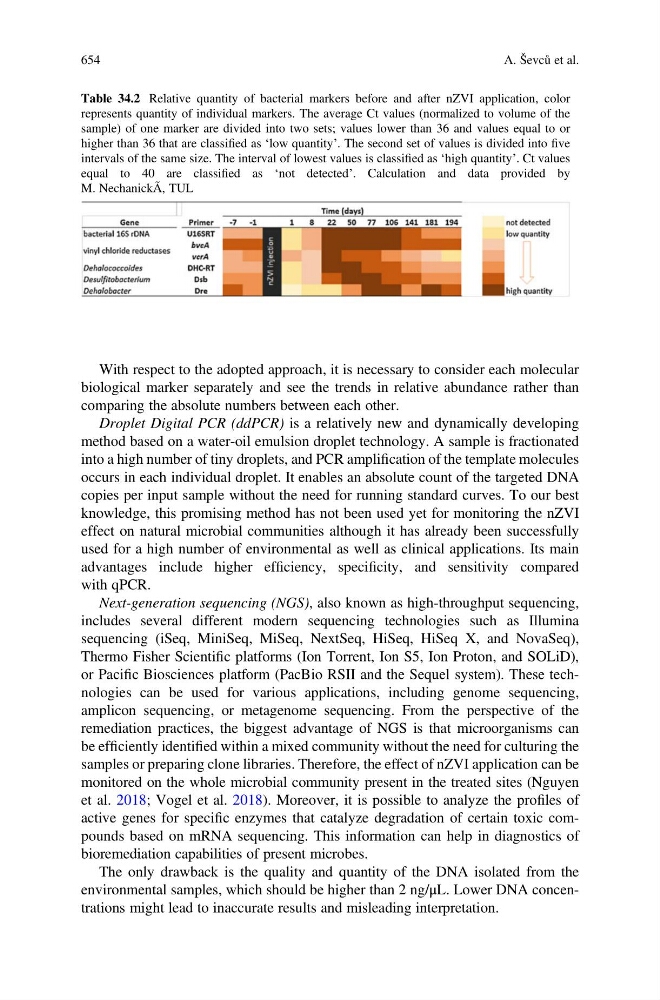
With respect to the adopted approach, it is necessary to consider each molecular
biological marker separately and see the trends in relative abundance rather than
comparing the absolute numbers between each other.
Droplet Digital PCR (ddPCR) is a relatively new and dynamically developing
method based on a water-oil emulsion droplet technology. A sample is fractionated
into a high number of tiny droplets, and PCR amplification of the template molecules
occurs in each individual droplet. It enables an absolute count of the targeted DNA
copies per input sample without the need for running standard curves. To our best
knowledge, this promising method has not been used yet for monitoring the nZVI
effect on natural microbial communities although it has already been successfully
used for a high number of environmental as well as clinical applications. Its main
advantages include higher efficiency, specificity, and sensitivity compared
with qPCR.
Next-generation sequencing (NGS), also known as high-throughput sequencing,
includes several different modern sequencing technologies such as Illumina
sequencing (iSeq, MiniSeq, MiSeq, NextSeq, HiSeq, HiSeq X, and NovaSeq),
Thermo Fisher Scientific platforms (Ion Torrent, Ion S5, Ion Proton, and SOLiD),
or Pacific Biosciences platform (PacBio RSII and the Sequel system). These technologies can be used for various applications, including genome sequencing,
amplicon sequencing, or metagenome sequencing. From the perspective of the
remediation practices, the biggest advantage of NGS is that microorganisms can
be efficiently identified within a mixed community without the need for culturing the
samples or preparing clone libraries. Therefore, the effect of nZVI application can be
monitored on the whole microbial community present in the treated sites (Nguyen
et al. 2018; Vogel et al. 2018). Moreover, it is possible to analyze the profiles of
active genes for specific enzymes that catalyze degradation of certain toxic compounds based on mRNA sequencing. This information can help in diagnostics of
bioremediation capabilities of present microbes.
The only drawback is the quality and quantity of the DNA isolated from the
environmental samples, which should be higher than 2 ng/μL. Lower DNA concentrations might lead to inaccurate results and misleading interpretation.
Table 34.2 Relative quantity of bacterial markers before and after nZVI application, color
represents quantity of individual markers. The average Ct values (normalized to volume of the
sample) of one marker are divided into two sets; values lower than 36 and values equal to or
higher than 36 that are classified as ‘low quantity’. The second set of values is divided into five
intervals of the same size. The interval of lowest values is classified as ‘high quantity’. Ct values
equal to 40 are classified as ‘not detected’. Calculation and data provided by
M. NechanickÃ, TUL
654
A. Ševců et al.