

method has proved to be a useful tool for the characterisation of nZVI nanoparticles
and it represents a unique technique for determination of the Fe
0 /Fe tot ratio in the
solid samples, including the identification of nZVI in complex environmental
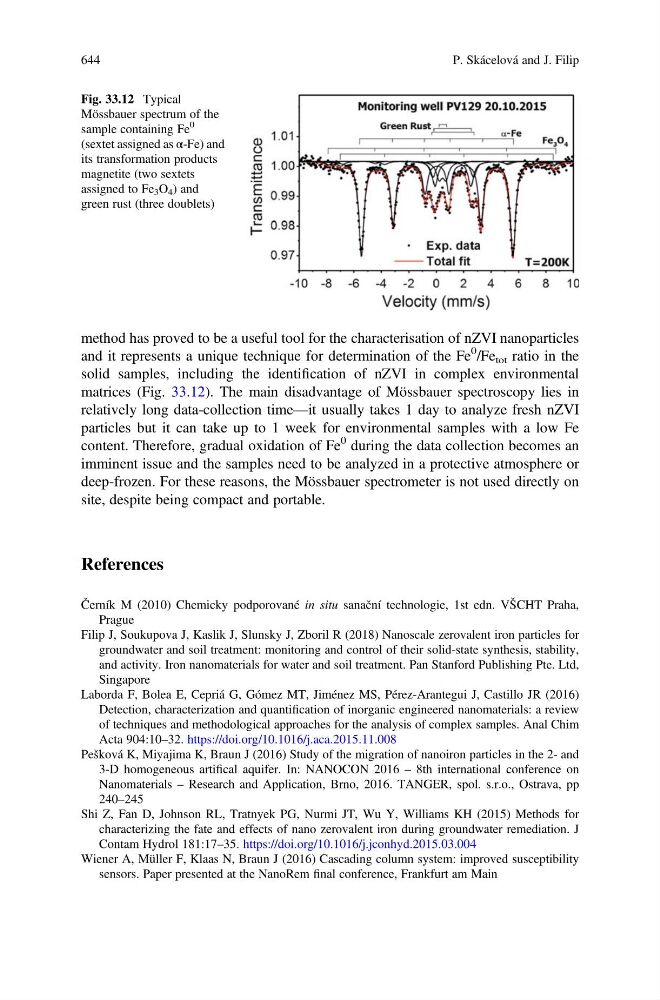
matrices (Fig. 33.12). The main disadvantage of Mössbauer spectroscopy lies in
relatively long data-collection time—it usually takes 1 day to analyze fresh nZVI
particles but it can take up to 1 week for environmental samples with a low Fe
content. Therefore, gradual oxidation of Fe
0 during the data collection becomes an
imminent issue and the samples need to be analyzed in a protective atmosphere or
deep-frozen. For these reasons, the Mössbauer spectrometer is not used directly on
site, despite being compact and portable.
References
Černík M (2010) Chemicky podporované in situ sanační technologie, 1st edn. VŠCHT Praha,
Prague
Filip J, Soukupova J, Kaslik J, Slunsky J, Zboril R (2018) Nanoscale zerovalent iron particles for
groundwater and soil treatment: monitoring and control of their solid-state synthesis, stability,
and activity. Iron nanomaterials for water and soil treatment. Pan Stanford Publishing Pte. Ltd,
Singapore
Laborda F, Bolea E, Cepriá G, Gómez MT, Jiménez MS, Pérez-Arantegui J, Castillo JR (2016)
Detection, characterization and quantification of inorganic engineered nanomaterials: a review
of techniques and methodological approaches for the analysis of complex samples. Anal Chim
Acta 904:10–32. https://doi.org/10.1016/j.aca.2015.11.008
Pešková K, Miyajima K, Braun J (2016) Study of the migration of nanoiron particles in the 2- and
3-D homogeneous artifical aquifer. In: NANOCON 2016 – 8th international conference on
Nanomaterials – Research and Application, Brno, 2016. TANGER, spol. s.r.o., Ostrava, pp
240–245
Shi Z, Fan D, Johnson RL, Tratnyek PG, Nurmi JT, Wu Y, Williams KH (2015) Methods for
characterizing the fate and effects of nano zerovalent iron during groundwater remediation. J
Contam Hydrol 181:17–35. https://doi.org/10.1016/j.jconhyd.2015.03.004
Wiener A, Müller F, Klaas N, Braun J (2016) Cascading column system: improved susceptibility
sensors. Paper presented at the NanoRem final conference, Frankfurt am Main
Fig. 33.12 Typical
Mössbauer spectrum of the
sample containing Fe
0
(sextet assigned as α-Fe) and
its transformation products
magnetite (two sextets
assigned to Fe 3 O 4 ) and
green rust (three doublets)
644
P. Skácelová and J. Filip