

the other methods mentioned hereafter, nanoparticles must be isolated from the
sample in order to avoid analysis of ballast material. Magnetic separation proved
to be simple and suitable for samples of groundwater-sediment mixture containing
nZVI and its transformation products. This additional step in the sample preparation
procedure allows easy identification of nanoparticles and their particle-size and
morphology characterization. Additional instrumental tools coupled with microscope (e.g., energy-dispersive spectroscopy, EDS) can serve for chemical analysis
of the solid sample. Further investigation can be performed employing other sophisticated extensions such as high-resolution techniques (HR-TEM, HR-SEM).
33.3.2.3 X-Ray Powder Diffraction
X-ray powder diffraction (XRD) measurements are crucial in terms of qualitative
and quantitative analysis of (nano)crystalline solid samples. XRD is suitable for fast
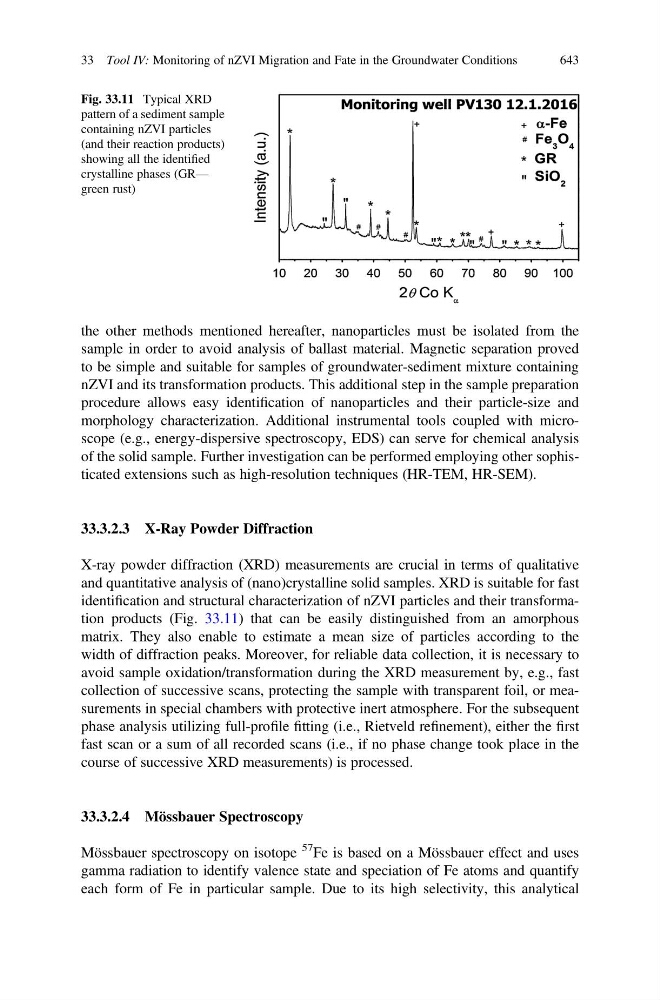
identification and structural characterization of nZVI particles and their transformation products (Fig. 33.11) that can be easily distinguished from an amorphous
matrix. They also enable to estimate a mean size of particles according to the
width of diffraction peaks. Moreover, for reliable data collection, it is necessary to
avoid sample oxidation/transformation during the XRD measurement by, e.g., fast
collection of successive scans, protecting the sample with transparent foil, or measurements in special chambers with protective inert atmosphere. For the subsequent
phase analysis utilizing full-profile fitting (i.e., Rietveld refinement), either the first
fast scan or a sum of all recorded scans (i.e., if no phase change took place in the
course of successive XRD measurements) is processed.
33.3.2.4 Mössbauer Spectroscopy
Mössbauer spectroscopy on isotope
57 Fe is based on a Mössbauer effect and uses
gamma radiation to identify valence state and speciation of Fe atoms and quantify
each form of Fe in particular sample. Due to its high selectivity, this analytical
Fig. 33.11 Typical XRD
pattern of a sediment sample
containing nZVI particles
(and their reaction products)
showing all the identified
crystalline phases (GR—
green rust)
33 Tool IV: Monitoring of nZVI Migration and Fate in the Groundwater Conditions
643