

biodegradation, (2) reactive liquid and crystalline substances (e.g., iron filings, iron
nanoparticles, KMnO 4 , etc.) for supporting in situ chemical oxidation/reduction of
the contaminants, (3) electrically conductive substances for supporting in situ
electrokinetics, and in situ vitrification, (4) solid proppants for ensuring long-term
effect of increasing hydraulic conductivity of the geological environment.
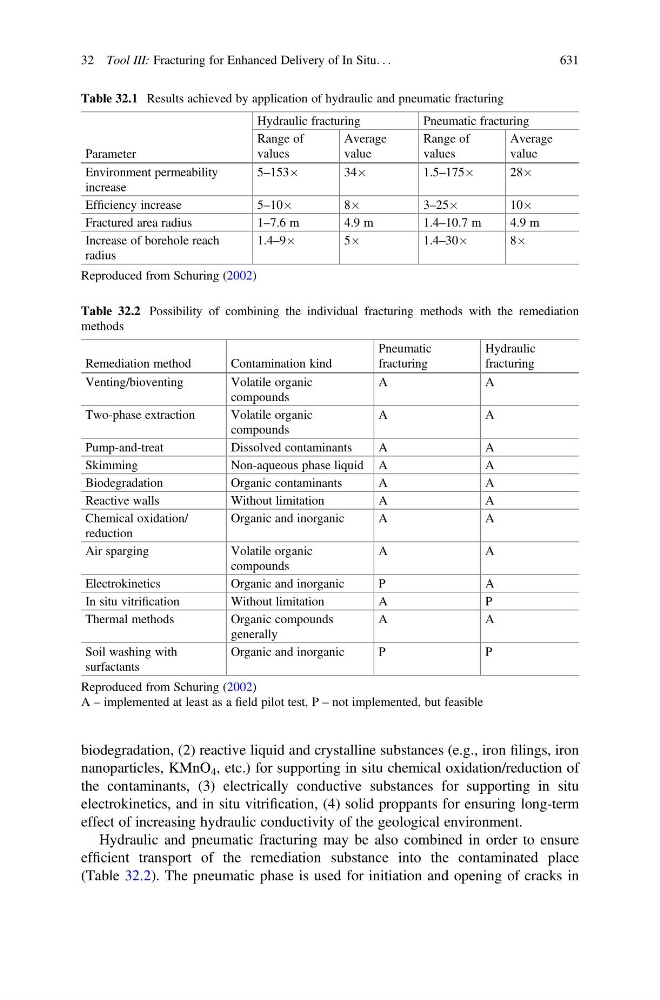
Hydraulic and pneumatic fracturing may be also combined in order to ensure
efficient transport of the remediation substance into the contaminated place
(Table 32.2). The pneumatic phase is used for initiation and opening of cracks in
Table 32.1 Results achieved by application of hydraulic and pneumatic fracturing
Parameter
Hydraulic fracturing
Pneumatic fracturing
Range of
values
Average
value
Range of
values
Average
value
Environment permeability
increase
5–153Â
34Â
1.5–175Â
28Â
Efficiency increase
5–10Â
8Â
3–25Â
10Â
Fractured area radius
1–7.6 m
4.9 m
1.4–10.7 m
4.9 m
Increase of borehole reach
radius
1.4–9Â
5Â
1.4–30Â
8Â
Reproduced from Schuring (2002)
Table 32.2 Possibility of combining the individual fracturing methods with the remediation
methods
Remediation method
Contamination kind
Pneumatic
fracturing
Hydraulic
fracturing
Venting/bioventing
Volatile organic
compounds
A
A
Two-phase extraction
Volatile organic
compounds
A
A
Pump-and-treat
Dissolved contaminants
A
A
Skimming
Non-aqueous phase liquid A
A
Biodegradation
Organic contaminants
A
A
Reactive walls
Without limitation
A
A
Chemical oxidation/
reduction
Organic and inorganic
A
A
Air sparging
Volatile organic
compounds
A
A
Electrokinetics
Organic and inorganic
P
A
In situ vitrification
Without limitation
A
P
Thermal methods
Organic compounds
generally
A
A
Soil washing with
surfactants
Organic and inorganic
P
P
Reproduced from Schuring (2002)
A – implemented at least as a field pilot test, P – not implemented, but feasible
32 Tool III: Fracturing for Enhanced Delivery of In Situ. . .
631