

relatively high (ca 2 m/s). The equipment for pneumatic fracturing may be placed
into a car trailer. In addition to what is stated above, complementary equipment may
be used for concurrent injection of liquid or solid complementary substances necessary for the remediation purposes.
In the case of pneumatic fracturing applications, the ability of a geological
environment to spontaneously keep the newly formed crack open is relied on. It
has been proved that relatively high amounts of liquid may flow through cracks of
even very small sizes. In the case of fragile geological materials, such as rocks of the
bedrock material, the formed cracks usually do not close back mainly owing to
irregular and coarse surface of the fractures and small movements of the individual
rock blocks. In the case of plastic clays, it has been proved that their swelling causes
the cracks to close. Within the framework of the pneumatic fracturing, the formed
cracks may be filled with the so-called permeable proppant (sand or a ceramic
material). The use of a proppant is particularly suitable in fine-grained incohesive
materials (silty sand). The proppant is transported into the geological environment
during the pneumatic fracturing directly by the injected gas flowing with high speed.
32.3 Hydraulic Fracturing
Hydraulic fracturing is carried out through a high-pressure injection of water or
polymer-based liquids into the borehole so that it causes artificial formation of a new,
more permeable area (crack) in the given depth. Similarly to pneumatic fracturing,
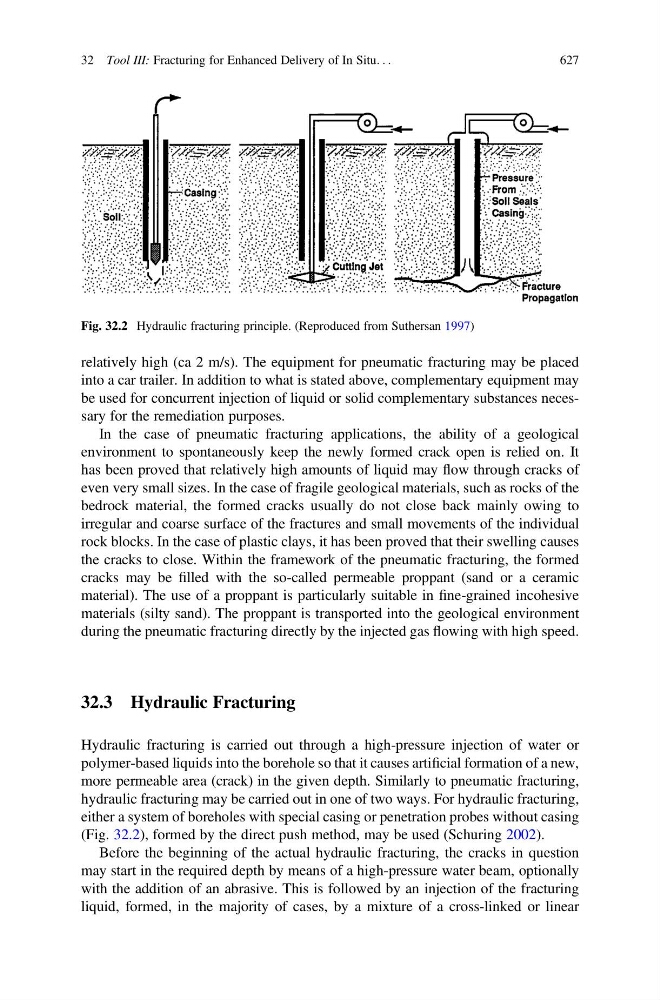
hydraulic fracturing may be carried out in one of two ways. For hydraulic fracturing,
either a system of boreholes with special casing or penetration probes without casing
(Fig. 32.2), formed by the direct push method, may be used (Schuring 2002).
Before the beginning of the actual hydraulic fracturing, the cracks in question
may start in the required depth by means of a high-pressure water beam, optionally
with the addition of an abrasive. This is followed by an injection of the fracturing
liquid, formed, in the majority of cases, by a mixture of a cross-linked or linear
Fig. 32.2 Hydraulic fracturing principle. (Reproduced from Suthersan 1997)
32 Tool III: Fracturing for Enhanced Delivery of In Situ. . .
627