

pressure of air or another gas. In the case of hydraulic fracturing, the cracks are
produced by pressure injection of a liquid into the geological environment. Pneumatic and hydraulic fracturing methods are further described below.
The speed of crack formation differs by orders of magnitude in the individual
methods. The crack created by means of hydraulic fracturing is formed by the lowest
speed (ca 0.1 m/s); in the case of pneumatic fracturing the speed is ca 2 m/s.
32.2 Pneumatic Fracturing
Pneumatic fracturing is carried out through high-pressure injection of gas into the
borehole so that it causes formation of new cracks and more permeable areas in the
geological environment. Fracturing may be carried out by means of either boreholes
with special casing (without packing) or penetration probes without casing (direct
push probes). It can be performed either in one level or in more levels, with the use of
packers. The pressurized air source is usually a compressor or high-pressure containers (Schuring 2002).
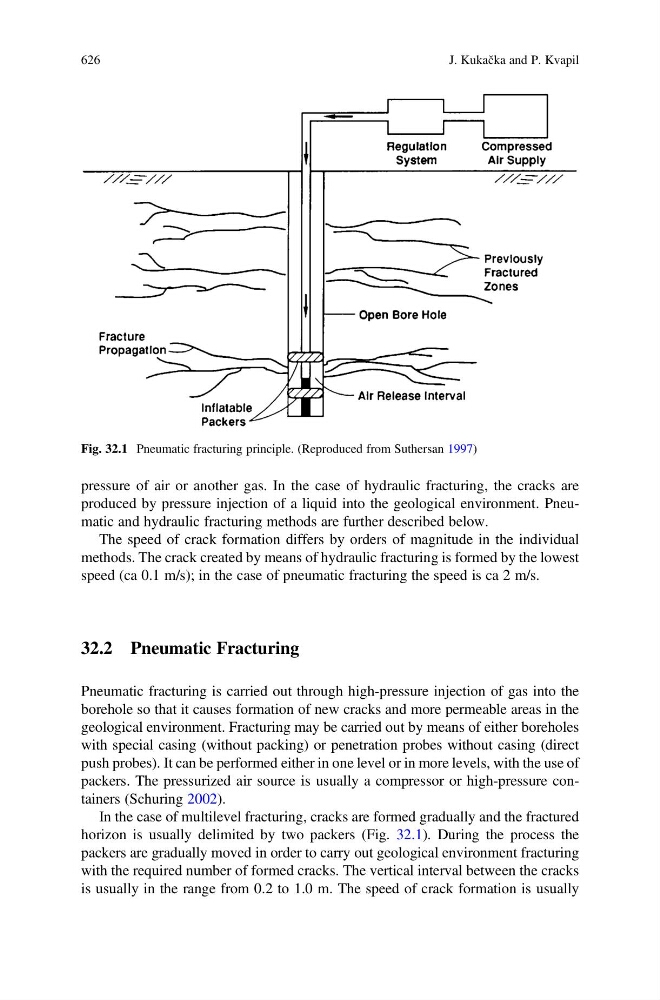
In the case of multilevel fracturing, cracks are formed gradually and the fractured
horizon is usually delimited by two packers (Fig. 32.1). During the process the
packers are gradually moved in order to carry out geological environment fracturing
with the required number of formed cracks. The vertical interval between the cracks
is usually in the range from 0.2 to 1.0 m. The speed of crack formation is usually
Fig. 32.1 Pneumatic fracturing principle. (Reproduced from Suthersan 1997)
626
J. Kukačka and P. Kvapil