

lithological boundaries, e.g., sand/gravel, sand/clay. A proper understanding of
lithology is crucial for tracking possible routes of contaminant migration and
possible area of its accumulation. The other useful additions are cone penetration
testing (CPT), hydraulic profiling tool (HPT), or possible upgrade of GC to consider
results more quantitative (McCall et al. 2014; Adamson et al. 2014).
There are other technologies useful for direct investigation based on different
principles. One of them is optical image profiler for petroleum hydrocarbons
(McCall et al. 2016).
Research conducted in recent years has pushed direct logging tools even further,
linking investigation directly to the remediation process. An example of such an
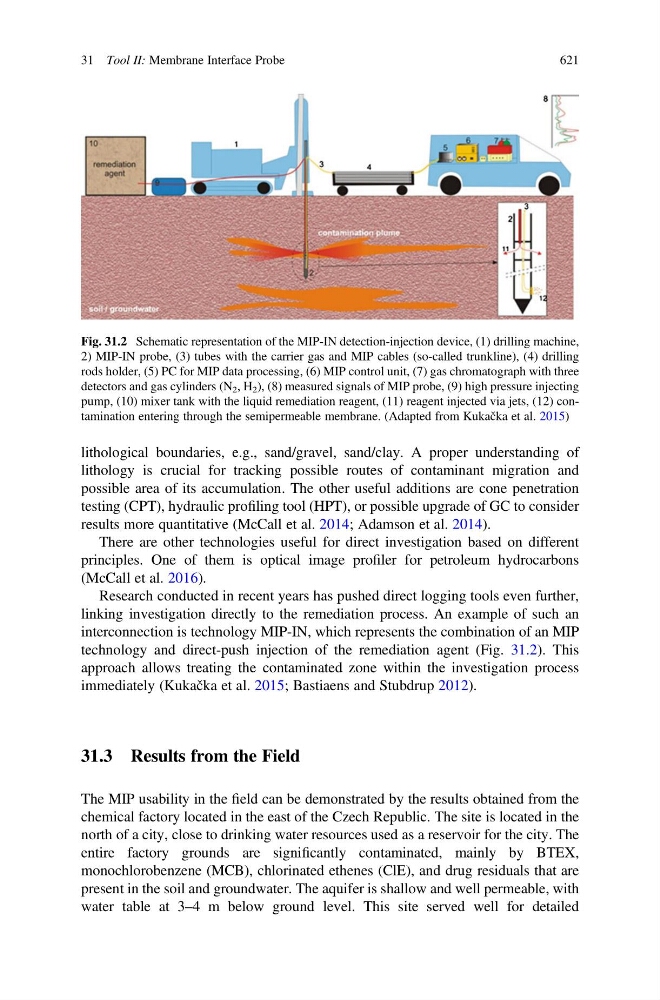
interconnection is technology MIP-IN, which represents the combination of an MIP
technology and direct-push injection of the remediation agent (Fig. 31.2). This
approach allows treating the contaminated zone within the investigation process
immediately (Kukačka et al. 2015; Bastiaens and Stubdrup 2012).
31.3 Results from the Field
The MIP usability in the field can be demonstrated by the results obtained from the
chemical factory located in the east of the Czech Republic. The site is located in the
north of a city, close to drinking water resources used as a reservoir for the city. The
entire factory grounds are significantly contaminated, mainly by BTEX,
monochlorobenzene (MCB), chlorinated ethenes (ClE), and drug residuals that are
present in the soil and groundwater. The aquifer is shallow and well permeable, with
water table at 3–4 m below ground level. This site served well for detailed
Fig. 31.2 Schematic representation of the MIP-IN detection-injection device, (1) drilling machine,
2) MIP-IN probe, (3) tubes with the carrier gas and MIP cables (so-called trunkline), (4) drilling
rods holder, (5) PC for MIP data processing, (6) MIP control unit, (7) gas chromatograph with three
detectors and gas cylinders (N 2 , H 2 ), (8) measured signals of MIP probe, (9) high pressure injecting
pump, (10) mixer tank with the liquid remediation reagent, (11) reagent injected via jets, (12) contamination entering through the semipermeable membrane. (Adapted from Kukačka et al. 2015)
31 Tool II: Membrane Interface Probe
621