

31.2 Membrane Interface Probe (MIP)
One of the core direct investigation technologies is MIP—membrane interface probe
(Geoprobe, USA). MIP is a probing system designed to delineate the contamination
plume and be capable of depicting distribution and relative magnitude of both
halogenated and nonhalogenated volatile organic compound (VOC) contaminants
in real time (McAndrews et al. 2003; Bronders et al. 2009). It can be used in both
saturated and vadose soils.
The principle of the operation is summarized in the following text. The probe is
equipped with a heating block with special semipermeable membrane, which comprises of a thin film polymer impregnated into a stainless steel screen. The probe is
pushed into the subsurface by a suitable drilling rig and the block is heated up to
120
C. Mobilized contaminants diffuse across the membrane on the basis of a
concentration gradient between the contaminated soil and the clean carrier gas,
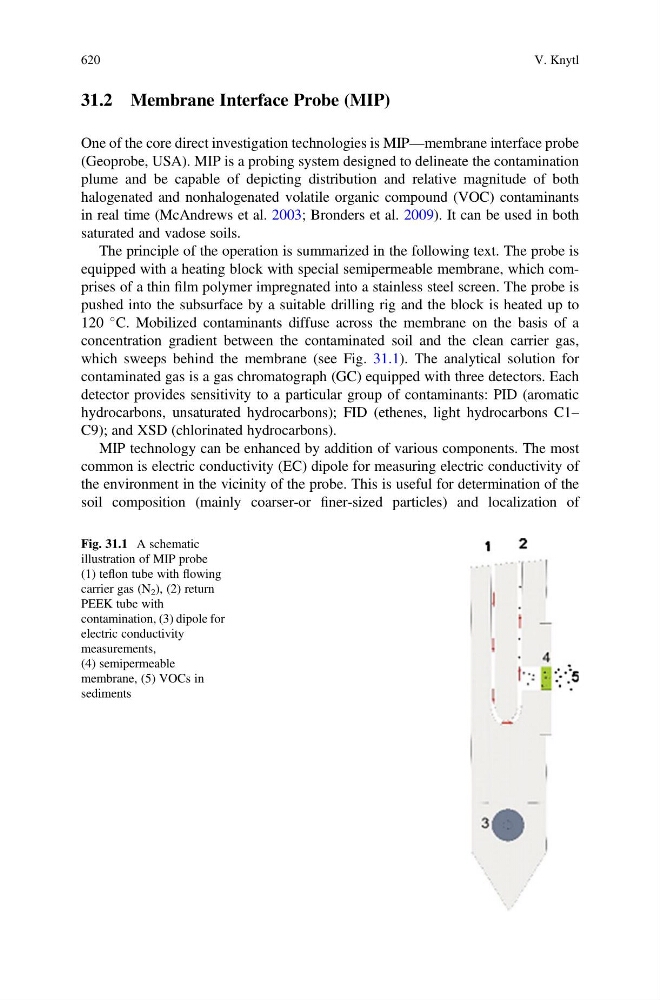
which sweeps behind the membrane (see Fig. 31.1). The analytical solution for
contaminated gas is a gas chromatograph (GC) equipped with three detectors. Each
detector provides sensitivity to a particular group of contaminants: PID (aromatic
hydrocarbons, unsaturated hydrocarbons); FID (ethenes, light hydrocarbons C1–
C9); and XSD (chlorinated hydrocarbons).
MIP technology can be enhanced by addition of various components. The most
common is electric conductivity (EC) dipole for measuring electric conductivity of
the environment in the vicinity of the probe. This is useful for determination of the
soil composition (mainly coarser-or finer-sized particles) and localization of
Fig. 31.1 A schematic
illustration of MIP probe
(1) teflon tube with flowing
carrier gas (N 2 ), (2) return
PEEK tube with
contamination, (3) dipole for
electric conductivity
measurements,
(4) semipermeable
membrane, (5) VOCs in
sediments
620
V. Knytl