

2.4 Remediation Using nZVI
While nZVI has been widely used for site remediation in USA since the beginning of the
new millennium, the number of full-scale remediations employing nZVI is lower in
Europe (Mueller et al. 2012). Nevertheless, there is an increasing tendency to use nZVI
as a novel in situ reduction technology and this material has become a well-known reagent
for many environmental consultants. Although RNIP particles (Toda Kogyo Corp., Japan)
have been applied to a few pilot-scale applications over the past 20 years, NANOFER
nZVI (NANO IRON s.r.o., Czech Republic) is the only commercially produced nanoscale
ZVI used for groundwater remediation in Europe nowadays. It has been used to treat over
twenty sites, mainly in Belgium, France, Switzerland, Spain, Portugal, Italy, Denmark and
the Czech Republic (Bardos et al. 2018).
Despite the great number of laboratory studies focused on pollutant removal by
nZVI published in the form of scientific papers, the number of the articles
documenting the full-scale or at least pilot-scale applications of nZVI is much
smaller. Their summary is provided in Table 2.5. What can account for such a
lack of literary sources could be the (hydro)geological as well as geochemical
complexity of groundwater and soil on site (i.e., leading to much higher degree of
uncertainty than in case of laboratory tests under the well-defined conditions)
complicating interpretation of the observed results (Litter et al. 2018).
The first documented pilot application of nZVI (in form of Fe/Pd bimetallic
nanoparticles) was performed by the pioneers of this technology, D. W. Elliott and
W. Zhang, in 2001 (Elliott and Zhang 2001). In the area of an active industrial zone
in Trenton, New Jersey, 1.7 kg of nZVI was fed by gravity through infiltration wells
within 2 days. The concentration of PCE (target contaminant; initial concentration
up to 800 μg/L) was reduced by 96% in 1 month after the application. Since that
time, bimetallic or bare nZVI has been used in plenty of pilot tests in USA but only
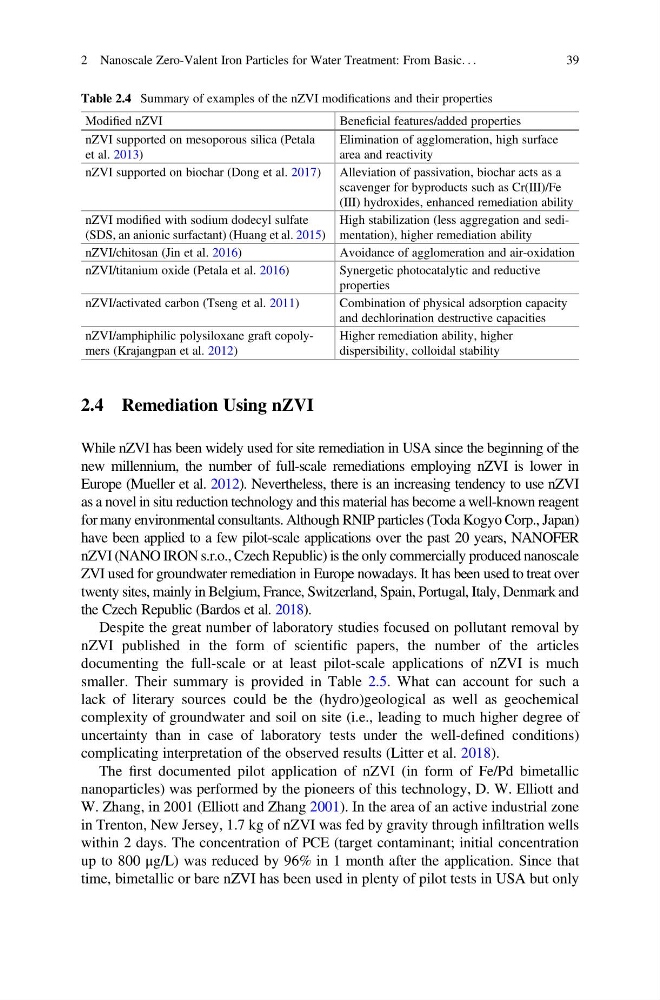
Table 2.4 Summary of examples of the nZVI modifications and their properties
Modified nZVI
Beneficial features/added properties
nZVI supported on mesoporous silica (Petala
et al. 2013)
Elimination of agglomeration, high surface
area and reactivity
nZVI supported on biochar (Dong et al. 2017) Alleviation of passivation, biochar acts as a
scavenger for byproducts such as Cr(III)/Fe
(III) hydroxides, enhanced remediation ability
nZVI modified with sodium dodecyl sulfate
(SDS, an anionic surfactant) (Huang et al. 2015)
High stabilization (less aggregation and sedimentation), higher remediation ability
nZVI/chitosan (Jin et al. 2016)
Avoidance of agglomeration and air-oxidation
nZVI/titanium oxide (Petala et al. 2016)
Synergetic photocatalytic and reductive
properties
nZVI/activated carbon (Tseng et al. 2011)
Combination of physical adsorption capacity
and dechlorination destructive capacities
nZVI/amphiphilic polysiloxane graft copolymers (Krajangpan et al. 2012)
Higher remediation ability, higher
dispersibility, colloidal stability
2 Nanoscale Zero-Valent Iron Particles for Water Treatment: From Basic. . .
39
While nZVI has been widely used for site remediation in USA since the beginning of the
new millennium, the number of full-scale remediations employing nZVI is lower in
Europe (Mueller et al. 2012). Nevertheless, there is an increasing tendency to use nZVI
as a novel in situ reduction technology and this material has become a well-known reagent
for many environmental consultants. Although RNIP particles (Toda Kogyo Corp., Japan)
have been applied to a few pilot-scale applications over the past 20 years, NANOFER
nZVI (NANO IRON s.r.o., Czech Republic) is the only commercially produced nanoscale
ZVI used for groundwater remediation in Europe nowadays. It has been used to treat over
twenty sites, mainly in Belgium, France, Switzerland, Spain, Portugal, Italy, Denmark and
the Czech Republic (Bardos et al. 2018).
Despite the great number of laboratory studies focused on pollutant removal by
nZVI published in the form of scientific papers, the number of the articles
documenting the full-scale or at least pilot-scale applications of nZVI is much
smaller. Their summary is provided in Table 2.5. What can account for such a
lack of literary sources could be the (hydro)geological as well as geochemical
complexity of groundwater and soil on site (i.e., leading to much higher degree of
uncertainty than in case of laboratory tests under the well-defined conditions)
complicating interpretation of the observed results (Litter et al. 2018).
The first documented pilot application of nZVI (in form of Fe/Pd bimetallic
nanoparticles) was performed by the pioneers of this technology, D. W. Elliott and
W. Zhang, in 2001 (Elliott and Zhang 2001). In the area of an active industrial zone
in Trenton, New Jersey, 1.7 kg of nZVI was fed by gravity through infiltration wells
within 2 days. The concentration of PCE (target contaminant; initial concentration
up to 800 μg/L) was reduced by 96% in 1 month after the application. Since that
time, bimetallic or bare nZVI has been used in plenty of pilot tests in USA but only
Table 2.4 Summary of examples of the nZVI modifications and their properties
Modified nZVI
Beneficial features/added properties
nZVI supported on mesoporous silica (Petala
et al. 2013)
Elimination of agglomeration, high surface
area and reactivity
nZVI supported on biochar (Dong et al. 2017) Alleviation of passivation, biochar acts as a
scavenger for byproducts such as Cr(III)/Fe
(III) hydroxides, enhanced remediation ability
nZVI modified with sodium dodecyl sulfate
(SDS, an anionic surfactant) (Huang et al. 2015)
High stabilization (less aggregation and sedimentation), higher remediation ability
nZVI/chitosan (Jin et al. 2016)
Avoidance of agglomeration and air-oxidation
nZVI/titanium oxide (Petala et al. 2016)
Synergetic photocatalytic and reductive
properties
nZVI/activated carbon (Tseng et al. 2011)
Combination of physical adsorption capacity
and dechlorination destructive capacities
nZVI/amphiphilic polysiloxane graft copolymers (Krajangpan et al. 2012)
Higher remediation ability, higher
dispersibility, colloidal stability
2 Nanoscale Zero-Valent Iron Particles for Water Treatment: From Basic. . .
39