

Table 2.3 Various nZVI support materials and their function (Zhou et al. 2016)
Modified material
Function
Silica
Protect the particles from intersystem dipolar interactions;
provide numerous hydroxyl groups on the surface as active
sites
Quercetin
Form complexes with some metal ions
Silver zeolite
High reactivity (e.g., antimicrobial activity) and good thermal
stability; cation exchange and adsorption
Bifunctional polymer (outer
PEO and inner PPO)
Outer hydrophilic region for colloidal stability and an inner
hydrophobic region for solubilization of organic compounds
AMT-TMSPT
To form a stable complex with soft transition metal ions (e.g.,
Ag and Cd).
CTAB and CPC
Retain analytes by strong hydrophobic and electrostatic
interactions
PV3A
Reduce particle size, ζ-potential, isoelectric point
Graphene
Have excellent mechanical, electrical, thermal, and optical
properties and very high specific surface area; to form a strong
π-π stacking interaction with the benzene ring
PDA
Offer biocompatibility, dispersibility in water, multifunctional
groups (amino and catechol groups), and provide π-π stacking
interaction to targets
PDMS
Full of functional groups such as hydrocarbyl, high biocompatibility, hydrophobic
PNIPAM
Thermosensitive, change the morphology by controlling temperature to accomplish the release of target compounds
MOFs
Possess extremely large surface area, low density, microporosity, easily designed or modified to have different pore sizes,
and regarded as promising candidates for storage, separation,
and catalysis
Chitosan
Hydrophilic, biocompatible, and biodegradable; full of amino
groups, can form a chelate complexes with heavy metal ions
Clay
Large surface area, hydrophilic, widely available, inexpensive
and safe
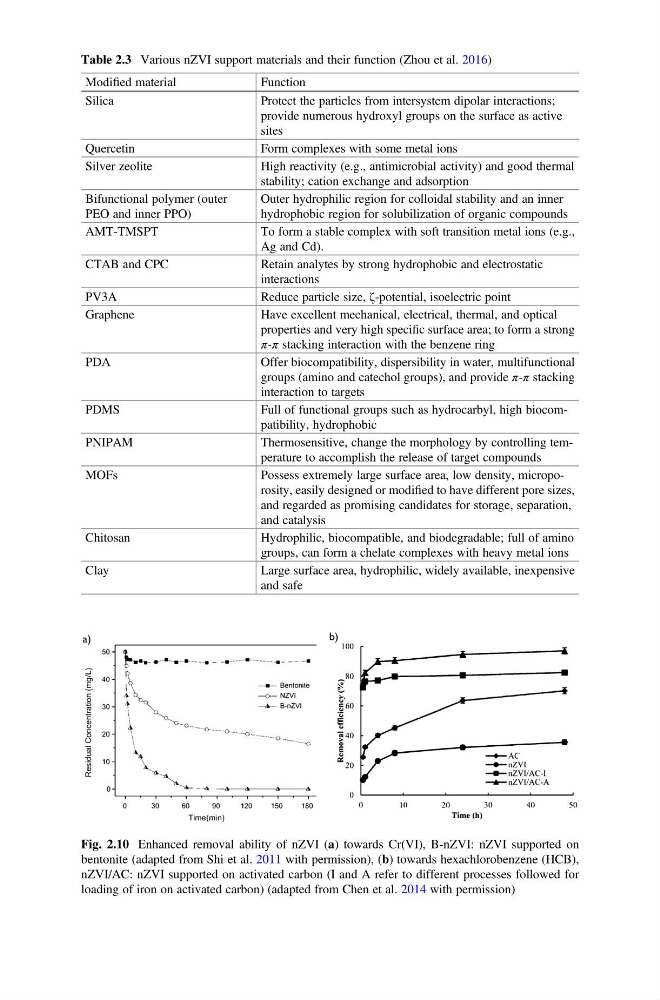
Fig. 2.10 Enhanced removal ability of nZVI (a) towards Cr(VI), B-nZVI: nZVI supported on
bentonite (adapted from Shi et al. 2011 with permission), (b) towards hexachlorobenzene (HCB),
nZVI/AC: nZVI supported on activated carbon (I and A refer to different processes followed for
loading of iron on activated carbon) (adapted from Chen et al. 2014 with permission)
Modified material
Function
Silica
Protect the particles from intersystem dipolar interactions;
provide numerous hydroxyl groups on the surface as active
sites
Quercetin
Form complexes with some metal ions
Silver zeolite
High reactivity (e.g., antimicrobial activity) and good thermal
stability; cation exchange and adsorption
Bifunctional polymer (outer
PEO and inner PPO)
Outer hydrophilic region for colloidal stability and an inner
hydrophobic region for solubilization of organic compounds
AMT-TMSPT
To form a stable complex with soft transition metal ions (e.g.,
Ag and Cd).
CTAB and CPC
Retain analytes by strong hydrophobic and electrostatic
interactions
PV3A
Reduce particle size, ζ-potential, isoelectric point
Graphene
Have excellent mechanical, electrical, thermal, and optical
properties and very high specific surface area; to form a strong
π-π stacking interaction with the benzene ring
PDA
Offer biocompatibility, dispersibility in water, multifunctional
groups (amino and catechol groups), and provide π-π stacking
interaction to targets
PDMS
Full of functional groups such as hydrocarbyl, high biocompatibility, hydrophobic
PNIPAM
Thermosensitive, change the morphology by controlling temperature to accomplish the release of target compounds
MOFs
Possess extremely large surface area, low density, microporosity, easily designed or modified to have different pore sizes,
and regarded as promising candidates for storage, separation,
and catalysis
Chitosan
Hydrophilic, biocompatible, and biodegradable; full of amino
groups, can form a chelate complexes with heavy metal ions
Clay
Large surface area, hydrophilic, widely available, inexpensive
and safe
Fig. 2.10 Enhanced removal ability of nZVI (a) towards Cr(VI), B-nZVI: nZVI supported on
bentonite (adapted from Shi et al. 2011 with permission), (b) towards hexachlorobenzene (HCB),
nZVI/AC: nZVI supported on activated carbon (I and A refer to different processes followed for
loading of iron on activated carbon) (adapted from Chen et al. 2014 with permission)