

27.6.6.2 Cadmium, Lead, and Copper
Cadmium (Cd) is a rare element, which enters the environment via several routes:
refining and use of Cd, Cu and Ni smelting, and fuel combustion. It can accumulate
in biota with high bioconcentration factors of 2000–4000 especially for mollusks.
Ecotoxicity of Cd to aquatic biota depends on the pH and the water hardness. Acute
LC50s may range from 2 to 3200 μg/L (US EPA 2018). The chronic effects in both
aquatic invertebrates and vertebrates include, e.g., reduced growth or reproduction
impairment occurring at low μg/L concentrations. Embryos and early life stages are
commonly more sensitive under the same conditions than adults.
Lead (Pb) is found in all media and biota. Its elevated concentrations result from
diverse human activities like base metal mining and smelting, combustion of leaded
gasoline, use of Pb in hunting or in paints, and also from the uncontrolled disposal of
Pb-containing products like batteries and electronic devices. Background environmental concentrations are low, usually below μg/L, but they may increase depending
on the sources of the pollution and the environmental conditions, where the low pH
and the ion content greatly affect Pb
2+ bioavailability. Very high concentrations can
be found in soil near the sources of the contamination (up to gram per kg of soil).
Among all the studied species, diatoms (algae) and crustaceans were found highly
sensitive (US EPA 2018), but the pronounced toxic effects like neurotoxicity or
anaemia have been demonstrated in humans and other vertebrates such as birds,
which may accumulate high Pb levels through the food chain.
Copper (Cu) is nowadays mined on every continent except Antarctica. Its
application as an electrical conductor in wires and cables accounts for about 75%
of its usage. In the form of alloys, copper can also be used in building construction
(tubes, sheets, rods) or fine electroindustry. Copper is essential to various enzymes in
biota, but the elevated environmental concentrations have been found highly toxic to
many aquatic and marine species, especially to many plants and algae. Similarly to
Cd, bioavailability and toxicity of Cu are strongly influenced by some environmental
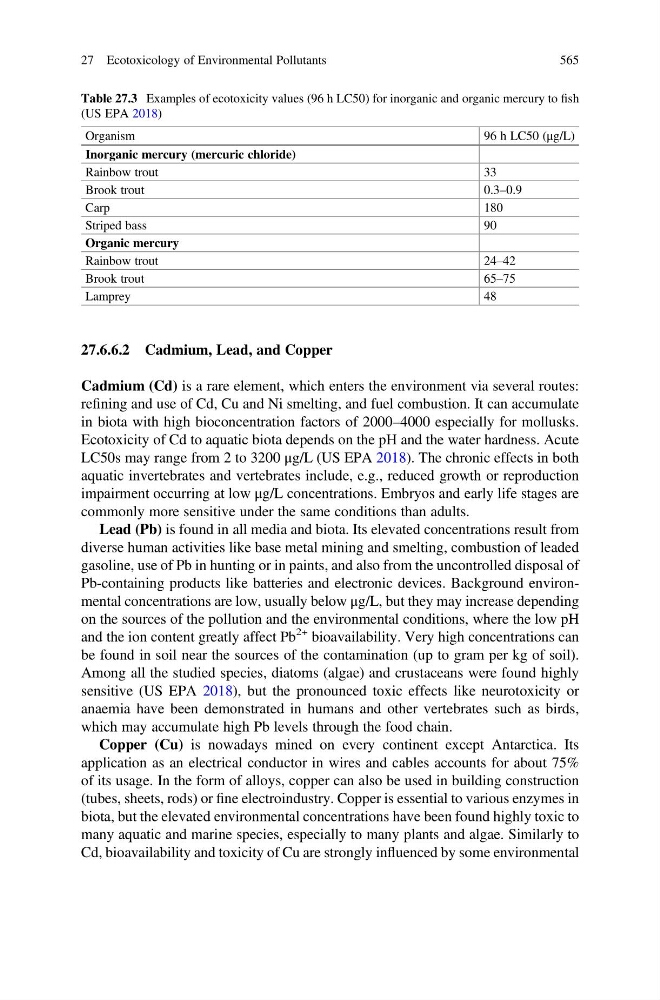
Table 27.3 Examples of ecotoxicity values (96 h LC50) for inorganic and organic mercury to fish
(US EPA 2018)
Organism
96 h LC50 (μg/L)
Inorganic mercury (mercuric chloride)
Rainbow trout
33
Brook trout
0.3–0.9
Carp
180
Striped bass
90
Organic mercury
Rainbow trout
24–42
Brook trout
65–75
Lamprey
48
27 Ecotoxicology of Environmental Pollutants
565
Cadmium (Cd) is a rare element, which enters the environment via several routes:
refining and use of Cd, Cu and Ni smelting, and fuel combustion. It can accumulate
in biota with high bioconcentration factors of 2000–4000 especially for mollusks.
Ecotoxicity of Cd to aquatic biota depends on the pH and the water hardness. Acute
LC50s may range from 2 to 3200 μg/L (US EPA 2018). The chronic effects in both
aquatic invertebrates and vertebrates include, e.g., reduced growth or reproduction
impairment occurring at low μg/L concentrations. Embryos and early life stages are
commonly more sensitive under the same conditions than adults.
Lead (Pb) is found in all media and biota. Its elevated concentrations result from
diverse human activities like base metal mining and smelting, combustion of leaded
gasoline, use of Pb in hunting or in paints, and also from the uncontrolled disposal of
Pb-containing products like batteries and electronic devices. Background environmental concentrations are low, usually below μg/L, but they may increase depending
on the sources of the pollution and the environmental conditions, where the low pH
and the ion content greatly affect Pb
2+ bioavailability. Very high concentrations can
be found in soil near the sources of the contamination (up to gram per kg of soil).
Among all the studied species, diatoms (algae) and crustaceans were found highly
sensitive (US EPA 2018), but the pronounced toxic effects like neurotoxicity or
anaemia have been demonstrated in humans and other vertebrates such as birds,
which may accumulate high Pb levels through the food chain.
Copper (Cu) is nowadays mined on every continent except Antarctica. Its
application as an electrical conductor in wires and cables accounts for about 75%
of its usage. In the form of alloys, copper can also be used in building construction
(tubes, sheets, rods) or fine electroindustry. Copper is essential to various enzymes in
biota, but the elevated environmental concentrations have been found highly toxic to
many aquatic and marine species, especially to many plants and algae. Similarly to
Cd, bioavailability and toxicity of Cu are strongly influenced by some environmental
Table 27.3 Examples of ecotoxicity values (96 h LC50) for inorganic and organic mercury to fish
(US EPA 2018)
Organism
96 h LC50 (μg/L)
Inorganic mercury (mercuric chloride)
Rainbow trout
33
Brook trout
0.3–0.9
Carp
180
Striped bass
90
Organic mercury
Rainbow trout
24–42
Brook trout
65–75
Lamprey
48
27 Ecotoxicology of Environmental Pollutants
565