

components. Major environmentally related risks include spills in marine systems,
soil, surface water and ground water contamination. Such accidents are known to
have a deteriorating impact on ecosystem functioning. Although ecotoxicological
studies with individual components of oil or its products are available (e.g., acute
48 h LC50 values for different fish species range 2–175 mg/L for different types of
oil), it is considered that PAHs (see Sect. 27.6.3) provide the largest contribution to
the overall toxicity. They are easily bioaccumulated through food chains and they are
prone to photoactivation in the environment or metabolic bioactivation in the
organisms, both of which create reactive species targeting important macromolecules like proteins, phospholipids as well as nucleic acids DNA or RNA. The effects
in organisms include acute lethality, developmental malformations as well as chronic
effects like immunotoxicity or behavioral toxicity, which have mostly been
documented in vertebrates like fish, amphibians, or other wildlife.
27.6.2 Benzene
Benzene and its derivatives are broadly distributed in the environment due to their
use as solvents or intermediates in chemical and pharmaceutical industry. The often
reported toxic effects in mammals—including humans—are acute neurotoxicity or
cardiotoxicity. Chronic exposures, when metabolic activation in liver and production
of ROS have been described, result in hepatotoxicity or bone marrow toxicity
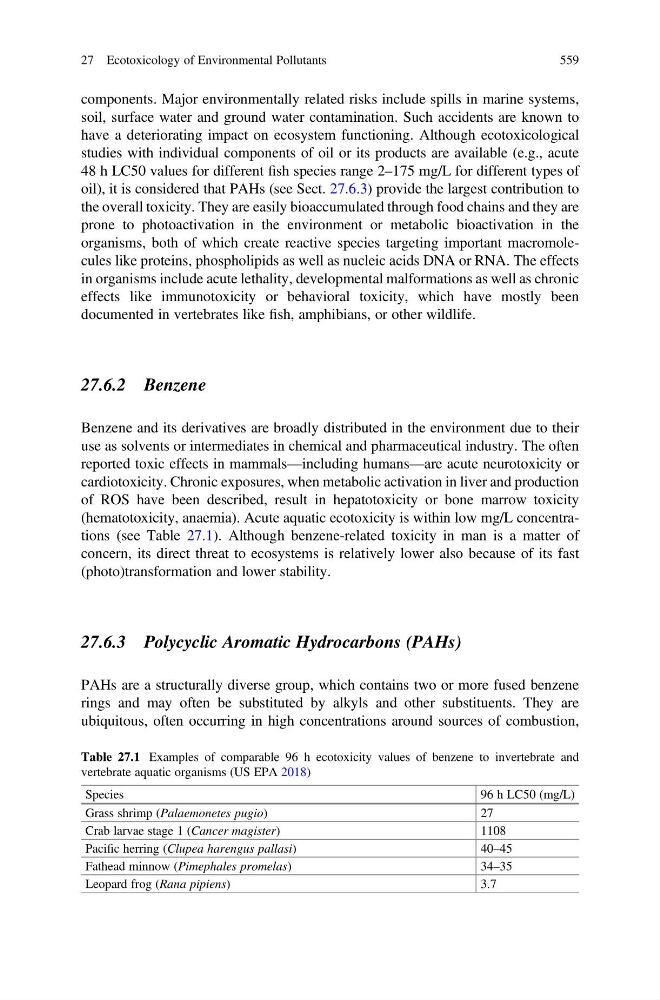
(hematotoxicity, anaemia). Acute aquatic ecotoxicity is within low mg/L concentrations (see Table 27.1). Although benzene-related toxicity in man is a matter of
concern, its direct threat to ecosystems is relatively lower also because of its fast
(photo)transformation and lower stability.
27.6.3 Polycyclic Aromatic Hydrocarbons (PAHs)
PAHs are a structurally diverse group, which contains two or more fused benzene
rings and may often be substituted by alkyls and other substituents. They are
ubiquitous, often occurring in high concentrations around sources of combustion,
Table 27.1 Examples of comparable 96 h ecotoxicity values of benzene to invertebrate and
vertebrate aquatic organisms (US EPA 2018)
Species
96 h LC50 (mg/L)
Grass shrimp (Palaemonetes pugio)
2 7
Crab larvae stage 1 (Cancer magister)
1108
Pacific herring (Clupea harengus pallasi)
4 0 –45
Fathead minnow (Pimephales promelas)
3 4 –35
Leopard frog (Rana pipiens)
3.7
27 Ecotoxicology of Environmental Pollutants
559
soil, surface water and ground water contamination. Such accidents are known to
have a deteriorating impact on ecosystem functioning. Although ecotoxicological
studies with individual components of oil or its products are available (e.g., acute
48 h LC50 values for different fish species range 2–175 mg/L for different types of
oil), it is considered that PAHs (see Sect. 27.6.3) provide the largest contribution to
the overall toxicity. They are easily bioaccumulated through food chains and they are
prone to photoactivation in the environment or metabolic bioactivation in the
organisms, both of which create reactive species targeting important macromolecules like proteins, phospholipids as well as nucleic acids DNA or RNA. The effects
in organisms include acute lethality, developmental malformations as well as chronic
effects like immunotoxicity or behavioral toxicity, which have mostly been
documented in vertebrates like fish, amphibians, or other wildlife.
27.6.2 Benzene
Benzene and its derivatives are broadly distributed in the environment due to their
use as solvents or intermediates in chemical and pharmaceutical industry. The often
reported toxic effects in mammals—including humans—are acute neurotoxicity or
cardiotoxicity. Chronic exposures, when metabolic activation in liver and production
of ROS have been described, result in hepatotoxicity or bone marrow toxicity
(hematotoxicity, anaemia). Acute aquatic ecotoxicity is within low mg/L concentrations (see Table 27.1). Although benzene-related toxicity in man is a matter of
concern, its direct threat to ecosystems is relatively lower also because of its fast
(photo)transformation and lower stability.
27.6.3 Polycyclic Aromatic Hydrocarbons (PAHs)
PAHs are a structurally diverse group, which contains two or more fused benzene
rings and may often be substituted by alkyls and other substituents. They are
ubiquitous, often occurring in high concentrations around sources of combustion,
Table 27.1 Examples of comparable 96 h ecotoxicity values of benzene to invertebrate and
vertebrate aquatic organisms (US EPA 2018)
Species
96 h LC50 (mg/L)
Grass shrimp (Palaemonetes pugio)
2 7
Crab larvae stage 1 (Cancer magister)
1108
Pacific herring (Clupea harengus pallasi)
4 0 –45
Fathead minnow (Pimephales promelas)
3 4 –35
Leopard frog (Rana pipiens)
3.7
27 Ecotoxicology of Environmental Pollutants
559