

27.6 Ecotoxicity of Major Pollutant Classes
The following sections provide a brief overview and examples of major classes of
contaminants and their ecotoxicological hazards.
27.6.1 Crude Oil, Oil, Petrol, Gasoline
Petroleum is a naturally occurring substance of global importance. Petroleum itself
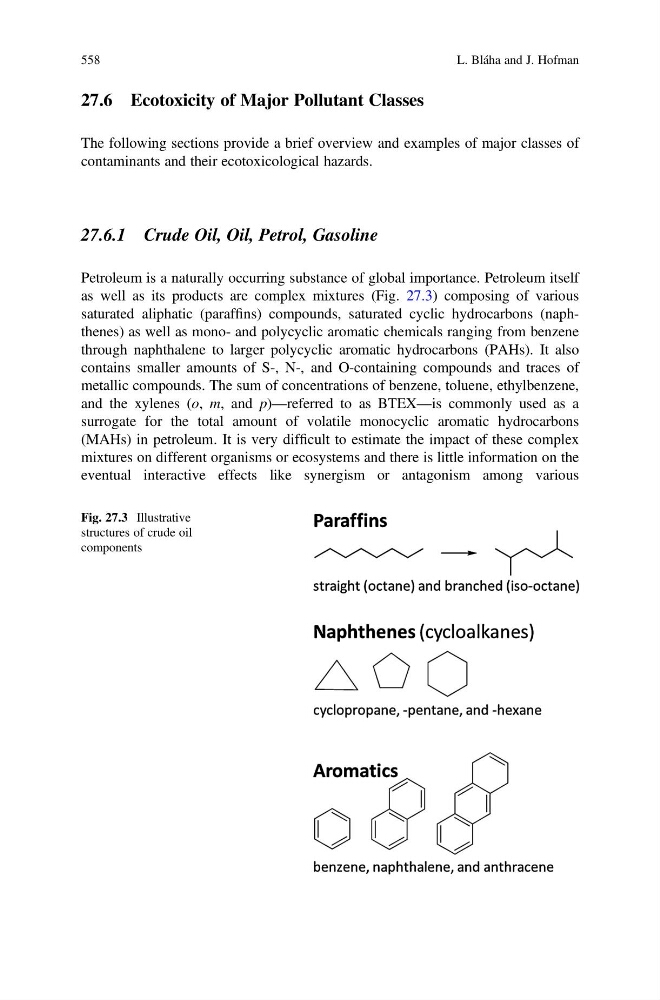
as well as its products are complex mixtures (Fig. 27.3) composing of various
saturated aliphatic (paraffins) compounds, saturated cyclic hydrocarbons (naphthenes) as well as mono- and polycyclic aromatic chemicals ranging from benzene
through naphthalene to larger polycyclic aromatic hydrocarbons (PAHs). It also
contains smaller amounts of S-, N-, and O-containing compounds and traces of
metallic compounds. The sum of concentrations of benzene, toluene, ethylbenzene,
and the xylenes (o, m, and p)—referred to as BTEX—is commonly used as a
surrogate for the total amount of volatile monocyclic aromatic hydrocarbons
(MAHs) in petroleum. It is very difficult to estimate the impact of these complex
mixtures on different organisms or ecosystems and there is little information on the
eventual interactive effects like synergism or antagonism among various
Fig. 27.3 Illustrative
structures of crude oil
components
558
L. Bláha and J. Hofman
The following sections provide a brief overview and examples of major classes of
contaminants and their ecotoxicological hazards.
27.6.1 Crude Oil, Oil, Petrol, Gasoline
Petroleum is a naturally occurring substance of global importance. Petroleum itself
as well as its products are complex mixtures (Fig. 27.3) composing of various
saturated aliphatic (paraffins) compounds, saturated cyclic hydrocarbons (naphthenes) as well as mono- and polycyclic aromatic chemicals ranging from benzene
through naphthalene to larger polycyclic aromatic hydrocarbons (PAHs). It also
contains smaller amounts of S-, N-, and O-containing compounds and traces of
metallic compounds. The sum of concentrations of benzene, toluene, ethylbenzene,
and the xylenes (o, m, and p)—referred to as BTEX—is commonly used as a
surrogate for the total amount of volatile monocyclic aromatic hydrocarbons
(MAHs) in petroleum. It is very difficult to estimate the impact of these complex
mixtures on different organisms or ecosystems and there is little information on the
eventual interactive effects like synergism or antagonism among various
Fig. 27.3 Illustrative
structures of crude oil
components
558
L. Bláha and J. Hofman