

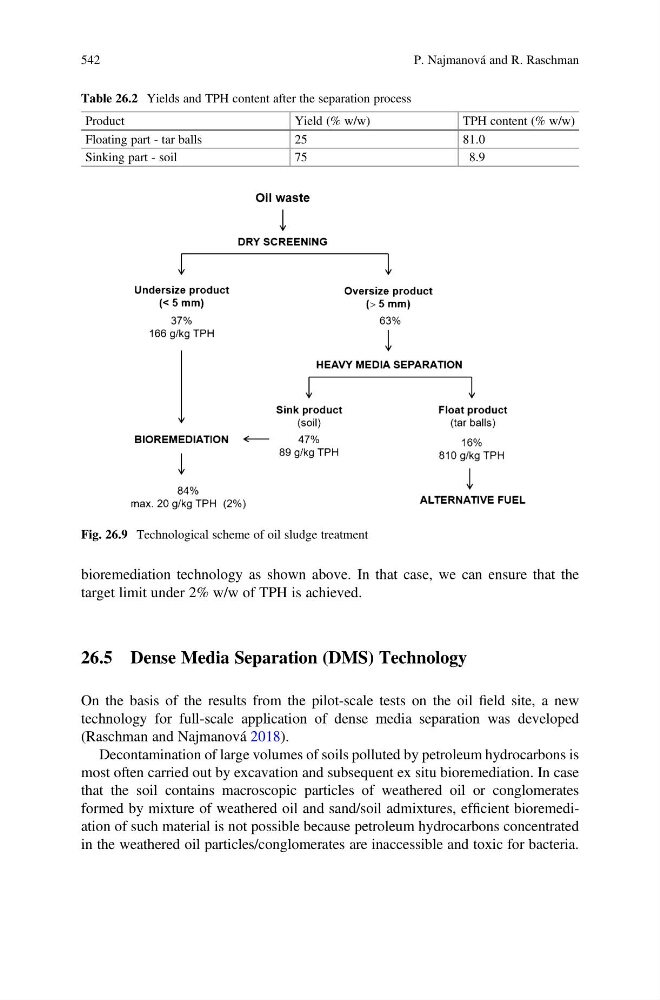
bioremediation technology as shown above. In that case, we can ensure that the
target limit under 2% w/w of TPH is achieved.
26.5 Dense Media Separation (DMS) Technology
On the basis of the results from the pilot-scale tests on the oil field site, a new
technology for full-scale application of dense media separation was developed
(Raschman and Najmanová 2018).
Decontamination of large volumes of soils polluted by petroleum hydrocarbons is
most often carried out by excavation and subsequent ex situ bioremediation. In case
that the soil contains macroscopic particles of weathered oil or conglomerates
formed by mixture of weathered oil and sand/soil admixtures, efficient bioremediation of such material is not possible because petroleum hydrocarbons concentrated
in the weathered oil particles/conglomerates are inaccessible and toxic for bacteria.
Table 26.2 Yields and TPH content after the separation process
Product
Yield (% w/w)
TPH content (% w/w)
Floating part - tar balls
25
81.0
Sinking part - soil
75
8.9
Fig. 26.9 Technological scheme of oil sludge treatment
542
P. Najmanová and R. Raschman
target limit under 2% w/w of TPH is achieved.
26.5 Dense Media Separation (DMS) Technology
On the basis of the results from the pilot-scale tests on the oil field site, a new
technology for full-scale application of dense media separation was developed
(Raschman and Najmanová 2018).
Decontamination of large volumes of soils polluted by petroleum hydrocarbons is
most often carried out by excavation and subsequent ex situ bioremediation. In case
that the soil contains macroscopic particles of weathered oil or conglomerates
formed by mixture of weathered oil and sand/soil admixtures, efficient bioremediation of such material is not possible because petroleum hydrocarbons concentrated
in the weathered oil particles/conglomerates are inaccessible and toxic for bacteria.
Table 26.2 Yields and TPH content after the separation process
Product
Yield (% w/w)
TPH content (% w/w)
Floating part - tar balls
25
81.0
Sinking part - soil
75
8.9
Fig. 26.9 Technological scheme of oil sludge treatment
542
P. Najmanová and R. Raschman