

Despite the promising efficiency of the bioremediation pilot-scale test (around
80%), the output concentrations (approx. 6–7 g/kg) were still very high and achieving the target limits (2% of TPH) would have been costly, even if possible. So the
alternative method of physical pretreatment followed by bioremediation was
suggested and performed on-site.
26.4 Pilot-Scale Test of Physical Pretreatment
As shown in Sect. 26.3.1, the biotechnological methods do not allow sufficient
decomposition of the soil parts with a high content of petroleum products and pieces
of pure bitumen. However, the contamination in oil sludge is usually spread out in a
heterogenic way so there are still some parts of the contaminated soil suitable for a
biodegradation process. The suggested technological process of physical
pretreatment was based on separating highly contaminated parts of sludge and soil
from parts with lower contamination. To remove these parts from the soil before
biodegradation, an original separation method was developed.
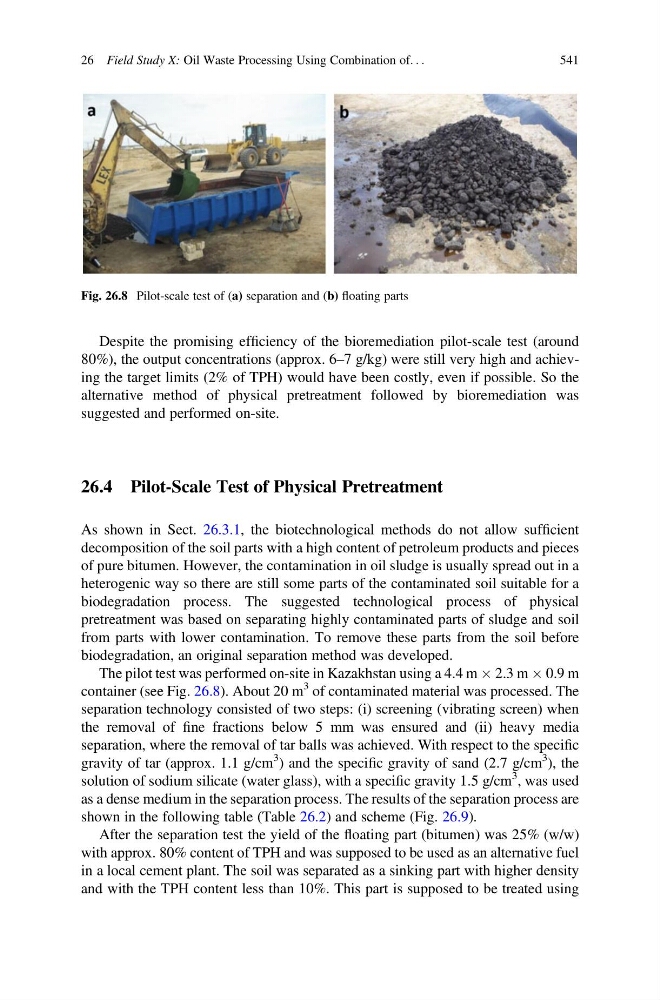
The pilot test was performed on-site in Kazakhstan using a 4.4 m  2.3 m  0.9 m
container (see Fig. 26.8). About 20 m
3 of contaminated material was processed. The
separation technology consisted of two steps: (i) screening (vibrating screen) when
the removal of fine fractions below 5 mm was ensured and (ii) heavy media
separation, where the removal of tar balls was achieved. With respect to the specific
gravity of tar (approx. 1.1 g/cm
3 ) and the specific gravity of sand (2.7 g/cm
3 ), the
solution of sodium silicate (water glass), with a specific gravity 1.5 g/cm
3 , was used
as a dense medium in the separation process. The results of the separation process are
shown in the following table (Table 26.2) and scheme (Fig. 26.9).
After the separation test the yield of the floating part (bitumen) was 25% (w/w)
with approx. 80% content of TPH and was supposed to be used as an alternative fuel
in a local cement plant. The soil was separated as a sinking part with higher density
and with the TPH content less than 10%. This part is supposed to be treated using
Fig. 26.8 Pilot-scale test of (a) separation and (b) floating parts
26 Field Study X: Oil Waste Processing Using Combination of. . .
541
80%), the output concentrations (approx. 6–7 g/kg) were still very high and achieving the target limits (2% of TPH) would have been costly, even if possible. So the
alternative method of physical pretreatment followed by bioremediation was
suggested and performed on-site.
26.4 Pilot-Scale Test of Physical Pretreatment
As shown in Sect. 26.3.1, the biotechnological methods do not allow sufficient
decomposition of the soil parts with a high content of petroleum products and pieces
of pure bitumen. However, the contamination in oil sludge is usually spread out in a
heterogenic way so there are still some parts of the contaminated soil suitable for a
biodegradation process. The suggested technological process of physical
pretreatment was based on separating highly contaminated parts of sludge and soil
from parts with lower contamination. To remove these parts from the soil before
biodegradation, an original separation method was developed.
The pilot test was performed on-site in Kazakhstan using a 4.4 m  2.3 m  0.9 m
container (see Fig. 26.8). About 20 m
3 of contaminated material was processed. The
separation technology consisted of two steps: (i) screening (vibrating screen) when
the removal of fine fractions below 5 mm was ensured and (ii) heavy media
separation, where the removal of tar balls was achieved. With respect to the specific
gravity of tar (approx. 1.1 g/cm
3 ) and the specific gravity of sand (2.7 g/cm
3 ), the
solution of sodium silicate (water glass), with a specific gravity 1.5 g/cm
3 , was used
as a dense medium in the separation process. The results of the separation process are
shown in the following table (Table 26.2) and scheme (Fig. 26.9).
After the separation test the yield of the floating part (bitumen) was 25% (w/w)
with approx. 80% content of TPH and was supposed to be used as an alternative fuel
in a local cement plant. The soil was separated as a sinking part with higher density
and with the TPH content less than 10%. This part is supposed to be treated using
Fig. 26.8 Pilot-scale test of (a) separation and (b) floating parts
26 Field Study X: Oil Waste Processing Using Combination of. . .
541