

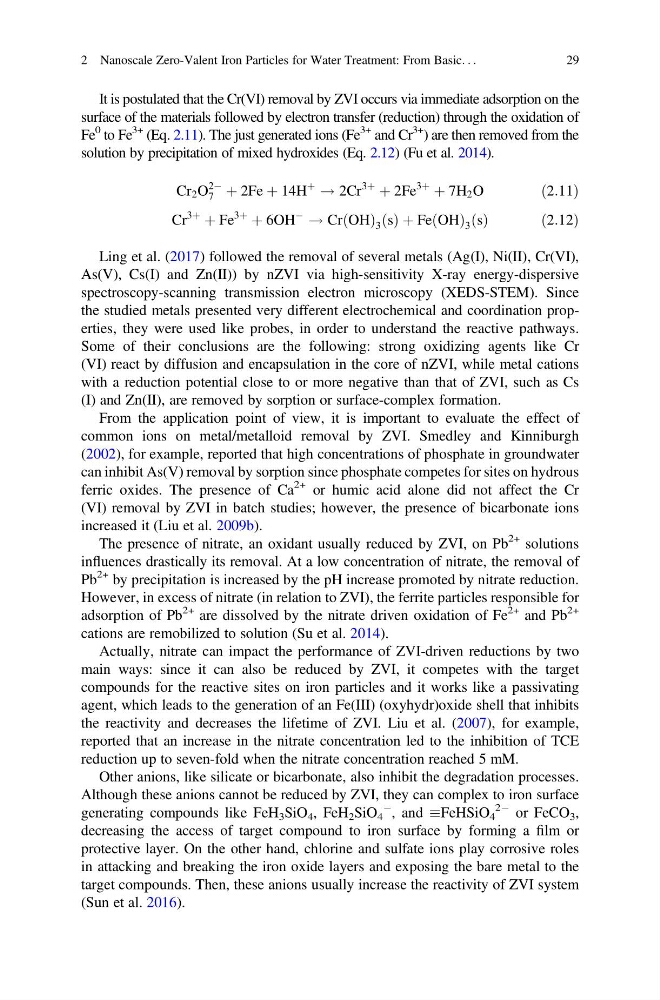
It is postulated that the Cr(VI) removal by ZVI occurs via immediate adsorption on the
surface of the materials followed by electron transfer (reduction) through the oxidation of
Fe
0 to Fe
3+ (Eq. 2.11). The just generated ions (Fe
3+ and Cr
3+
) are then removed from the
solution by precipitation of mixed hydroxides (Eq. 2.12) (Fu et al. 2014).
Cr 2 O
2À
7 þ 2Fe þ 14H
þ
! 2Cr
3þ
þ 2Fe
3þ
þ 7H 2 O
ð2:11Þ
Cr
3þ
þ Fe
3þ
þ 6OH
À
! Cr OH
ð Þ 3 s
ð Þ þ Fe OH
ð Þ 3 s
ð Þ
ð2:12Þ
Ling et al. (2017) followed the removal of several metals (Ag(I), Ni(II), Cr(VI),
As(V), Cs(I) and Zn(II)) by nZVI via high-sensitivity X-ray energy-dispersive
spectroscopy-scanning transmission electron microscopy (XEDS-STEM). Since
the studied metals presented very different electrochemical and coordination properties, they were used like probes, in order to understand the reactive pathways.
Some of their conclusions are the following: strong oxidizing agents like Cr
(VI) react by diffusion and encapsulation in the core of nZVI, while metal cations
with a reduction potential close to or more negative than that of ZVI, such as Cs
(I) and Zn(II), are removed by sorption or surface-complex formation.
From the application point of view, it is important to evaluate the effect of
common ions on metal/metalloid removal by ZVI. Smedley and Kinniburgh
(2002), for example, reported that high concentrations of phosphate in groundwater
can inhibit As(V) removal by sorption since phosphate competes for sites on hydrous
ferric oxides. The presence of Ca
2+ or humic acid alone did not affect the Cr
(VI) removal by ZVI in batch studies; however, the presence of bicarbonate ions
increased it (Liu et al. 2009b).
The presence of nitrate, an oxidant usually reduced by ZVI, on Pb
2+ solutions
influences drastically its removal. At a low concentration of nitrate, the removal of
Pb
2+ by precipitation is increased by the pH increase promoted by nitrate reduction.
However, in excess of nitrate (in relation to ZVI), the ferrite particles responsible for
adsorption of Pb
2+ are dissolved by the nitrate driven oxidation of Fe
2+ and Pb
2+
cations are remobilized to solution (Su et al. 2014).
Actually, nitrate can impact the performance of ZVI-driven reductions by two
main ways: since it can also be reduced by ZVI, it competes with the target
compounds for the reactive sites on iron particles and it works like a passivating
agent, which leads to the generation of an Fe(III) (oxyhydr)oxide shell that inhibits
the reactivity and decreases the lifetime of ZVI. Liu et al. (2007), for example,
reported that an increase in the nitrate concentration led to the inhibition of TCE
reduction up to seven-fold when the nitrate concentration reached 5 mM.
Other anions, like silicate or bicarbonate, also inhibit the degradation processes.
Although these anions cannot be reduced by ZVI, they can complex to iron surface
generating compounds like FeH 3 SiO 4 , FeH 2 SiO 4
À
, and FeHSiO 4
2À or FeCO 3 ,
decreasing the access of target compound to iron surface by forming a film or
protective layer. On the other hand, chlorine and sulfate ions play corrosive roles
in attacking and breaking the iron oxide layers and exposing the bare metal to the
target compounds. Then, these anions usually increase the reactivity of ZVI system
(Sun et al. 2016).
2 Nanoscale Zero-Valent Iron Particles for Water Treatment: From Basic. . .
29
surface of the materials followed by electron transfer (reduction) through the oxidation of
Fe
0 to Fe
3+ (Eq. 2.11). The just generated ions (Fe
3+ and Cr
3+
) are then removed from the
solution by precipitation of mixed hydroxides (Eq. 2.12) (Fu et al. 2014).
Cr 2 O
2À
7 þ 2Fe þ 14H
þ
! 2Cr
3þ
þ 2Fe
3þ
þ 7H 2 O
ð2:11Þ
Cr
3þ
þ Fe
3þ
þ 6OH
À
! Cr OH
ð Þ 3 s
ð Þ þ Fe OH
ð Þ 3 s
ð Þ
ð2:12Þ
Ling et al. (2017) followed the removal of several metals (Ag(I), Ni(II), Cr(VI),
As(V), Cs(I) and Zn(II)) by nZVI via high-sensitivity X-ray energy-dispersive
spectroscopy-scanning transmission electron microscopy (XEDS-STEM). Since
the studied metals presented very different electrochemical and coordination properties, they were used like probes, in order to understand the reactive pathways.
Some of their conclusions are the following: strong oxidizing agents like Cr
(VI) react by diffusion and encapsulation in the core of nZVI, while metal cations
with a reduction potential close to or more negative than that of ZVI, such as Cs
(I) and Zn(II), are removed by sorption or surface-complex formation.
From the application point of view, it is important to evaluate the effect of
common ions on metal/metalloid removal by ZVI. Smedley and Kinniburgh
(2002), for example, reported that high concentrations of phosphate in groundwater
can inhibit As(V) removal by sorption since phosphate competes for sites on hydrous
ferric oxides. The presence of Ca
2+ or humic acid alone did not affect the Cr
(VI) removal by ZVI in batch studies; however, the presence of bicarbonate ions
increased it (Liu et al. 2009b).
The presence of nitrate, an oxidant usually reduced by ZVI, on Pb
2+ solutions
influences drastically its removal. At a low concentration of nitrate, the removal of
Pb
2+ by precipitation is increased by the pH increase promoted by nitrate reduction.
However, in excess of nitrate (in relation to ZVI), the ferrite particles responsible for
adsorption of Pb
2+ are dissolved by the nitrate driven oxidation of Fe
2+ and Pb
2+
cations are remobilized to solution (Su et al. 2014).
Actually, nitrate can impact the performance of ZVI-driven reductions by two
main ways: since it can also be reduced by ZVI, it competes with the target
compounds for the reactive sites on iron particles and it works like a passivating
agent, which leads to the generation of an Fe(III) (oxyhydr)oxide shell that inhibits
the reactivity and decreases the lifetime of ZVI. Liu et al. (2007), for example,
reported that an increase in the nitrate concentration led to the inhibition of TCE
reduction up to seven-fold when the nitrate concentration reached 5 mM.
Other anions, like silicate or bicarbonate, also inhibit the degradation processes.
Although these anions cannot be reduced by ZVI, they can complex to iron surface
generating compounds like FeH 3 SiO 4 , FeH 2 SiO 4
À
, and FeHSiO 4
2À or FeCO 3 ,
decreasing the access of target compound to iron surface by forming a film or
protective layer. On the other hand, chlorine and sulfate ions play corrosive roles
in attacking and breaking the iron oxide layers and exposing the bare metal to the
target compounds. Then, these anions usually increase the reactivity of ZVI system
(Sun et al. 2016).
2 Nanoscale Zero-Valent Iron Particles for Water Treatment: From Basic. . .
29