

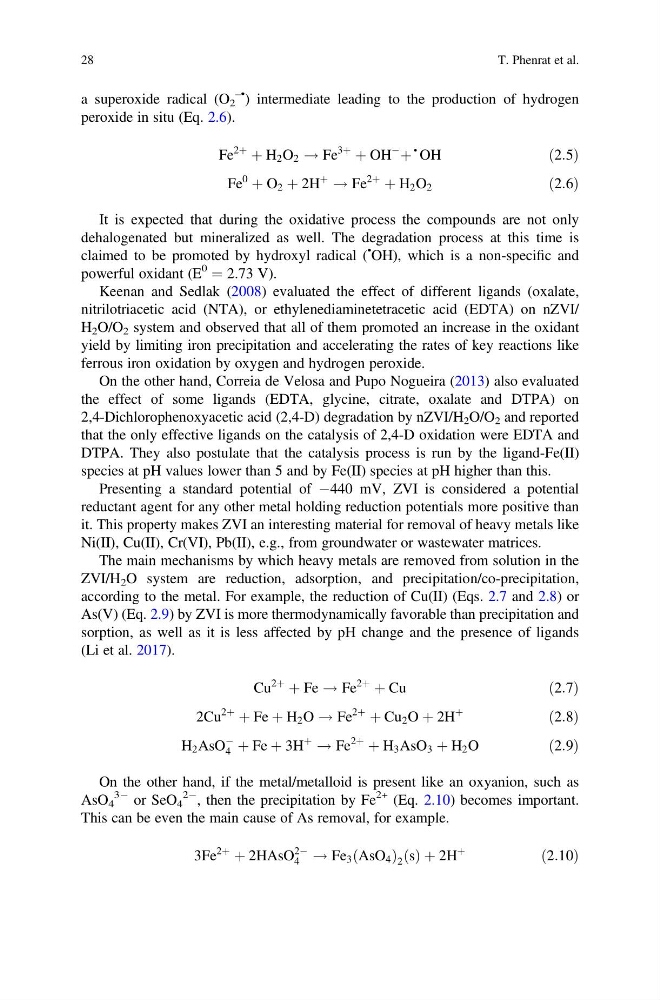
a superoxide radical (O 2
–• ) intermediate leading to the production of hydrogen
peroxide in situ (Eq. 2.6).
Fe
2þ
þ H 2 O 2 ! Fe
3þ
þ OH
À
þ
• OH
ð2:5Þ
Fe
0
þ O 2 þ 2H
þ
! Fe
2þ
þ H 2 O 2
ð2:6Þ
It is expected that during the oxidative process the compounds are not only
dehalogenated but mineralized as well. The degradation process at this time is
claimed to be promoted by hydroxyl radical (
• OH), which is a non-specific and
powerful oxidant (E
0
¼ 2.73 V).
Keenan and Sedlak (2008) evaluated the effect of different ligands (oxalate,
nitrilotriacetic acid (NTA), or ethylenediaminetetracetic acid (EDTA) on nZVI/
H 2 O/O 2 system and observed that all of them promoted an increase in the oxidant
yield by limiting iron precipitation and accelerating the rates of key reactions like
ferrous iron oxidation by oxygen and hydrogen peroxide.
On the other hand, Correia de Velosa and Pupo Nogueira (2013) also evaluated
the effect of some ligands (EDTA, glycine, citrate, oxalate and DTPA) on
2,4-Dichlorophenoxyacetic acid (2,4-D) degradation by nZVI/H 2 O/O 2 and reported
that the only effective ligands on the catalysis of 2,4-D oxidation were EDTA and
DTPA. They also postulate that the catalysis process is run by the ligand-Fe(II)
species at pH values lower than 5 and by Fe(II) species at pH higher than this.
Presenting a standard potential of À440 mV, ZVI is considered a potential
reductant agent for any other metal holding reduction potentials more positive than
it. This property makes ZVI an interesting material for removal of heavy metals like
Ni(II), Cu(II), Cr(VI), Pb(II), e.g., from groundwater or wastewater matrices.
The main mechanisms by which heavy metals are removed from solution in the
ZVI/H 2 O system are reduction, adsorption, and precipitation/co-precipitation,
according to the metal. For example, the reduction of Cu(II) (Eqs. 2.7 and 2.8) or
As(V) (Eq. 2.9) by ZVI is more thermodynamically favorable than precipitation and
sorption, as well as it is less affected by pH change and the presence of ligands
(Li et al. 2017).
Cu
2þ
þ Fe ! Fe
2þ
þ Cu
ð2:7Þ
2Cu
2þ
þ Fe þ H 2 O ! Fe
2þ
þ Cu 2 O þ 2H
þ
ð2:8Þ
H 2 AsO
À
4 þ Fe þ 3H
þ
! Fe
2þ
þ H 3 AsO 3 þ H 2 O
ð2:9Þ
On the other hand, if the metal/metalloid is present like an oxyanion, such as
AsO 4
3À or SeO 4
2À , then the precipitation by Fe
2+ (Eq. 2.10) becomes important.
This can be even the main cause of As removal, for example.
3Fe
2þ
þ 2HAsO
2À
4 ! Fe 3 AsO 4
ð
Þ 2 s
ð Þ þ 2H
þ
ð2:10Þ
28
T. Phenrat et al.
–• ) intermediate leading to the production of hydrogen
peroxide in situ (Eq. 2.6).
Fe
2þ
þ H 2 O 2 ! Fe
3þ
þ OH
À
þ
• OH
ð2:5Þ
Fe
0
þ O 2 þ 2H
þ
! Fe
2þ
þ H 2 O 2
ð2:6Þ
It is expected that during the oxidative process the compounds are not only
dehalogenated but mineralized as well. The degradation process at this time is
claimed to be promoted by hydroxyl radical (
• OH), which is a non-specific and
powerful oxidant (E
0
¼ 2.73 V).
Keenan and Sedlak (2008) evaluated the effect of different ligands (oxalate,
nitrilotriacetic acid (NTA), or ethylenediaminetetracetic acid (EDTA) on nZVI/
H 2 O/O 2 system and observed that all of them promoted an increase in the oxidant
yield by limiting iron precipitation and accelerating the rates of key reactions like
ferrous iron oxidation by oxygen and hydrogen peroxide.
On the other hand, Correia de Velosa and Pupo Nogueira (2013) also evaluated
the effect of some ligands (EDTA, glycine, citrate, oxalate and DTPA) on
2,4-Dichlorophenoxyacetic acid (2,4-D) degradation by nZVI/H 2 O/O 2 and reported
that the only effective ligands on the catalysis of 2,4-D oxidation were EDTA and
DTPA. They also postulate that the catalysis process is run by the ligand-Fe(II)
species at pH values lower than 5 and by Fe(II) species at pH higher than this.
Presenting a standard potential of À440 mV, ZVI is considered a potential
reductant agent for any other metal holding reduction potentials more positive than
it. This property makes ZVI an interesting material for removal of heavy metals like
Ni(II), Cu(II), Cr(VI), Pb(II), e.g., from groundwater or wastewater matrices.
The main mechanisms by which heavy metals are removed from solution in the
ZVI/H 2 O system are reduction, adsorption, and precipitation/co-precipitation,
according to the metal. For example, the reduction of Cu(II) (Eqs. 2.7 and 2.8) or
As(V) (Eq. 2.9) by ZVI is more thermodynamically favorable than precipitation and
sorption, as well as it is less affected by pH change and the presence of ligands
(Li et al. 2017).
Cu
2þ
þ Fe ! Fe
2þ
þ Cu
ð2:7Þ
2Cu
2þ
þ Fe þ H 2 O ! Fe
2þ
þ Cu 2 O þ 2H
þ
ð2:8Þ
H 2 AsO
À
4 þ Fe þ 3H
þ
! Fe
2þ
þ H 3 AsO 3 þ H 2 O
ð2:9Þ
On the other hand, if the metal/metalloid is present like an oxyanion, such as
AsO 4
3À or SeO 4
2À , then the precipitation by Fe
2+ (Eq. 2.10) becomes important.
This can be even the main cause of As removal, for example.
3Fe
2þ
þ 2HAsO
2À
4 ! Fe 3 AsO 4
ð
Þ 2 s
ð Þ þ 2H
þ
ð2:10Þ
28
T. Phenrat et al.