

decontamination of soil and sludge; however, it may be used also in the case of other
materials that may be colonized by microorganisms, such as railway sleepers
(Covino et al. 2016). Nonetheless, the co-composting process is not suitable for
inert materials, such as construction waste. The following paragraphs deal with the
typical contaminants degradable during the co-composting process, together with
references to the selected documents dealing with co-composting of these
substances.
23.3.3.2 Substances of Petroleum Origin
Soil contamination by petroleum substances is often removed by different bioremediation methods than co-composting because petroleum substances may be removed
by simpler and cheaper methods frequently. Thus, the co-composting process
particularly finds its use in the cases when utilization of standard biodegradation
methods is insufficient, for example, because of excess input concentrations of the
contaminants, unsuitably contaminated matrix, or the presence of heavy petroleum
fractions. It is often used, for example, in the case of petroleum sludge with high
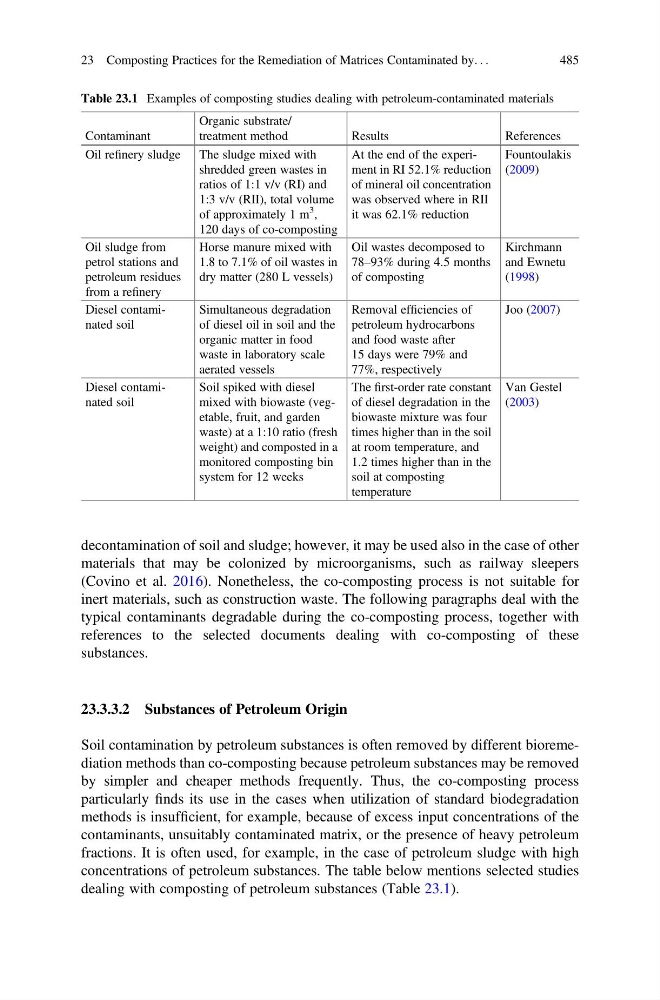
concentrations of petroleum substances. The table below mentions selected studies
dealing with composting of petroleum substances (Table 23.1).
Table 23.1 Examples of composting studies dealing with petroleum-contaminated materials
Contaminant
Organic substrate/
treatment method
Results
References
Oil refinery sludge The sludge mixed with
shredded green wastes in
ratios of 1:1 v/v (RI) and
1:3 v/v (RII), total volume
of approximately 1 m
3
,
120 days of co-composting
At the end of the experiment in RI 52.1% reduction
of mineral oil concentration
was observed where in RII
it was 62.1% reduction
Fountoulakis
(2009)
Oil sludge from
petrol stations and
petroleum residues
from a refinery
Horse manure mixed with
1.8 to 7.1% of oil wastes in
dry matter (280 L vessels)
Oil wastes decomposed to
78–93% during 4.5 months
of composting
Kirchmann
and Ewnetu
(1998)
Diesel contaminated soil
Simultaneous degradation
of diesel oil in soil and the
organic matter in food
waste in laboratory scale
aerated vessels
Removal efficiencies of
petroleum hydrocarbons
and food waste after
15 days were 79% and
77%, respectively
Joo (2007)
Diesel contaminated soil
Soil spiked with diesel
mixed with biowaste (vegetable, fruit, and garden
waste) at a 1:10 ratio (fresh
weight) and composted in a
monitored composting bin
system for 12 weeks
The first-order rate constant
of diesel degradation in the
biowaste mixture was four
times higher than in the soil
at room temperature, and
1.2 times higher than in the
soil at composting
temperature
Van Gestel
(2003)
23 Composting Practices for the Remediation of Matrices Contaminated by. . .
485
materials that may be colonized by microorganisms, such as railway sleepers
(Covino et al. 2016). Nonetheless, the co-composting process is not suitable for
inert materials, such as construction waste. The following paragraphs deal with the
typical contaminants degradable during the co-composting process, together with
references to the selected documents dealing with co-composting of these
substances.
23.3.3.2 Substances of Petroleum Origin
Soil contamination by petroleum substances is often removed by different bioremediation methods than co-composting because petroleum substances may be removed
by simpler and cheaper methods frequently. Thus, the co-composting process
particularly finds its use in the cases when utilization of standard biodegradation
methods is insufficient, for example, because of excess input concentrations of the
contaminants, unsuitably contaminated matrix, or the presence of heavy petroleum
fractions. It is often used, for example, in the case of petroleum sludge with high
concentrations of petroleum substances. The table below mentions selected studies
dealing with composting of petroleum substances (Table 23.1).
Table 23.1 Examples of composting studies dealing with petroleum-contaminated materials
Contaminant
Organic substrate/
treatment method
Results
References
Oil refinery sludge The sludge mixed with
shredded green wastes in
ratios of 1:1 v/v (RI) and
1:3 v/v (RII), total volume
of approximately 1 m
3
,
120 days of co-composting
At the end of the experiment in RI 52.1% reduction
of mineral oil concentration
was observed where in RII
it was 62.1% reduction
Fountoulakis
(2009)
Oil sludge from
petrol stations and
petroleum residues
from a refinery
Horse manure mixed with
1.8 to 7.1% of oil wastes in
dry matter (280 L vessels)
Oil wastes decomposed to
78–93% during 4.5 months
of composting
Kirchmann
and Ewnetu
(1998)
Diesel contaminated soil
Simultaneous degradation
of diesel oil in soil and the
organic matter in food
waste in laboratory scale
aerated vessels
Removal efficiencies of
petroleum hydrocarbons
and food waste after
15 days were 79% and
77%, respectively
Joo (2007)
Diesel contaminated soil
Soil spiked with diesel
mixed with biowaste (vegetable, fruit, and garden
waste) at a 1:10 ratio (fresh
weight) and composted in a
monitored composting bin
system for 12 weeks
The first-order rate constant
of diesel degradation in the
biowaste mixture was four
times higher than in the soil
at room temperature, and
1.2 times higher than in the
soil at composting
temperature
Van Gestel
(2003)
23 Composting Practices for the Remediation of Matrices Contaminated by. . .
485