

There are further uncertainties concerning the fact whether the degradation of
organic contaminants occurs more thanks to the presence of specific degradation
microorganisms or the presence of complex microbial communities (Peng et al.
2013). In order to optimize the utilization of the co-composting process in practice, it
will be necessary to verify, in the future, what the relations of the individual
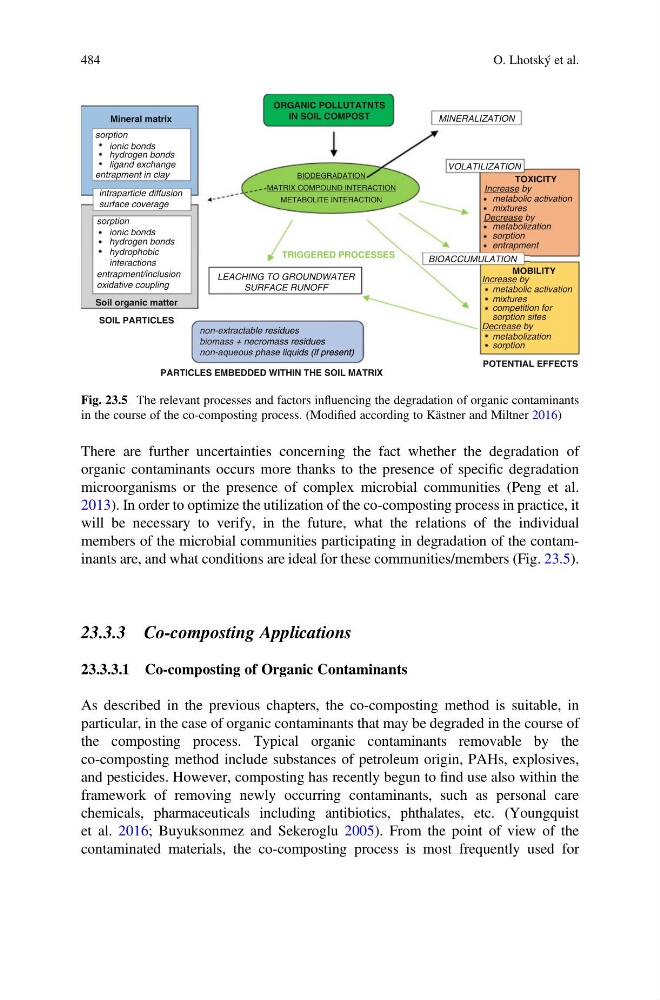
members of the microbial communities participating in degradation of the contaminants are, and what conditions are ideal for these communities/members (Fig. 23.5).
23.3.3 Co-composting Applications
23.3.3.1 Co-composting of Organic Contaminants
As described in the previous chapters, the co-composting method is suitable, in
particular, in the case of organic contaminants that may be degraded in the course of
the composting process. Typical organic contaminants removable by the
co-composting method include substances of petroleum origin, PAHs, explosives,
and pesticides. However, composting has recently begun to find use also within the
framework of removing newly occurring contaminants, such as personal care
chemicals, pharmaceuticals including antibiotics, phthalates, etc. (Youngquist
et al. 2016; Buyuksonmez and Sekeroglu 2005). From the point of view of the
contaminated materials, the co-composting process is most frequently used for
ORGANIC POLLUTATNTS
IN SOIL COMPOST
Mineral matrix
sorption
sorption
ionic bonds
ionic bonds
hydrogen bonds
hydrogen bonds
ligand exchange
entrapment in clay
intraparticle diffusion
surface coverage
hydrophobic
interactions
entrapment/inclusion
oxidative coupling
Soil organic matter
LEACHING TO GROUNDWATER
SURFACE RUNOFF
non-extractable residues
biomass + necromass residues
non-aqueous phase liquids (if present)
MINERALIZATION
VOLATILIZATION
TOXICITY
Increase by
Increase by
Decrease by
Decrease by
metabolic activation
metabolic activation
mixtures
mixtures
metabolization
metabolization
sorption
sorption
entrapment
BIOACCUMULATION
MOBILITY
competition for
sorption sites
POTENTIAL EFFECTS
SOIL PARTICLES
PARTICLES EMBEDDED WITHIN THE SOIL MATRIX
BIODEGRADATION
MATRIX COMPOUND INTERACTION
METABOLITE INTERACTION
TRIGGERED PROCESSES
Fig. 23.5 The relevant processes and factors influencing the degradation of organic contaminants
in the course of the co-composting process. (Modified according to Kästner and Miltner 2016)
484
O. Lhotský et al.
organic contaminants occurs more thanks to the presence of specific degradation
microorganisms or the presence of complex microbial communities (Peng et al.
2013). In order to optimize the utilization of the co-composting process in practice, it
will be necessary to verify, in the future, what the relations of the individual
members of the microbial communities participating in degradation of the contaminants are, and what conditions are ideal for these communities/members (Fig. 23.5).
23.3.3 Co-composting Applications
23.3.3.1 Co-composting of Organic Contaminants
As described in the previous chapters, the co-composting method is suitable, in
particular, in the case of organic contaminants that may be degraded in the course of
the composting process. Typical organic contaminants removable by the
co-composting method include substances of petroleum origin, PAHs, explosives,
and pesticides. However, composting has recently begun to find use also within the
framework of removing newly occurring contaminants, such as personal care
chemicals, pharmaceuticals including antibiotics, phthalates, etc. (Youngquist
et al. 2016; Buyuksonmez and Sekeroglu 2005). From the point of view of the
contaminated materials, the co-composting process is most frequently used for
ORGANIC POLLUTATNTS
IN SOIL COMPOST
Mineral matrix
sorption
sorption
ionic bonds
ionic bonds
hydrogen bonds
hydrogen bonds
ligand exchange
entrapment in clay
intraparticle diffusion
surface coverage
hydrophobic
interactions
entrapment/inclusion
oxidative coupling
Soil organic matter
LEACHING TO GROUNDWATER
SURFACE RUNOFF
non-extractable residues
biomass + necromass residues
non-aqueous phase liquids (if present)
MINERALIZATION
VOLATILIZATION
TOXICITY
Increase by
Increase by
Decrease by
Decrease by
metabolic activation
metabolic activation
mixtures
mixtures
metabolization
metabolization
sorption
sorption
entrapment
BIOACCUMULATION
MOBILITY
competition for
sorption sites
POTENTIAL EFFECTS
SOIL PARTICLES
PARTICLES EMBEDDED WITHIN THE SOIL MATRIX
BIODEGRADATION
MATRIX COMPOUND INTERACTION
METABOLITE INTERACTION
TRIGGERED PROCESSES
Fig. 23.5 The relevant processes and factors influencing the degradation of organic contaminants
in the course of the co-composting process. (Modified according to Kästner and Miltner 2016)
484
O. Lhotský et al.