

23.2.1 Outline of the Composting Process
Composting is a biowaste management option used worldwide. Solid organic
materials of agricultural, industrial, or municipal origin are transformed through
composting into a stable, highly humified material that improves soil fertility and
structure. The conversion of untreated (raw) wastes (starting material or substrate)
into a stable material is carried out for the most part by aerobic microorganisms
(active biomass), namely bacteria and fungi. Overall, composting is a result of the
co-occurrence of mineralization and humification processes. The former is highest in
the early phases (although it continues until full compost maturity, see below) and it
gives rise to by-products such as water and carbon dioxide, while the latter happens
chiefly in the mid–late stages and results in the formation of organic complexes rich
in humic and fulvic acids. Moreover, as bio-oxidative reactions at expenses of the
substrate are exothermic, the activity of microorganisms generates heat, thus
influencing the temperature levels being attained within the compost mixture. The
simplified scheme reported below can be used to sum up the inputs and outputs of
the composting process:
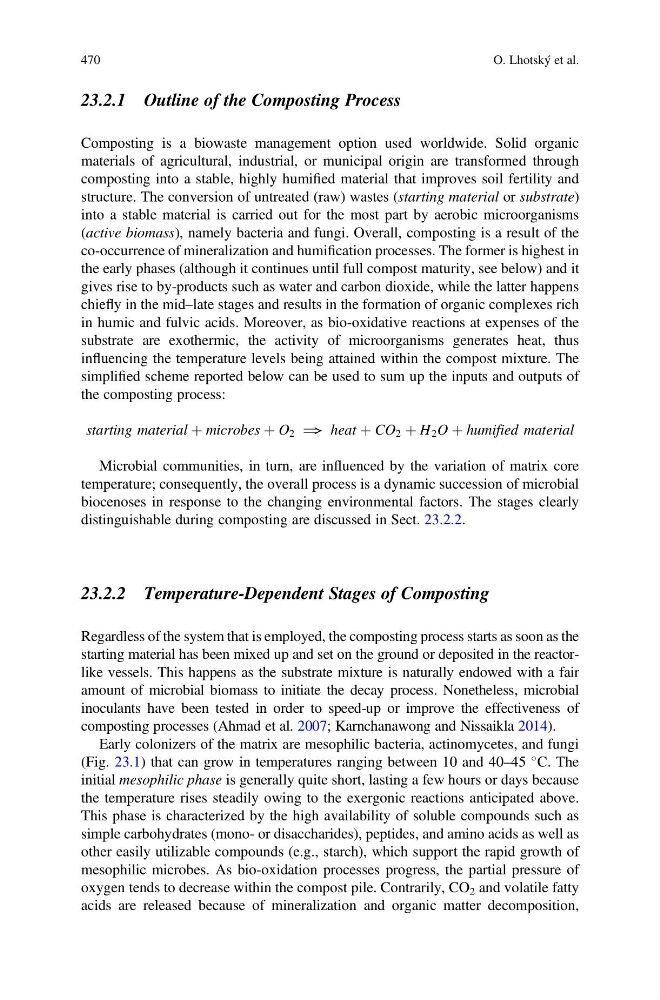
starting material þ microbes þ O 2 ⟹ heat þ CO 2 þ H 2 O þ humified material
Microbial communities, in turn, are influenced by the variation of matrix core
temperature; consequently, the overall process is a dynamic succession of microbial
biocenoses in response to the changing environmental factors. The stages clearly
distinguishable during composting are discussed in Sect. 23.2.2.
23.2.2 Temperature-Dependent Stages of Composting
Regardless of the system that is employed, the composting process starts as soon as the
starting material has been mixed up and set on the ground or deposited in the reactorlike vessels. This happens as the substrate mixture is naturally endowed with a fair
amount of microbial biomass to initiate the decay process. Nonetheless, microbial
inoculants have been tested in order to speed-up or improve the effectiveness of
composting processes (Ahmad et al. 2007; Karnchanawong and Nissaikla 2014).
Early colonizers of the matrix are mesophilic bacteria, actinomycetes, and fungi
(Fig. 23.1) that can grow in temperatures ranging between 10 and 40–45
C. The
initial mesophilic phase is generally quite short, lasting a few hours or days because
the temperature rises steadily owing to the exergonic reactions anticipated above.
This phase is characterized by the high availability of soluble compounds such as
simple carbohydrates (mono- or disaccharides), peptides, and amino acids as well as
other easily utilizable compounds (e.g., starch), which support the rapid growth of
mesophilic microbes. As bio-oxidation processes progress, the partial pressure of
oxygen tends to decrease within the compost pile. Contrarily, CO 2 and volatile fatty
acids are released because of mineralization and organic matter decomposition,
470
O. Lhotský et al.
Composting is a biowaste management option used worldwide. Solid organic
materials of agricultural, industrial, or municipal origin are transformed through
composting into a stable, highly humified material that improves soil fertility and
structure. The conversion of untreated (raw) wastes (starting material or substrate)
into a stable material is carried out for the most part by aerobic microorganisms
(active biomass), namely bacteria and fungi. Overall, composting is a result of the
co-occurrence of mineralization and humification processes. The former is highest in
the early phases (although it continues until full compost maturity, see below) and it
gives rise to by-products such as water and carbon dioxide, while the latter happens
chiefly in the mid–late stages and results in the formation of organic complexes rich
in humic and fulvic acids. Moreover, as bio-oxidative reactions at expenses of the
substrate are exothermic, the activity of microorganisms generates heat, thus
influencing the temperature levels being attained within the compost mixture. The
simplified scheme reported below can be used to sum up the inputs and outputs of
the composting process:
starting material þ microbes þ O 2 ⟹ heat þ CO 2 þ H 2 O þ humified material
Microbial communities, in turn, are influenced by the variation of matrix core
temperature; consequently, the overall process is a dynamic succession of microbial
biocenoses in response to the changing environmental factors. The stages clearly
distinguishable during composting are discussed in Sect. 23.2.2.
23.2.2 Temperature-Dependent Stages of Composting
Regardless of the system that is employed, the composting process starts as soon as the
starting material has been mixed up and set on the ground or deposited in the reactorlike vessels. This happens as the substrate mixture is naturally endowed with a fair
amount of microbial biomass to initiate the decay process. Nonetheless, microbial
inoculants have been tested in order to speed-up or improve the effectiveness of
composting processes (Ahmad et al. 2007; Karnchanawong and Nissaikla 2014).
Early colonizers of the matrix are mesophilic bacteria, actinomycetes, and fungi
(Fig. 23.1) that can grow in temperatures ranging between 10 and 40–45
C. The
initial mesophilic phase is generally quite short, lasting a few hours or days because
the temperature rises steadily owing to the exergonic reactions anticipated above.
This phase is characterized by the high availability of soluble compounds such as
simple carbohydrates (mono- or disaccharides), peptides, and amino acids as well as
other easily utilizable compounds (e.g., starch), which support the rapid growth of
mesophilic microbes. As bio-oxidation processes progress, the partial pressure of
oxygen tends to decrease within the compost pile. Contrarily, CO 2 and volatile fatty
acids are released because of mineralization and organic matter decomposition,
470
O. Lhotský et al.