

Other inorganic parameters were determined after several preparation steps in a
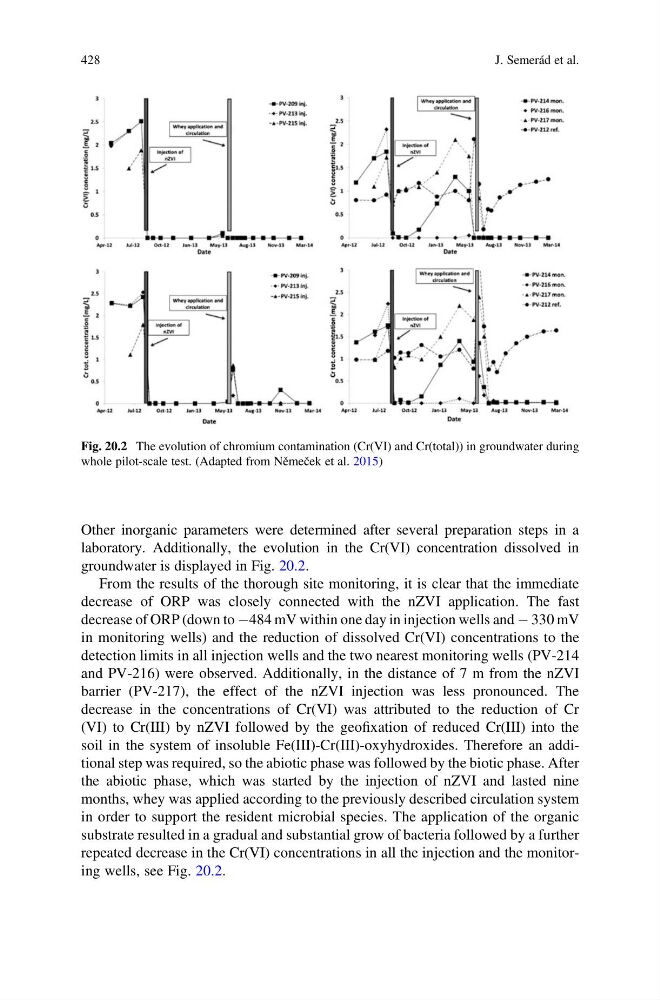
laboratory. Additionally, the evolution in the Cr(VI) concentration dissolved in
groundwater is displayed in Fig. 20.2.
From the results of the thorough site monitoring, it is clear that the immediate
decrease of ORP was closely connected with the nZVI application. The fast
decrease of ORP (down to À484 mV within one day in injection wells and À 330 mV
in monitoring wells) and the reduction of dissolved Cr(VI) concentrations to the
detection limits in all injection wells and the two nearest monitoring wells (PV-214
and PV-216) were observed. Additionally, in the distance of 7 m from the nZVI
barrier (PV-217), the effect of the nZVI injection was less pronounced. The
decrease in the concentrations of Cr(VI) was attributed to the reduction of Cr
(VI) to Cr(III) by nZVI followed by the geofixation of reduced Cr(III) into the
soil in the system of insoluble Fe(III)-Cr(III)-oxyhydroxides. Therefore an additional step was required, so the abiotic phase was followed by the biotic phase. After
the abiotic phase, which was started by the injection of nZVI and lasted nine
months, whey was applied according to the previously described circulation system
in order to support the resident microbial species. The application of the organic
substrate resulted in a gradual and substantial grow of bacteria followed by a further
repeated decrease in the Cr(VI) concentrations in all the injection and the monitoring wells, see Fig. 20.2.
Fig. 20.2 The evolution of chromium contamination (Cr(VI) and Cr(total)) in groundwater during
whole pilot-scale test. (Adapted from Němeček et al. 2015)
428
J. Semerád et al.
laboratory. Additionally, the evolution in the Cr(VI) concentration dissolved in
groundwater is displayed in Fig. 20.2.
From the results of the thorough site monitoring, it is clear that the immediate
decrease of ORP was closely connected with the nZVI application. The fast
decrease of ORP (down to À484 mV within one day in injection wells and À 330 mV
in monitoring wells) and the reduction of dissolved Cr(VI) concentrations to the
detection limits in all injection wells and the two nearest monitoring wells (PV-214
and PV-216) were observed. Additionally, in the distance of 7 m from the nZVI
barrier (PV-217), the effect of the nZVI injection was less pronounced. The
decrease in the concentrations of Cr(VI) was attributed to the reduction of Cr
(VI) to Cr(III) by nZVI followed by the geofixation of reduced Cr(III) into the
soil in the system of insoluble Fe(III)-Cr(III)-oxyhydroxides. Therefore an additional step was required, so the abiotic phase was followed by the biotic phase. After
the abiotic phase, which was started by the injection of nZVI and lasted nine
months, whey was applied according to the previously described circulation system
in order to support the resident microbial species. The application of the organic
substrate resulted in a gradual and substantial grow of bacteria followed by a further
repeated decrease in the Cr(VI) concentrations in all the injection and the monitoring wells, see Fig. 20.2.
Fig. 20.2 The evolution of chromium contamination (Cr(VI) and Cr(total)) in groundwater during
whole pilot-scale test. (Adapted from Němeček et al. 2015)
428
J. Semerád et al.