

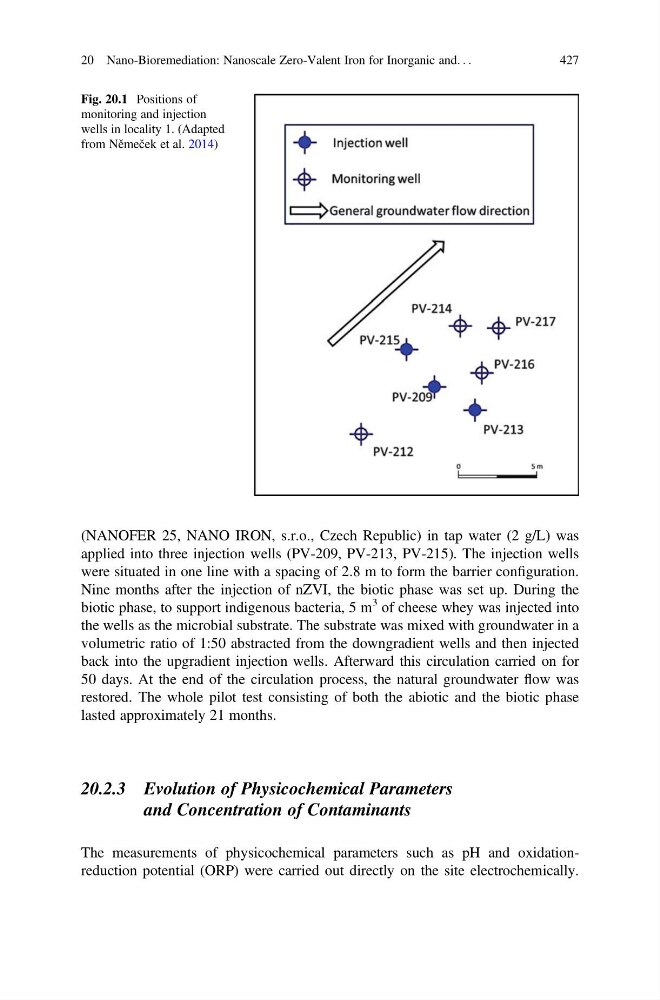
(NANOFER 25, NANO IRON, s.r.o., Czech Republic) in tap water (2 g/L) was
applied into three injection wells (PV-209, PV-213, PV-215). The injection wells
were situated in one line with a spacing of 2.8 m to form the barrier configuration.
Nine months after the injection of nZVI, the biotic phase was set up. During the
biotic phase, to support indigenous bacteria, 5 m
3 of cheese whey was injected into
the wells as the microbial substrate. The substrate was mixed with groundwater in a
volumetric ratio of 1:50 abstracted from the downgradient wells and then injected
back into the upgradient injection wells. Afterward this circulation carried on for
50 days. At the end of the circulation process, the natural groundwater flow was
restored. The whole pilot test consisting of both the abiotic and the biotic phase
lasted approximately 21 months.
20.2.3 Evolution of Physicochemical Parameters
and Concentration of Contaminants
The measurements of physicochemical parameters such as pH and oxidationreduction potential (ORP) were carried out directly on the site electrochemically.
Fig. 20.1 Positions of
monitoring and injection
wells in locality 1. (Adapted
from Němeček et al. 2014)
20 Nano-Bioremediation: Nanoscale Zero-Valent Iron for Inorganic and. . .
427
applied into three injection wells (PV-209, PV-213, PV-215). The injection wells
were situated in one line with a spacing of 2.8 m to form the barrier configuration.
Nine months after the injection of nZVI, the biotic phase was set up. During the
biotic phase, to support indigenous bacteria, 5 m
3 of cheese whey was injected into
the wells as the microbial substrate. The substrate was mixed with groundwater in a
volumetric ratio of 1:50 abstracted from the downgradient wells and then injected
back into the upgradient injection wells. Afterward this circulation carried on for
50 days. At the end of the circulation process, the natural groundwater flow was
restored. The whole pilot test consisting of both the abiotic and the biotic phase
lasted approximately 21 months.
20.2.3 Evolution of Physicochemical Parameters
and Concentration of Contaminants
The measurements of physicochemical parameters such as pH and oxidationreduction potential (ORP) were carried out directly on the site electrochemically.
Fig. 20.1 Positions of
monitoring and injection
wells in locality 1. (Adapted
from Němeček et al. 2014)
20 Nano-Bioremediation: Nanoscale Zero-Valent Iron for Inorganic and. . .
427