

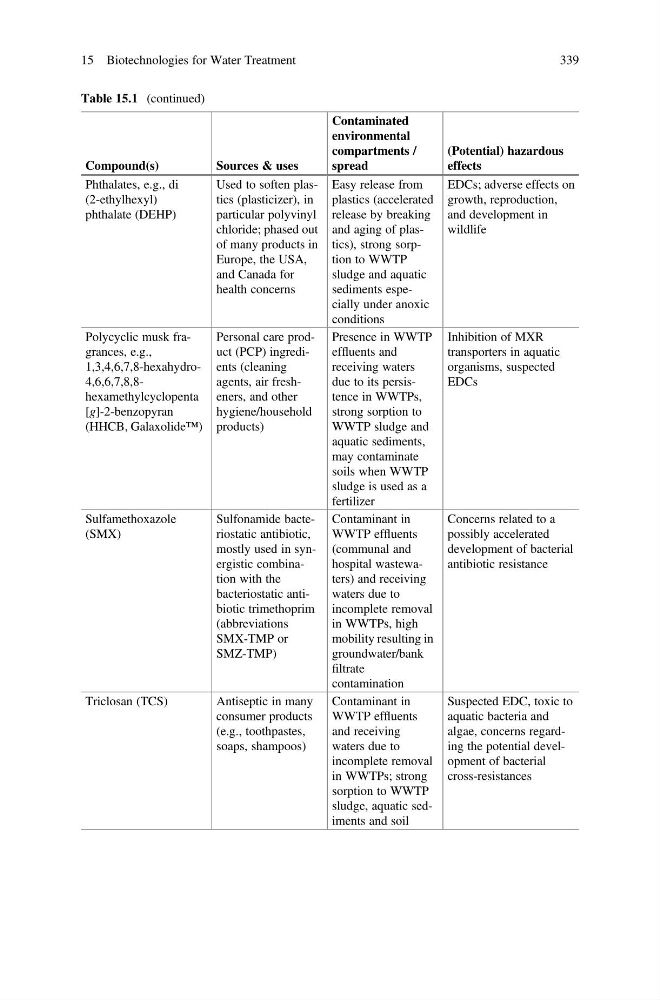
Table 15.1 (continued)
Compound(s)
Sources & uses
Contaminated
environmental
compartments /
spread
(Potential) hazardous
effects
Phthalates, e.g., di
(2-ethylhexyl)
phthalate (DEHP)
Used to soften plastics (plasticizer), in
particular polyvinyl
chloride; phased out
of many products in
Europe, the USA,
and Canada for
health concerns
Easy release from
plastics (accelerated
release by breaking
and aging of plastics), strong sorption to WWTP
sludge and aquatic
sediments especially under anoxic
conditions
EDCs; adverse effects on
growth, reproduction,
and development in
wildlife
Polycyclic musk fragrances, e.g.,
4,6,6,7,8,8hexamethylcyclopenta
[g]-2-benzopyran
(HHCB, Galaxolide™)
Personal care product (PCP) ingredients (cleaning
agents, air fresheners, and other
hygiene/household
products)
Presence in WWTP
effluents and
receiving waters
due to its persistence in WWTPs,
strong sorption to
WWTP sludge and
aquatic sediments,
may contaminate
soils when WWTP
sludge is used as a
fertilizer
Inhibition of MXR
transporters in aquatic
organisms, suspected
EDCs
Sulfamethoxazole
(SMX)
Sulfonamide bacteriostatic antibiotic,
mostly used in synergistic combination with the
bacteriostatic antibiotic trimethoprim
(abbreviations
SMX-TMP or
SMZ-TMP)
Contaminant in
WWTP effluents
(communal and
hospital wastewaters) and receiving
waters due to
incomplete removal
in WWTPs, high
mobility resulting in
groundwater/bank
filtrate
contamination
Concerns related to a
possibly accelerated
development of bacterial
antibiotic resistance
Triclosan (TCS)
Antiseptic in many
consumer products
(e.g., toothpastes,
soaps, shampoos)
Contaminant in
WWTP effluents
and receiving
waters due to
incomplete removal
in WWTPs; strong
sorption to WWTP
sludge, aquatic sediments and soil
Suspected EDC, toxic to
aquatic bacteria and
algae, concerns regarding the potential development of bacterial
cross-resistances
15 Biotechnologies for Water Treatment
339
Compound(s)
Sources & uses
Contaminated
environmental
compartments /
spread
(Potential) hazardous
effects
Phthalates, e.g., di
(2-ethylhexyl)
phthalate (DEHP)
Used to soften plastics (plasticizer), in
particular polyvinyl
chloride; phased out
of many products in
Europe, the USA,
and Canada for
health concerns
Easy release from
plastics (accelerated
release by breaking
and aging of plastics), strong sorption to WWTP
sludge and aquatic
sediments especially under anoxic
conditions
EDCs; adverse effects on
growth, reproduction,
and development in
wildlife
Polycyclic musk fragrances, e.g.,
4,6,6,7,8,8hexamethylcyclopenta
[g]-2-benzopyran
(HHCB, Galaxolide™)
Personal care product (PCP) ingredients (cleaning
agents, air fresheners, and other
hygiene/household
products)
Presence in WWTP
effluents and
receiving waters
due to its persistence in WWTPs,
strong sorption to
WWTP sludge and
aquatic sediments,
may contaminate
soils when WWTP
sludge is used as a
fertilizer
Inhibition of MXR
transporters in aquatic
organisms, suspected
EDCs
Sulfamethoxazole
(SMX)
Sulfonamide bacteriostatic antibiotic,
mostly used in synergistic combination with the
bacteriostatic antibiotic trimethoprim
(abbreviations
SMX-TMP or
SMZ-TMP)
Contaminant in
WWTP effluents
(communal and
hospital wastewaters) and receiving
waters due to
incomplete removal
in WWTPs, high
mobility resulting in
groundwater/bank
filtrate
contamination
Concerns related to a
possibly accelerated
development of bacterial
antibiotic resistance
Triclosan (TCS)
Antiseptic in many
consumer products
(e.g., toothpastes,
soaps, shampoos)
Contaminant in
WWTP effluents
and receiving
waters due to
incomplete removal
in WWTPs; strong
sorption to WWTP
sludge, aquatic sediments and soil
Suspected EDC, toxic to
aquatic bacteria and
algae, concerns regarding the potential development of bacterial
cross-resistances
15 Biotechnologies for Water Treatment
339