

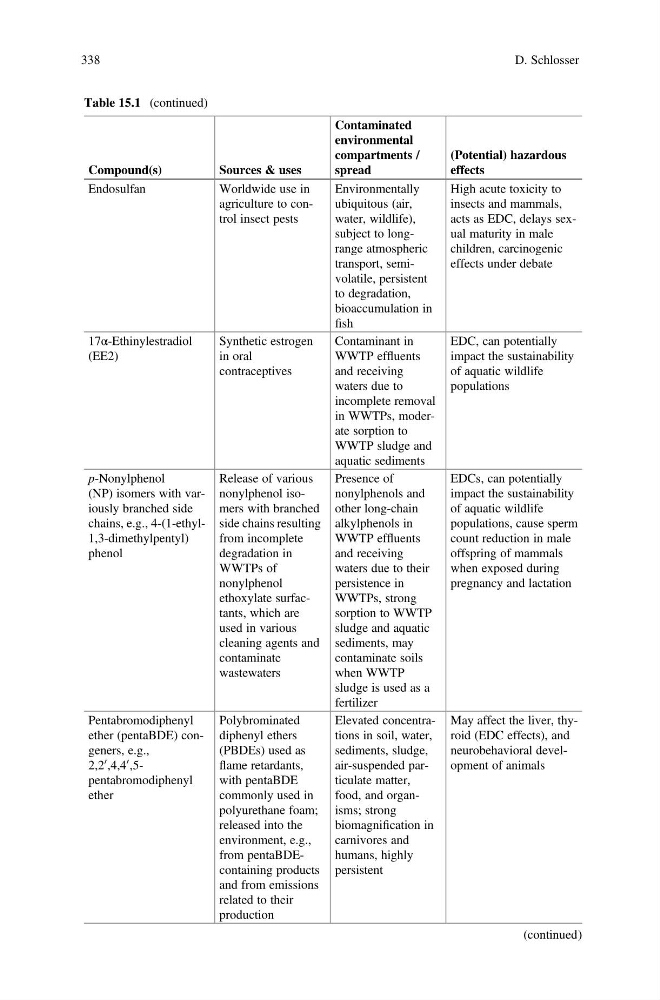
Table 15.1 (continued)
Compound(s)
Sources & uses
Contaminated
environmental
compartments /
spread
(Potential) hazardous
effects
Endosulfan
Worldwide use in
agriculture to control insect pests
Environmentally
ubiquitous (air,
water, wildlife),
subject to longrange atmospheric
transport, semivolatile, persistent
to degradation,
bioaccumulation in
fish
High acute toxicity to
insects and mammals,
acts as EDC, delays sexual maturity in male
children, carcinogenic
effects under debate
17α-Ethinylestradiol
(EE2)
Synthetic estrogen
in oral
contraceptives
Contaminant in
WWTP effluents
and receiving
waters due to
incomplete removal
in WWTPs, moderate sorption to
WWTP sludge and
aquatic sediments
EDC, can potentially
impact the sustainability
of aquatic wildlife
populations
p-Nonylphenol
(NP) isomers with variously branched side
chains, e.g., 4-(1-ethyl1,3-dimethylpentyl)
phenol
Release of various
nonylphenol isomers with branched
side chains resulting
from incomplete
degradation in
WWTPs of
nonylphenol
ethoxylate surfactants, which are
used in various
cleaning agents and
contaminate
wastewaters
Presence of
nonylphenols and
other long-chain
alkylphenols in
WWTP effluents
and receiving
waters due to their
persistence in
WWTPs, strong
sorption to WWTP
sludge and aquatic
sediments, may
contaminate soils
when WWTP
sludge is used as a
fertilizer
EDCs, can potentially
impact the sustainability
of aquatic wildlife
populations, cause sperm
count reduction in male
offspring of mammals
when exposed during
pregnancy and lactation
Pentabromodiphenyl
ether (pentaBDE) congeners, e.g.,
2,2
0 ,4,4
0 ,5pentabromodiphenyl
ether
Polybrominated
diphenyl ethers
(PBDEs) used as
flame retardants,
with pentaBDE
commonly used in
polyurethane foam;
released into the
environment, e.g.,
from pentaBDEcontaining products
and from emissions
related to their
production
Elevated concentrations in soil, water,
sediments, sludge,
air-suspended particulate matter,
food, and organisms; strong
biomagnification in
carnivores and
humans, highly
persistent
May affect the liver, thyroid (EDC effects), and
neurobehavioral development of animals
(continued)
338
D. Schlosser
Compound(s)
Sources & uses
Contaminated
environmental
compartments /
spread
(Potential) hazardous
effects
Endosulfan
Worldwide use in
agriculture to control insect pests
Environmentally
ubiquitous (air,
water, wildlife),
subject to longrange atmospheric
transport, semivolatile, persistent
to degradation,
bioaccumulation in
fish
High acute toxicity to
insects and mammals,
acts as EDC, delays sexual maturity in male
children, carcinogenic
effects under debate
17α-Ethinylestradiol
(EE2)
Synthetic estrogen
in oral
contraceptives
Contaminant in
WWTP effluents
and receiving
waters due to
incomplete removal
in WWTPs, moderate sorption to
WWTP sludge and
aquatic sediments
EDC, can potentially
impact the sustainability
of aquatic wildlife
populations
p-Nonylphenol
(NP) isomers with variously branched side
chains, e.g., 4-(1-ethyl1,3-dimethylpentyl)
phenol
Release of various
nonylphenol isomers with branched
side chains resulting
from incomplete
degradation in
WWTPs of
nonylphenol
ethoxylate surfactants, which are
used in various
cleaning agents and
contaminate
wastewaters
Presence of
nonylphenols and
other long-chain
alkylphenols in
WWTP effluents
and receiving
waters due to their
persistence in
WWTPs, strong
sorption to WWTP
sludge and aquatic
sediments, may
contaminate soils
when WWTP
sludge is used as a
fertilizer
EDCs, can potentially
impact the sustainability
of aquatic wildlife
populations, cause sperm
count reduction in male
offspring of mammals
when exposed during
pregnancy and lactation
Pentabromodiphenyl
ether (pentaBDE) congeners, e.g.,
2,2
0 ,4,4
0 ,5pentabromodiphenyl
ether
Polybrominated
diphenyl ethers
(PBDEs) used as
flame retardants,
with pentaBDE
commonly used in
polyurethane foam;
released into the
environment, e.g.,
from pentaBDEcontaining products
and from emissions
related to their
production
Elevated concentrations in soil, water,
sediments, sludge,
air-suspended particulate matter,
food, and organisms; strong
biomagnification in
carnivores and
humans, highly
persistent
May affect the liver, thyroid (EDC effects), and
neurobehavioral development of animals
(continued)
338
D. Schlosser