

13.6 Test Results of the Mobile Line on Site
13.6.1 Arsenic Separation
The proposed technology was tested using actual groundwater with a naturally
elevated concentration of As in two different localities being 12 km far away from
each other (unspecified localities in the Czech Republic labeled MEZ and KLU). The
water from MEZ contained about 90 μg/L As, the water from KLU contained about
100 μg/L, while the limit for concentration of As in drinking water is 10 μg/L. The
dose and timing of the reagents was adjusted on site by technological laboratories to
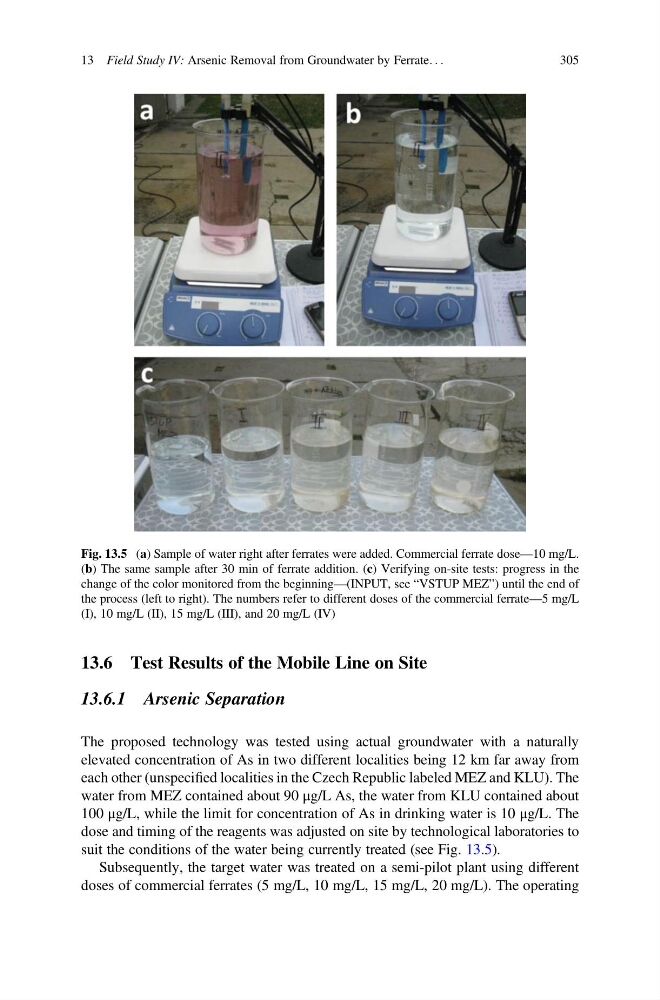
suit the conditions of the water being currently treated (see Fig. 13.5).
Subsequently, the target water was treated on a semi-pilot plant using different
doses of commercial ferrates (5 mg/L, 10 mg/L, 15 mg/L, 20 mg/L). The operating
Fig. 13.5 (a) Sample of water right after ferrates were added. Commercial ferrate dose—10 mg/L.
(b) The same sample after 30 min of ferrate addition. (c) Verifying on-site tests: progress in the
change of the color monitored from the beginning—(INPUT, see “VSTUP MEZ”) until the end of
the process (left to right). The numbers refer to different doses of the commercial ferrate—5 mg/L
(I), 10 mg/L (II), 15 mg/L (III), and 20 mg/L (IV)
13 Field Study IV: Arsenic Removal from Groundwater by Ferrate. . .
305
13.6.1 Arsenic Separation
The proposed technology was tested using actual groundwater with a naturally
elevated concentration of As in two different localities being 12 km far away from
each other (unspecified localities in the Czech Republic labeled MEZ and KLU). The
water from MEZ contained about 90 μg/L As, the water from KLU contained about
100 μg/L, while the limit for concentration of As in drinking water is 10 μg/L. The
dose and timing of the reagents was adjusted on site by technological laboratories to
suit the conditions of the water being currently treated (see Fig. 13.5).
Subsequently, the target water was treated on a semi-pilot plant using different
doses of commercial ferrates (5 mg/L, 10 mg/L, 15 mg/L, 20 mg/L). The operating
Fig. 13.5 (a) Sample of water right after ferrates were added. Commercial ferrate dose—10 mg/L.
(b) The same sample after 30 min of ferrate addition. (c) Verifying on-site tests: progress in the
change of the color monitored from the beginning—(INPUT, see “VSTUP MEZ”) until the end of
the process (left to right). The numbers refer to different doses of the commercial ferrate—5 mg/L
(I), 10 mg/L (II), 15 mg/L (III), and 20 mg/L (IV)
13 Field Study IV: Arsenic Removal from Groundwater by Ferrate. . .
305