

• Larger particles formation support: application of polymeric flocculant solution
increases efficiency in separation of the Fe-As complex by filtration
• Reaction time: 20 min (1 min ferrate addition, 5–7 min acid addition, 12–15 min
flocculant addition)
• Microflakes separation time: 10 min sedimentation (negligible sludge formation),
15 min three-step filtration (sand filtration + microfiltration + ultrafiltration)
13.5 Description of a Mobile Semi-Pilot Plant for Ferrate
Application
On the basis of the laboratory tests results, a prototype of a mobile technological unit
for ferrate (Fe(IV), Fe(V)) application has been designed. This mobile device is
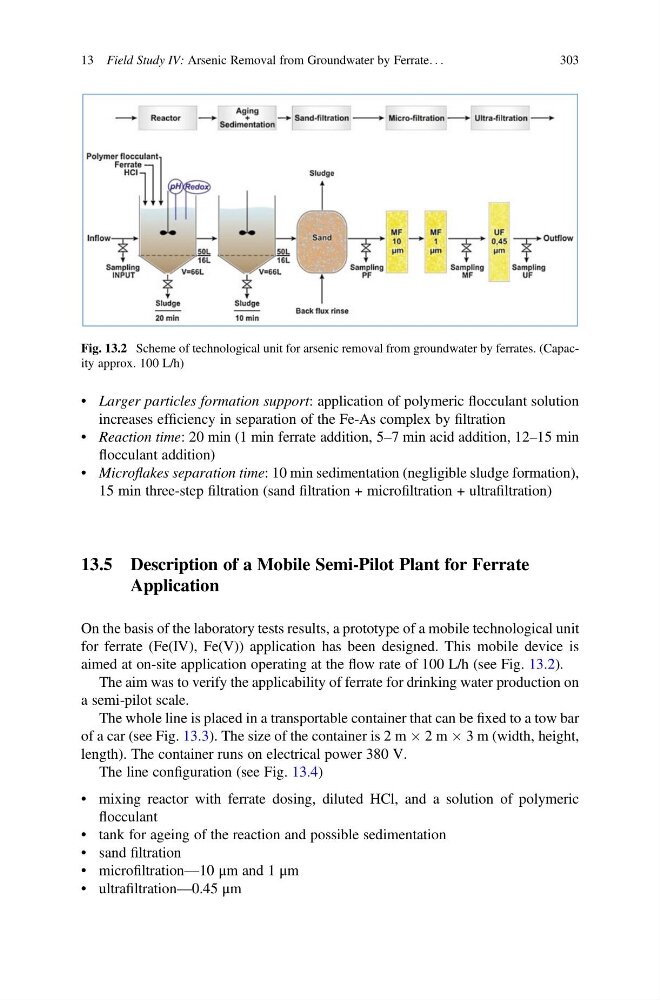
aimed at on-site application operating at the flow rate of 100 L/h (see Fig. 13.2).
The aim was to verify the applicability of ferrate for drinking water production on
a semi-pilot scale.
The whole line is placed in a transportable container that can be fixed to a tow bar
of a car (see Fig. 13.3). The size of the container is 2 m  2 m  3 m (width, height,
length). The container runs on electrical power 380 V.
The line configuration (see Fig. 13.4)
• mixing reactor with ferrate dosing, diluted HCl, and a solution of polymeric
flocculant
• tank for ageing of the reaction and possible sedimentation
• sand filtration
• microfiltration—10 μm and 1 μm
• ultrafiltration—0.45 μm
Fig. 13.2 Scheme of technological unit for arsenic removal from groundwater by ferrates. (Capacity approx. 100 L/h)
13 Field Study IV: Arsenic Removal from Groundwater by Ferrate. . .
303
increases efficiency in separation of the Fe-As complex by filtration
• Reaction time: 20 min (1 min ferrate addition, 5–7 min acid addition, 12–15 min
flocculant addition)
• Microflakes separation time: 10 min sedimentation (negligible sludge formation),
15 min three-step filtration (sand filtration + microfiltration + ultrafiltration)
13.5 Description of a Mobile Semi-Pilot Plant for Ferrate
Application
On the basis of the laboratory tests results, a prototype of a mobile technological unit
for ferrate (Fe(IV), Fe(V)) application has been designed. This mobile device is
aimed at on-site application operating at the flow rate of 100 L/h (see Fig. 13.2).
The aim was to verify the applicability of ferrate for drinking water production on
a semi-pilot scale.
The whole line is placed in a transportable container that can be fixed to a tow bar
of a car (see Fig. 13.3). The size of the container is 2 m  2 m  3 m (width, height,
length). The container runs on electrical power 380 V.
The line configuration (see Fig. 13.4)
• mixing reactor with ferrate dosing, diluted HCl, and a solution of polymeric
flocculant
• tank for ageing of the reaction and possible sedimentation
• sand filtration
• microfiltration—10 μm and 1 μm
• ultrafiltration—0.45 μm
Fig. 13.2 Scheme of technological unit for arsenic removal from groundwater by ferrates. (Capacity approx. 100 L/h)
13 Field Study IV: Arsenic Removal from Groundwater by Ferrate. . .
303