

practical significance only in the case of systems described by a single process
because comparison with a more complex process is ambiguous (Tiehm et al. 1997).
1.3 Quantitative Expression of Redox Potential
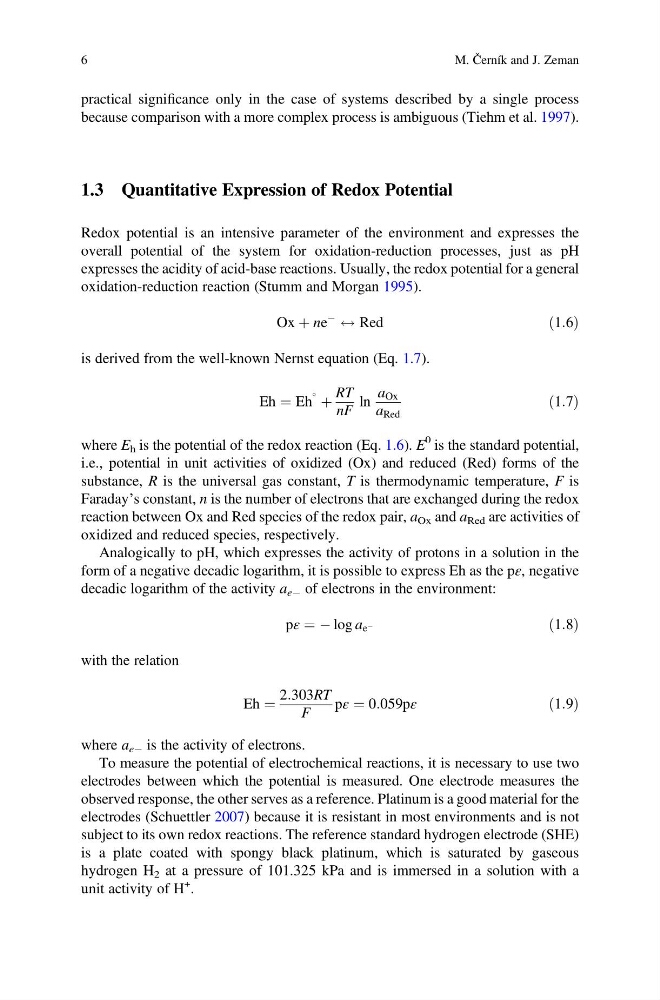
Redox potential is an intensive parameter of the environment and expresses the
overall potential of the system for oxidation-reduction processes, just as pH
expresses the acidity of acid-base reactions. Usually, the redox potential for a general
oxidation-reduction reaction (Stumm and Morgan 1995).
Ox þ ne
À
$ Red
ð1:6Þ
is derived from the well-known Nernst equation (Eq. 1.7).
Eh ¼ Eh
þ
RT
nF
ln
a Ox
a Red
ð1:7Þ
where E h is the potential of the redox reaction (Eq. 1.6). E
0 is the standard potential,
i.e., potential in unit activities of oxidized (Ox) and reduced (Red) forms of the
substance, R is the universal gas constant, T is thermodynamic temperature, F is
Faraday’s constant, n is the number of electrons that are exchanged during the redox
reaction between Ox and Red species of the redox pair, a Ox and a Red are activities of
oxidized and reduced species, respectively.
Analogically to pH, which expresses the activity of protons in a solution in the
form of a negative decadic logarithm, it is possible to express Eh as the pε, negative
decadic logarithm of the activity a eÀ of electrons in the environment:
pε ¼ À log a e À
ð1:8Þ
with the relation
Eh ¼
2:303RT
F
pε ¼ 0:059pε
ð1:9Þ
where a eÀ is the activity of electrons.
To measure the potential of electrochemical reactions, it is necessary to use two
electrodes between which the potential is measured. One electrode measures the
observed response, the other serves as a reference. Platinum is a good material for the
electrodes (Schuettler 2007) because it is resistant in most environments and is not
subject to its own redox reactions. The reference standard hydrogen electrode (SHE)
is a plate coated with spongy black platinum, which is saturated by gaseous
hydrogen H 2 at a pressure of 101.325 kPa and is immersed in a solution with a
unit activity of H
+ .
6
M . Černík and J. Zeman
because comparison with a more complex process is ambiguous (Tiehm et al. 1997).
1.3 Quantitative Expression of Redox Potential
Redox potential is an intensive parameter of the environment and expresses the
overall potential of the system for oxidation-reduction processes, just as pH
expresses the acidity of acid-base reactions. Usually, the redox potential for a general
oxidation-reduction reaction (Stumm and Morgan 1995).
Ox þ ne
À
$ Red
ð1:6Þ
is derived from the well-known Nernst equation (Eq. 1.7).
Eh ¼ Eh
þ
RT
nF
ln
a Ox
a Red
ð1:7Þ
where E h is the potential of the redox reaction (Eq. 1.6). E
0 is the standard potential,
i.e., potential in unit activities of oxidized (Ox) and reduced (Red) forms of the
substance, R is the universal gas constant, T is thermodynamic temperature, F is
Faraday’s constant, n is the number of electrons that are exchanged during the redox
reaction between Ox and Red species of the redox pair, a Ox and a Red are activities of
oxidized and reduced species, respectively.
Analogically to pH, which expresses the activity of protons in a solution in the
form of a negative decadic logarithm, it is possible to express Eh as the pε, negative
decadic logarithm of the activity a eÀ of electrons in the environment:
pε ¼ À log a e À
ð1:8Þ
with the relation
Eh ¼
2:303RT
F
pε ¼ 0:059pε
ð1:9Þ
where a eÀ is the activity of electrons.
To measure the potential of electrochemical reactions, it is necessary to use two
electrodes between which the potential is measured. One electrode measures the
observed response, the other serves as a reference. Platinum is a good material for the
electrodes (Schuettler 2007) because it is resistant in most environments and is not
subject to its own redox reactions. The reference standard hydrogen electrode (SHE)
is a plate coated with spongy black platinum, which is saturated by gaseous
hydrogen H 2 at a pressure of 101.325 kPa and is immersed in a solution with a
unit activity of H
+ .
6
M . Černík and J. Zeman