

high efficiency, multiple functionality, and high flexibility in system size. Photooxidation technology possesses all the salient features that may offer leapfrogging
opportunities in water treatment.
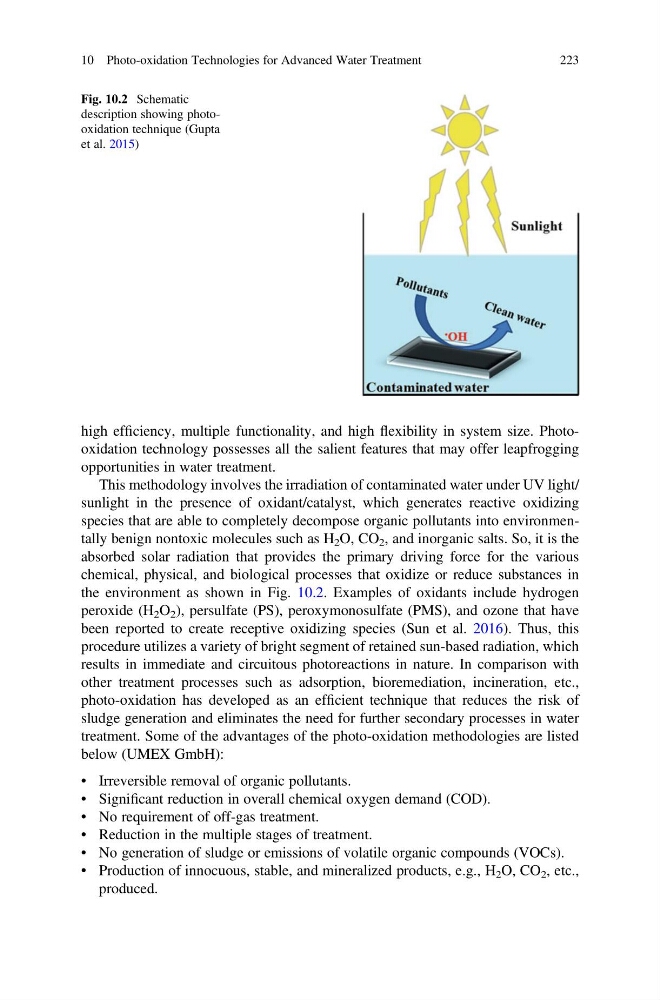
This methodology involves the irradiation of contaminated water under UV light/
sunlight in the presence of oxidant/catalyst, which generates reactive oxidizing
species that are able to completely decompose organic pollutants into environmentally benign nontoxic molecules such as H 2 O, CO 2 , and inorganic salts. So, it is the
absorbed solar radiation that provides the primary driving force for the various
chemical, physical, and biological processes that oxidize or reduce substances in
the environment as shown in Fig. 10.2. Examples of oxidants include hydrogen
peroxide (H 2 O 2 ), persulfate (PS), peroxymonosulfate (PMS), and ozone that have
been reported to create receptive oxidizing species (Sun et al. 2016). Thus, this
procedure utilizes a variety of bright segment of retained sun-based radiation, which
results in immediate and circuitous photoreactions in nature. In comparison with
other treatment processes such as adsorption, bioremediation, incineration, etc.,
photo-oxidation has developed as an efficient technique that reduces the risk of
sludge generation and eliminates the need for further secondary processes in water
treatment. Some of the advantages of the photo-oxidation methodologies are listed
below (UMEX GmbH):
• Irreversible removal of organic pollutants.
• Significant reduction in overall chemical oxygen demand (COD).
• No requirement of off-gas treatment.
• Reduction in the multiple stages of treatment.
• No generation of sludge or emissions of volatile organic compounds (VOCs).
• Production of innocuous, stable, and mineralized products, e.g., H 2 O, CO 2 , etc.,
produced.
Fig. 10.2 Schematic
description showing photooxidation technique (Gupta
et al. 2015)
10 Photo-oxidation Technologies for Advanced Water Treatment
223
opportunities in water treatment.
This methodology involves the irradiation of contaminated water under UV light/
sunlight in the presence of oxidant/catalyst, which generates reactive oxidizing
species that are able to completely decompose organic pollutants into environmentally benign nontoxic molecules such as H 2 O, CO 2 , and inorganic salts. So, it is the
absorbed solar radiation that provides the primary driving force for the various
chemical, physical, and biological processes that oxidize or reduce substances in
the environment as shown in Fig. 10.2. Examples of oxidants include hydrogen
peroxide (H 2 O 2 ), persulfate (PS), peroxymonosulfate (PMS), and ozone that have
been reported to create receptive oxidizing species (Sun et al. 2016). Thus, this
procedure utilizes a variety of bright segment of retained sun-based radiation, which
results in immediate and circuitous photoreactions in nature. In comparison with
other treatment processes such as adsorption, bioremediation, incineration, etc.,
photo-oxidation has developed as an efficient technique that reduces the risk of
sludge generation and eliminates the need for further secondary processes in water
treatment. Some of the advantages of the photo-oxidation methodologies are listed
below (UMEX GmbH):
• Irreversible removal of organic pollutants.
• Significant reduction in overall chemical oxygen demand (COD).
• No requirement of off-gas treatment.
• Reduction in the multiple stages of treatment.
• No generation of sludge or emissions of volatile organic compounds (VOCs).
• Production of innocuous, stable, and mineralized products, e.g., H 2 O, CO 2 , etc.,
produced.
Fig. 10.2 Schematic
description showing photooxidation technique (Gupta
et al. 2015)
10 Photo-oxidation Technologies for Advanced Water Treatment
223