

10.1 Introduction
It is a universally accepted fact that “water is the elixir of life” as almost all forms of
living organisms depend on it in order to survive. However, with the incessantly
growing population and rapid modernization, lack of an adequate supply of clean
drinking water has become an issue of serious concern across the globe, as poor
water quality not only threatens the health of people and ecosystems but also limits
economic productivity and development opportunities.
Although several water purification techniques such as ion exchange (Raghu and
Basha 2007), reverse osmosis (Dialynas et al. 2008), electrolysis (Jin et al. 2003),
precipitation (Yan et al. 2017), ultrafiltration (Fan et al. 2014), and adsorption (Liang
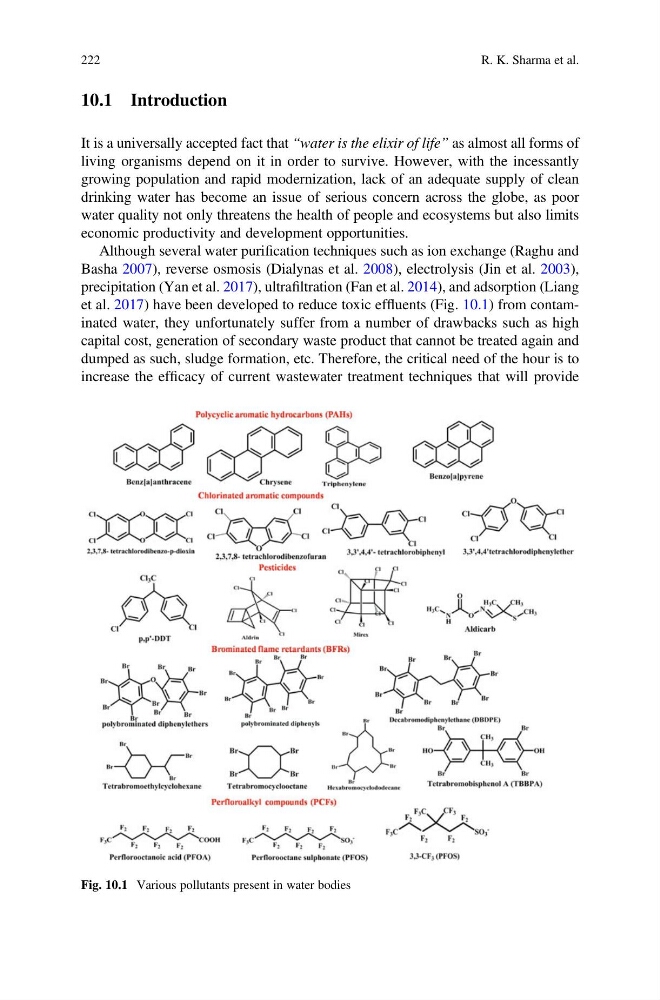
et al. 2017) have been developed to reduce toxic effluents (Fig. 10.1) from contaminated water, they unfortunately suffer from a number of drawbacks such as high
capital cost, generation of secondary waste product that cannot be treated again and
dumped as such, sludge formation, etc. Therefore, the critical need of the hour is to
increase the efficacy of current wastewater treatment techniques that will provide
Fig. 10.1 Various pollutants present in water bodies
222
R. K. Sharma et al.
It is a universally accepted fact that “water is the elixir of life” as almost all forms of
living organisms depend on it in order to survive. However, with the incessantly
growing population and rapid modernization, lack of an adequate supply of clean
drinking water has become an issue of serious concern across the globe, as poor
water quality not only threatens the health of people and ecosystems but also limits
economic productivity and development opportunities.
Although several water purification techniques such as ion exchange (Raghu and
Basha 2007), reverse osmosis (Dialynas et al. 2008), electrolysis (Jin et al. 2003),
precipitation (Yan et al. 2017), ultrafiltration (Fan et al. 2014), and adsorption (Liang
et al. 2017) have been developed to reduce toxic effluents (Fig. 10.1) from contaminated water, they unfortunately suffer from a number of drawbacks such as high
capital cost, generation of secondary waste product that cannot be treated again and
dumped as such, sludge formation, etc. Therefore, the critical need of the hour is to
increase the efficacy of current wastewater treatment techniques that will provide
Fig. 10.1 Various pollutants present in water bodies
222
R. K. Sharma et al.