

not only adsorb and reduce contaminants but also enhance bioremediation processes
(Krol et al. 2013; Němeček et al. 2016). It has been recently found that nZVI can be
successfully applied as a heterogeneous catalyst for peroxydisulfate (Kang et al.
2018; Kim et al. 2018) and peroxymonosulfate (Tan et al. 2018; Wang et al. 2017).
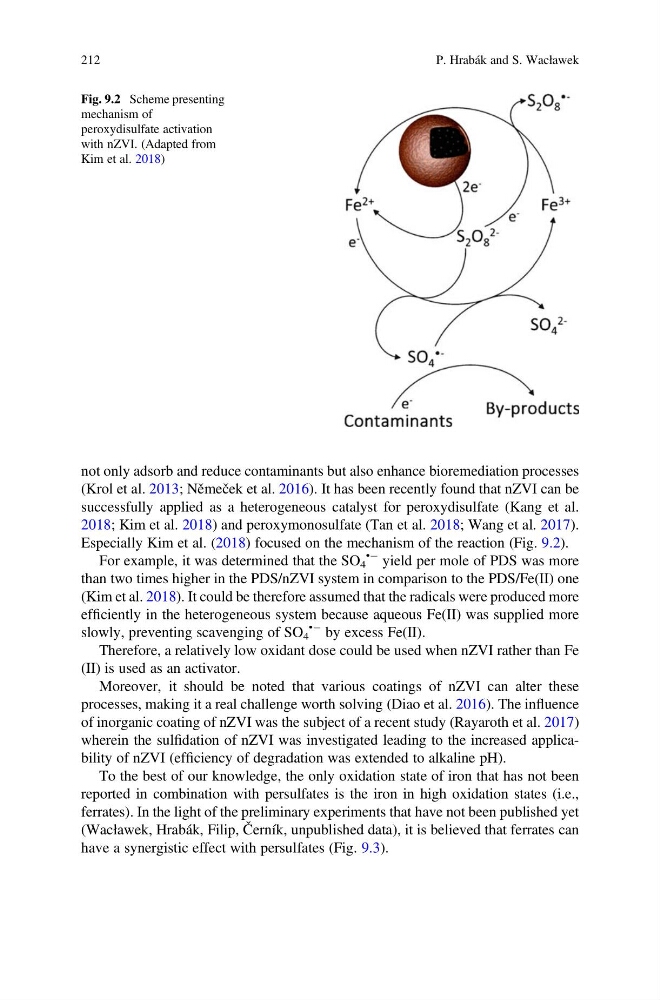
Especially Kim et al. (2018) focused on the mechanism of the reaction (Fig. 9.2).
For example, it was determined that the SO 4
•À yield per mole of PDS was more
than two times higher in the PDS/nZVI system in comparison to the PDS/Fe(II) one
(Kim et al. 2018). It could be therefore assumed that the radicals were produced more
efficiently in the heterogeneous system because aqueous Fe(II) was supplied more
slowly, preventing scavenging of SO 4
•À by excess Fe(II).
Therefore, a relatively low oxidant dose could be used when nZVI rather than Fe
(II) is used as an activator.
Moreover, it should be noted that various coatings of nZVI can alter these
processes, making it a real challenge worth solving (Diao et al. 2016). The influence
of inorganic coating of nZVI was the subject of a recent study (Rayaroth et al. 2017)
wherein the sulfidation of nZVI was investigated leading to the increased applicability of nZVI (efficiency of degradation was extended to alkaline pH).
To the best of our knowledge, the only oxidation state of iron that has not been
reported in combination with persulfates is the iron in high oxidation states (i.e.,
ferrates). In the light of the preliminary experiments that have not been published yet
(Wacławek, Hrabák, Filip, Černík, unpublished data), it is believed that ferrates can
have a synergistic effect with persulfates (Fig. 9.3).
Fig. 9.2 Scheme presenting
mechanism of
peroxydisulfate activation
with nZVI. (Adapted from
Kim et al. 2018)
212
P. Hrabák and S. Wacławek
(Krol et al. 2013; Němeček et al. 2016). It has been recently found that nZVI can be
successfully applied as a heterogeneous catalyst for peroxydisulfate (Kang et al.
2018; Kim et al. 2018) and peroxymonosulfate (Tan et al. 2018; Wang et al. 2017).
Especially Kim et al. (2018) focused on the mechanism of the reaction (Fig. 9.2).
For example, it was determined that the SO 4
•À yield per mole of PDS was more
than two times higher in the PDS/nZVI system in comparison to the PDS/Fe(II) one
(Kim et al. 2018). It could be therefore assumed that the radicals were produced more
efficiently in the heterogeneous system because aqueous Fe(II) was supplied more
slowly, preventing scavenging of SO 4
•À by excess Fe(II).
Therefore, a relatively low oxidant dose could be used when nZVI rather than Fe
(II) is used as an activator.
Moreover, it should be noted that various coatings of nZVI can alter these
processes, making it a real challenge worth solving (Diao et al. 2016). The influence
of inorganic coating of nZVI was the subject of a recent study (Rayaroth et al. 2017)
wherein the sulfidation of nZVI was investigated leading to the increased applicability of nZVI (efficiency of degradation was extended to alkaline pH).
To the best of our knowledge, the only oxidation state of iron that has not been
reported in combination with persulfates is the iron in high oxidation states (i.e.,
ferrates). In the light of the preliminary experiments that have not been published yet
(Wacławek, Hrabák, Filip, Černík, unpublished data), it is believed that ferrates can
have a synergistic effect with persulfates (Fig. 9.3).
Fig. 9.2 Scheme presenting
mechanism of
peroxydisulfate activation
with nZVI. (Adapted from
Kim et al. 2018)
212
P. Hrabák and S. Wacławek