

O 3 directly reacts with double bonds or aromatic ring containing compounds,
reduced sulfur containing groups, and deprotonated amines (von Gunten 2003).
•
OH
can be formed either in the reaction of O 3 with NOM or, in the pH > 8 range, with
OH
À ions. To support
•
OH formation from O 3 , H 2 O 2 is sometimes added to make a
mix called peroxon (Staehelin and Hoigne 1982) or the pH is adjusted to higher
values (Ramseier 2010).
In propagation reactions of
•
OH and O 3 with NOM and carbonates, other ROS,
e.g., perhydroxyl (HO 2
• ) or its deprotonated version superoxide radical anion (O 2
•–
)
emerge and make the reaction system even more complex. HO 2
•
/O 2
•– are poorly
reactive with organic compounds in water medium, i.e., react very slowly
(Gutteridge and Halliwell 1989). This is in contradiction to the reaction mechanisms
proposed by some authors; details will be discussed in Sect. 9.5. Superoxide easily
undertakes termination reactions, e.g., in the one with ozone in which oxygen is
formed. Two superoxide molecules can reconstitute H 2 O 2 in dismutation reaction
(2O 2
•– + 2H
+
! H 2 O 2 + O 2 ). In termination reactions, O 2 (mainly from O 2
•–
) or
H 2 O/OH
À (from
• OH) are formed.
H 2 O 2 additions to ozone are also used to avoid by-products formation. In case of
ozone, the most relevant DBP is bromate BrO
À , which could be formed if bromide
(Br
À ) is present in treated water (von Gunten and Hoigne 1994). Avoiding bromate
formation is a challenging task, which exceeds single ozone treatment technology.
Regarding the presence of ozone recalcitrant pollutants together with bromide and
NOM concentration, it might be either more efficient to enhance ozone dosing in
some cases or to optimize H 2 O 2 addition or to leave ozone AOP and switch over to
using UV/H 2 O 2 (Lutze 2013; von Gunten and Oliveras 1998). Ozonation is a fairly
established technology with solid knowledge foundation coming from water radiochemistry, with many full-scale applications and comprehensive literature, e.g., von
Sonntag and von Gunten (2012).
Changing the basic oxidant to H 2 O 2 , we move from potable water treatment
towards wastewater treatment technologies. Diluted H 2 O 2 itself is not a sufficiently
strong oxidant to treat dissolved TOC or specific organic pollutants. However,
various iron species are known to initiate
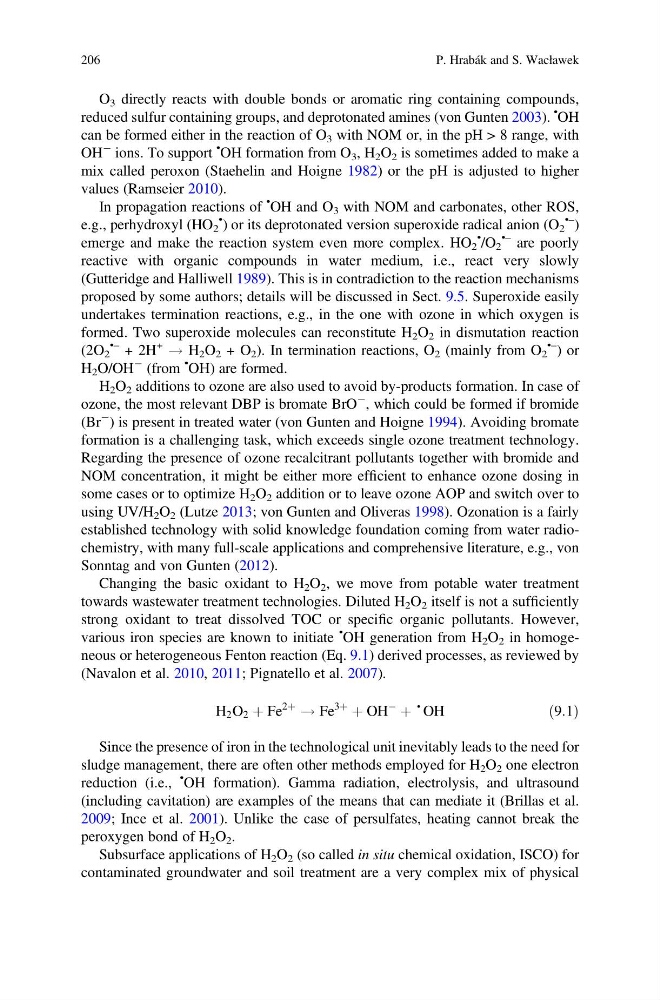
• OH generation from H 2 O 2 in homogeneous or heterogeneous Fenton reaction (Eq. 9.1) derived processes, as reviewed by
(Navalon et al. 2010, 2011; Pignatello et al. 2007).
H 2 O 2 þ Fe
2þ
! Fe
3þ
þ OH
À
þ
• OH
ð9:1Þ
Since the presence of iron in the technological unit inevitably leads to the need for
sludge management, there are often other methods employed for H 2 O 2 one electron
reduction (i.e.,
• OH formation). Gamma radiation, electrolysis, and ultrasound
(including cavitation) are examples of the means that can mediate it (Brillas et al.
2009; Ince et al. 2001). Unlike the case of persulfates, heating cannot break the
peroxygen bond of H 2 O 2 .
Subsurface applications of H 2 O 2 (so called in situ chemical oxidation, ISCO) for
contaminated groundwater and soil treatment are a very complex mix of physical
206
P. Hrabák and S. Wacławek
reduced sulfur containing groups, and deprotonated amines (von Gunten 2003).
•
OH
can be formed either in the reaction of O 3 with NOM or, in the pH > 8 range, with
OH
À ions. To support
•
OH formation from O 3 , H 2 O 2 is sometimes added to make a
mix called peroxon (Staehelin and Hoigne 1982) or the pH is adjusted to higher
values (Ramseier 2010).
In propagation reactions of
•
OH and O 3 with NOM and carbonates, other ROS,
e.g., perhydroxyl (HO 2
• ) or its deprotonated version superoxide radical anion (O 2
•–
)
emerge and make the reaction system even more complex. HO 2
•
/O 2
•– are poorly
reactive with organic compounds in water medium, i.e., react very slowly
(Gutteridge and Halliwell 1989). This is in contradiction to the reaction mechanisms
proposed by some authors; details will be discussed in Sect. 9.5. Superoxide easily
undertakes termination reactions, e.g., in the one with ozone in which oxygen is
formed. Two superoxide molecules can reconstitute H 2 O 2 in dismutation reaction
(2O 2
•– + 2H
+
! H 2 O 2 + O 2 ). In termination reactions, O 2 (mainly from O 2
•–
) or
H 2 O/OH
À (from
• OH) are formed.
H 2 O 2 additions to ozone are also used to avoid by-products formation. In case of
ozone, the most relevant DBP is bromate BrO
À , which could be formed if bromide
(Br
À ) is present in treated water (von Gunten and Hoigne 1994). Avoiding bromate
formation is a challenging task, which exceeds single ozone treatment technology.
Regarding the presence of ozone recalcitrant pollutants together with bromide and
NOM concentration, it might be either more efficient to enhance ozone dosing in
some cases or to optimize H 2 O 2 addition or to leave ozone AOP and switch over to
using UV/H 2 O 2 (Lutze 2013; von Gunten and Oliveras 1998). Ozonation is a fairly
established technology with solid knowledge foundation coming from water radiochemistry, with many full-scale applications and comprehensive literature, e.g., von
Sonntag and von Gunten (2012).
Changing the basic oxidant to H 2 O 2 , we move from potable water treatment
towards wastewater treatment technologies. Diluted H 2 O 2 itself is not a sufficiently
strong oxidant to treat dissolved TOC or specific organic pollutants. However,
various iron species are known to initiate
• OH generation from H 2 O 2 in homogeneous or heterogeneous Fenton reaction (Eq. 9.1) derived processes, as reviewed by
(Navalon et al. 2010, 2011; Pignatello et al. 2007).
H 2 O 2 þ Fe
2þ
! Fe
3þ
þ OH
À
þ
• OH
ð9:1Þ
Since the presence of iron in the technological unit inevitably leads to the need for
sludge management, there are often other methods employed for H 2 O 2 one electron
reduction (i.e.,
• OH formation). Gamma radiation, electrolysis, and ultrasound
(including cavitation) are examples of the means that can mediate it (Brillas et al.
2009; Ince et al. 2001). Unlike the case of persulfates, heating cannot break the
peroxygen bond of H 2 O 2 .
Subsurface applications of H 2 O 2 (so called in situ chemical oxidation, ISCO) for
contaminated groundwater and soil treatment are a very complex mix of physical
206
P. Hrabák and S. Wacławek