

in the treated water can lead to formation of toxic DBPs. More than 600 DBPs are
known today (Richardson et al. 2007). For chlorine species, most important DBPs
are:
• NaOCl or Cl 2 – trihalomethanes (THMs), haloacetic acids, haloacetonitriles,
chloral hydrates, trihalonitromethanes
• NH 2 Cl – nitrosamines, cyanogen halides, iodinated THMs, haloacetaldehyde
• ClO 2 – chlorite, chlorate, organic acids
Chlorine dioxide (ClO 2 ) offers several advantages in comparison to other chlorine
sources as it reacts directly as an electron acceptor rather than via chlorine substitution.
Moreover, it is more efficient in protozoa deactivation; its efficiency is
pH-independent and no malodorous DBPs are formed. However, in case of ClO 2
some relevant DBPs can also appear. As with other chlorine species, precise dosing
with a feedback to matrix components concentrations is absolutely necessary to avoid
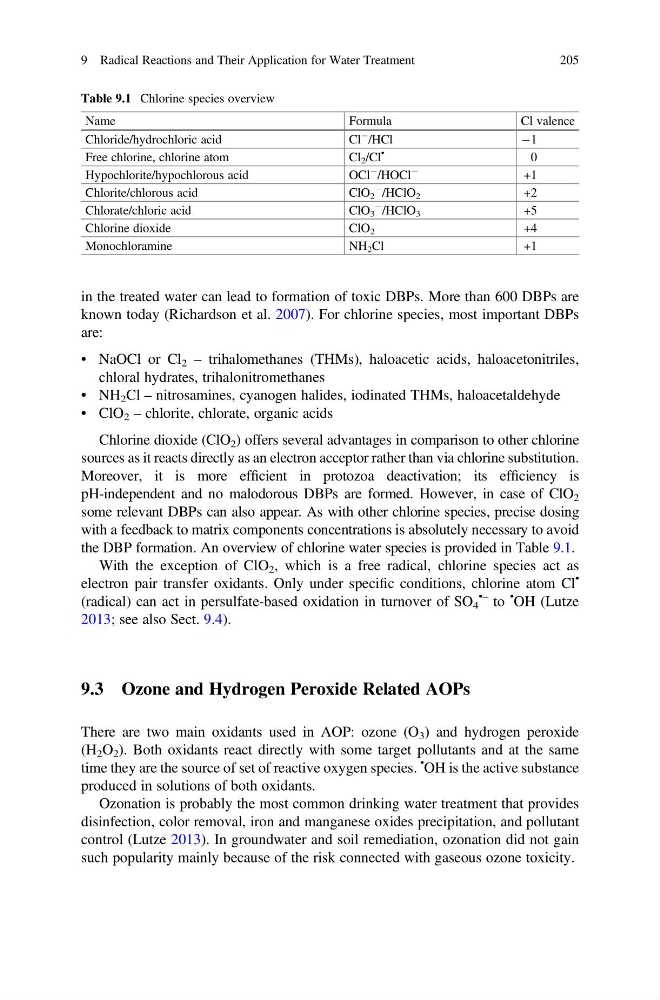
the DBP formation. An overview of chlorine water species is provided in Table 9.1.
With the exception of ClO 2 , which is a free radical, chlorine species act as
electron pair transfer oxidants. Only under specific conditions, chlorine atom Cl
•
(radical) can act in persulfate-based oxidation in turnover of SO 4
•– to
•
OH (Lutze
2013; see also Sect. 9.4).
9.3 Ozone and Hydrogen Peroxide Related AOPs
There are two main oxidants used in AOP: ozone (O 3 ) and hydrogen peroxide
(H 2 O 2 ). Both oxidants react directly with some target pollutants and at the same
time they are the source of set of reactive oxygen species.
•
OH is the active substance
produced in solutions of both oxidants.
Ozonation is probably the most common drinking water treatment that provides
disinfection, color removal, iron and manganese oxides precipitation, and pollutant
control (Lutze 2013). In groundwater and soil remediation, ozonation did not gain
such popularity mainly because of the risk connected with gaseous ozone toxicity.
Table 9.1 Chlorine species overview
Name
Formula
Cl valence
Chloride/hydrochloric acid
Cl
À /HCl
À1
Free chlorine, chlorine atom
Cl 2 /Cl
•
0
Hypochlorite/hypochlorous acid
OCl
À
/HOCl
À
+1
Chlorite/chlorous acid
ClO 2
À
/HClO 2
+2
Chlorate/chloric acid
ClO 3
À
/HClO 3
+5
Chlorine dioxide
ClO 2
+4
Monochloramine
NH 2 Cl
+1
9 Radical Reactions and Their Application for Water Treatment
205
known today (Richardson et al. 2007). For chlorine species, most important DBPs
are:
• NaOCl or Cl 2 – trihalomethanes (THMs), haloacetic acids, haloacetonitriles,
chloral hydrates, trihalonitromethanes
• NH 2 Cl – nitrosamines, cyanogen halides, iodinated THMs, haloacetaldehyde
• ClO 2 – chlorite, chlorate, organic acids
Chlorine dioxide (ClO 2 ) offers several advantages in comparison to other chlorine
sources as it reacts directly as an electron acceptor rather than via chlorine substitution.
Moreover, it is more efficient in protozoa deactivation; its efficiency is
pH-independent and no malodorous DBPs are formed. However, in case of ClO 2
some relevant DBPs can also appear. As with other chlorine species, precise dosing
with a feedback to matrix components concentrations is absolutely necessary to avoid
the DBP formation. An overview of chlorine water species is provided in Table 9.1.
With the exception of ClO 2 , which is a free radical, chlorine species act as
electron pair transfer oxidants. Only under specific conditions, chlorine atom Cl
•
(radical) can act in persulfate-based oxidation in turnover of SO 4
•– to
•
OH (Lutze
2013; see also Sect. 9.4).
9.3 Ozone and Hydrogen Peroxide Related AOPs
There are two main oxidants used in AOP: ozone (O 3 ) and hydrogen peroxide
(H 2 O 2 ). Both oxidants react directly with some target pollutants and at the same
time they are the source of set of reactive oxygen species.
•
OH is the active substance
produced in solutions of both oxidants.
Ozonation is probably the most common drinking water treatment that provides
disinfection, color removal, iron and manganese oxides precipitation, and pollutant
control (Lutze 2013). In groundwater and soil remediation, ozonation did not gain
such popularity mainly because of the risk connected with gaseous ozone toxicity.
Table 9.1 Chlorine species overview
Name
Formula
Cl valence
Chloride/hydrochloric acid
Cl
À /HCl
À1
Free chlorine, chlorine atom
Cl 2 /Cl
•
0
Hypochlorite/hypochlorous acid
OCl
À
/HOCl
À
+1
Chlorite/chlorous acid
ClO 2
À
/HClO 2
+2
Chlorate/chloric acid
ClO 3
À
/HClO 3
+5
Chlorine dioxide
ClO 2
+4
Monochloramine
NH 2 Cl
+1
9 Radical Reactions and Their Application for Water Treatment
205