

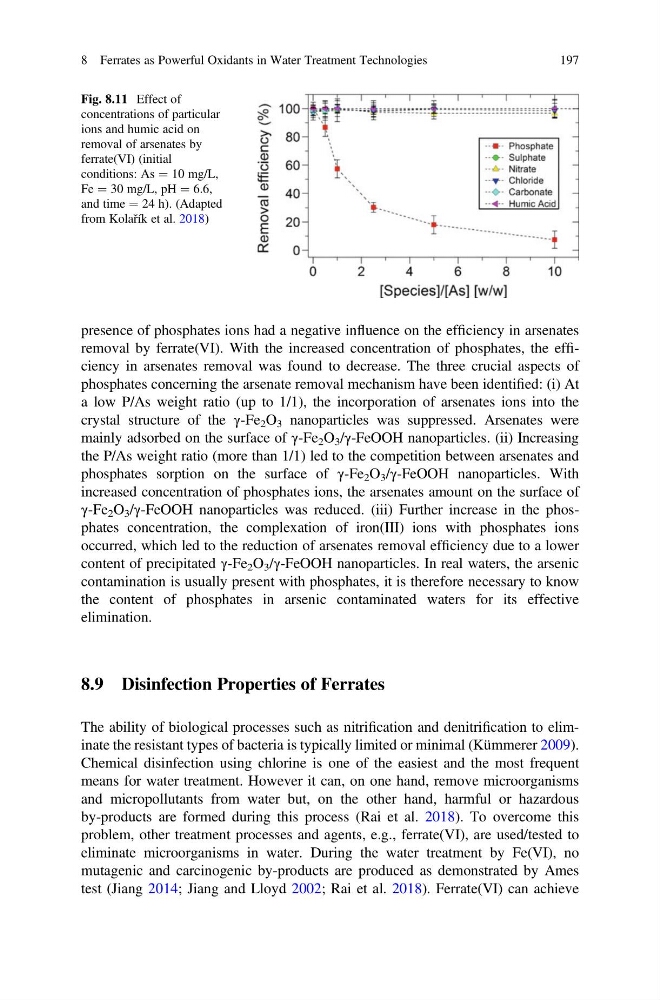
presence of phosphates ions had a negative influence on the efficiency in arsenates
removal by ferrate(VI). With the increased concentration of phosphates, the efficiency in arsenates removal was found to decrease. The three crucial aspects of
phosphates concerning the arsenate removal mechanism have been identified: (i) At
a low P/As weight ratio (up to 1/1), the incorporation of arsenates ions into the
crystal structure of the γ-Fe 2 O 3 nanoparticles was suppressed. Arsenates were
mainly adsorbed on the surface of γ-Fe 2 O 3 /γ-FeOOH nanoparticles. (ii) Increasing
the P/As weight ratio (more than 1/1) led to the competition between arsenates and
phosphates sorption on the surface of γ-Fe 2 O 3 /γ-FeOOH nanoparticles. With
increased concentration of phosphates ions, the arsenates amount on the surface of
γ-Fe 2 O 3 /γ-FeOOH nanoparticles was reduced. (iii) Further increase in the phosphates concentration, the complexation of iron(III) ions with phosphates ions
occurred, which led to the reduction of arsenates removal efficiency due to a lower
content of precipitated γ-Fe 2 O 3 /γ-FeOOH nanoparticles. In real waters, the arsenic
contamination is usually present with phosphates, it is therefore necessary to know
the content of phosphates in arsenic contaminated waters for its effective
elimination.
8.9 Disinfection Properties of Ferrates
The ability of biological processes such as nitrification and denitrification to eliminate the resistant types of bacteria is typically limited or minimal (Kümmerer 2009).
Chemical disinfection using chlorine is one of the easiest and the most frequent
means for water treatment. However it can, on one hand, remove microorganisms
and micropollutants from water but, on the other hand, harmful or hazardous
by-products are formed during this process (Rai et al. 2018). To overcome this
problem, other treatment processes and agents, e.g., ferrate(VI), are used/tested to
eliminate microorganisms in water. During the water treatment by Fe(VI), no
mutagenic and carcinogenic by-products are produced as demonstrated by Ames
test (Jiang 2014; Jiang and Lloyd 2002; Rai et al. 2018). Ferrate(VI) can achieve
Fig. 8.11 Effect of
concentrations of particular
ions and humic acid on
removal of arsenates by
ferrate(VI) (initial
conditions: As ¼ 10 mg/L,
Fe ¼ 30 mg/L, pH ¼ 6.6,
and time ¼ 24 h). (Adapted
from Kolařík et al. 2018)
8 Ferrates as Powerful Oxidants in Water Treatment Technologies
197
removal by ferrate(VI). With the increased concentration of phosphates, the efficiency in arsenates removal was found to decrease. The three crucial aspects of
phosphates concerning the arsenate removal mechanism have been identified: (i) At
a low P/As weight ratio (up to 1/1), the incorporation of arsenates ions into the
crystal structure of the γ-Fe 2 O 3 nanoparticles was suppressed. Arsenates were
mainly adsorbed on the surface of γ-Fe 2 O 3 /γ-FeOOH nanoparticles. (ii) Increasing
the P/As weight ratio (more than 1/1) led to the competition between arsenates and
phosphates sorption on the surface of γ-Fe 2 O 3 /γ-FeOOH nanoparticles. With
increased concentration of phosphates ions, the arsenates amount on the surface of
γ-Fe 2 O 3 /γ-FeOOH nanoparticles was reduced. (iii) Further increase in the phosphates concentration, the complexation of iron(III) ions with phosphates ions
occurred, which led to the reduction of arsenates removal efficiency due to a lower
content of precipitated γ-Fe 2 O 3 /γ-FeOOH nanoparticles. In real waters, the arsenic
contamination is usually present with phosphates, it is therefore necessary to know
the content of phosphates in arsenic contaminated waters for its effective
elimination.
8.9 Disinfection Properties of Ferrates
The ability of biological processes such as nitrification and denitrification to eliminate the resistant types of bacteria is typically limited or minimal (Kümmerer 2009).
Chemical disinfection using chlorine is one of the easiest and the most frequent
means for water treatment. However it can, on one hand, remove microorganisms
and micropollutants from water but, on the other hand, harmful or hazardous
by-products are formed during this process (Rai et al. 2018). To overcome this
problem, other treatment processes and agents, e.g., ferrate(VI), are used/tested to
eliminate microorganisms in water. During the water treatment by Fe(VI), no
mutagenic and carcinogenic by-products are produced as demonstrated by Ames
test (Jiang 2014; Jiang and Lloyd 2002; Rai et al. 2018). Ferrate(VI) can achieve
Fig. 8.11 Effect of
concentrations of particular
ions and humic acid on
removal of arsenates by
ferrate(VI) (initial
conditions: As ¼ 10 mg/L,
Fe ¼ 30 mg/L, pH ¼ 6.6,
and time ¼ 24 h). (Adapted
from Kolařík et al. 2018)
8 Ferrates as Powerful Oxidants in Water Treatment Technologies
197