

with amine group of tramadol with subsequent dealkylation yielding aldehyde
and/or carboxylic groups (Sharma et al. 2016a).
Reactions of ferrate(VI) with sulfur- and nitrogen-containing pharmaceuticals are
completed in a couple of seconds or minutes and the detected products are less toxic
than the parent compounds (Sharma 2010). However, the related mechanism for the
degradation is ambiguous and can hardly be elucidated empirically due to the rapid
oxidation process and unstable intermediates for experimental trapping (Yu et al.
2017). In the case of sulfamethoxazole, DFT calculations were included in order to
elucidate how ferrate(VI) initiated oxidative degradation process and to understand
the reaction mechanisms (Yu et al. 2017). According to DFT study in the case of
sulfamethoxazole, ferrate provides, at the initial step, oxygen atoms for the oxidation
of aniline and isoxazole moieties. These theoretical findings are partially, not fully,
supported by the experimental results (Casbeer et al. 2013; Hightower et al. 2012).
The DFT calculations also show that a nucleophilic attack is a favorable pathway for
ferrate(VI) to initiate oxidation of sulfamethoxazole, which has not been proposed
previously. From the previous comments, it is clear that the degradation mechanism
of micropollutants is very complicated and several oxidation products are formed
during oxidation by ferrate.
Probably, the main problem is that the oxidation of drugs by ferrate(VI) can occur
by several possible pathways (Sharma 2013). It is well known that several oxidation
steps probably occur during the oxidation of a micropollutant by Fe(VI), which
usually includes one- or two-electron transfer of Fe(VI) to form Fe(V) and Fe(IV),
respectively, with Fe(II) and Fe(III) species as the final products. There is also a high
probability of consecutive reactions of Fe(V) and Fe(IV), respectively, with other
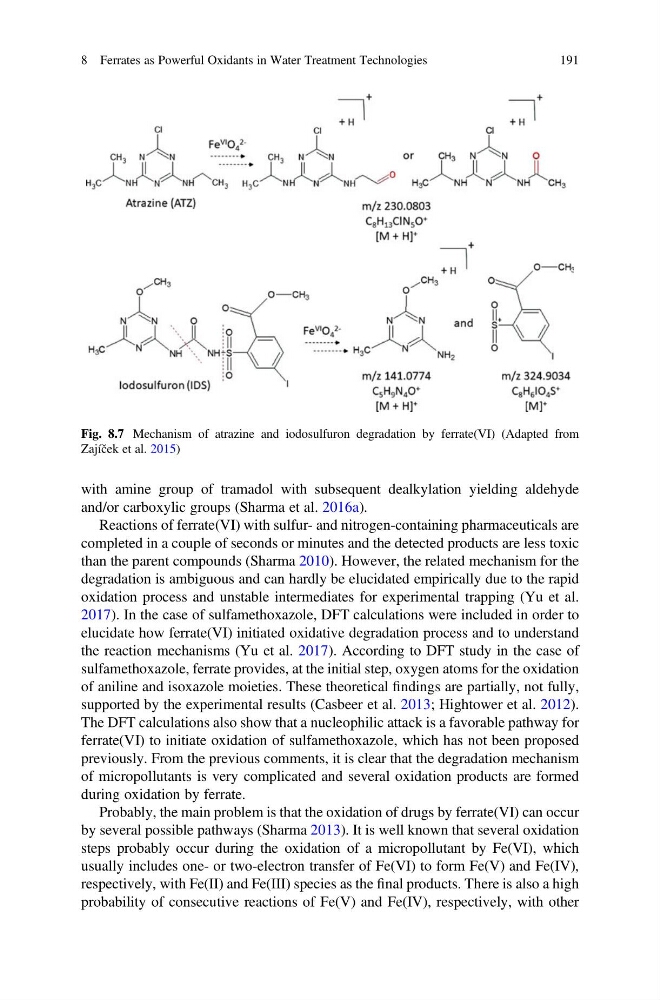
Fig. 8.7 Mechanism of atrazine and iodosulfuron degradation by ferrate(VI) (Adapted from
Zajíček et al. 2015)
8 Ferrates as Powerful Oxidants in Water Treatment Technologies
191
and/or carboxylic groups (Sharma et al. 2016a).
Reactions of ferrate(VI) with sulfur- and nitrogen-containing pharmaceuticals are
completed in a couple of seconds or minutes and the detected products are less toxic
than the parent compounds (Sharma 2010). However, the related mechanism for the
degradation is ambiguous and can hardly be elucidated empirically due to the rapid
oxidation process and unstable intermediates for experimental trapping (Yu et al.
2017). In the case of sulfamethoxazole, DFT calculations were included in order to
elucidate how ferrate(VI) initiated oxidative degradation process and to understand
the reaction mechanisms (Yu et al. 2017). According to DFT study in the case of
sulfamethoxazole, ferrate provides, at the initial step, oxygen atoms for the oxidation
of aniline and isoxazole moieties. These theoretical findings are partially, not fully,
supported by the experimental results (Casbeer et al. 2013; Hightower et al. 2012).
The DFT calculations also show that a nucleophilic attack is a favorable pathway for
ferrate(VI) to initiate oxidation of sulfamethoxazole, which has not been proposed
previously. From the previous comments, it is clear that the degradation mechanism
of micropollutants is very complicated and several oxidation products are formed
during oxidation by ferrate.
Probably, the main problem is that the oxidation of drugs by ferrate(VI) can occur
by several possible pathways (Sharma 2013). It is well known that several oxidation
steps probably occur during the oxidation of a micropollutant by Fe(VI), which
usually includes one- or two-electron transfer of Fe(VI) to form Fe(V) and Fe(IV),
respectively, with Fe(II) and Fe(III) species as the final products. There is also a high
probability of consecutive reactions of Fe(V) and Fe(IV), respectively, with other
Fig. 8.7 Mechanism of atrazine and iodosulfuron degradation by ferrate(VI) (Adapted from
Zajíček et al. 2015)
8 Ferrates as Powerful Oxidants in Water Treatment Technologies
191