

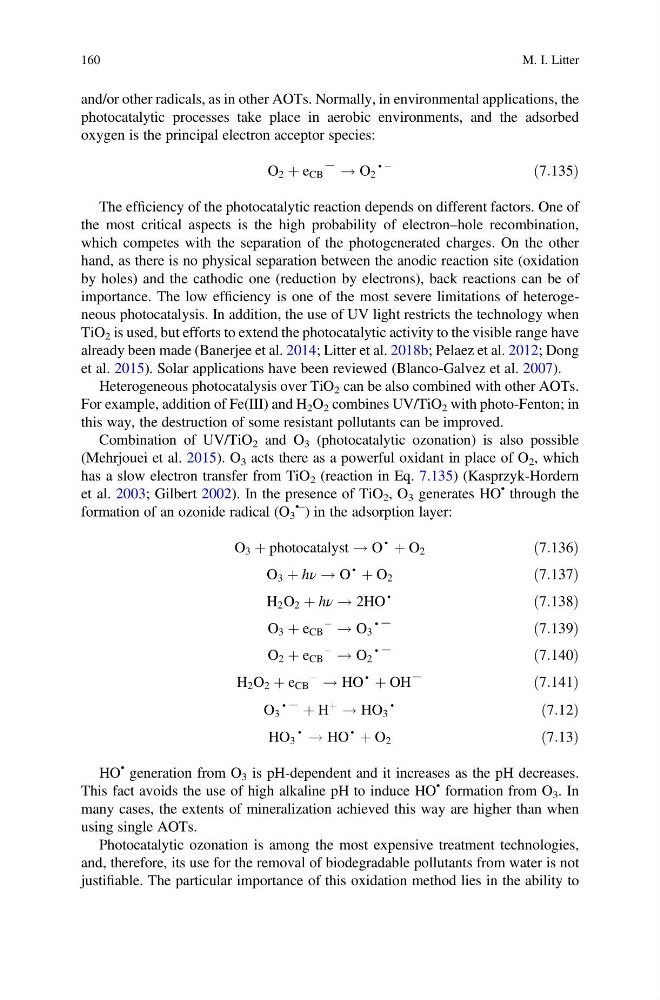
and/or other radicals, as in other AOTs. Normally, in environmental applications, the
photocatalytic processes take place in aerobic environments, and the adsorbed
oxygen is the principal electron acceptor species:
O 2 þ e CB
À ! O 2
• À
ð7:135Þ
The efficiency of the photocatalytic reaction depends on different factors. One of
the most critical aspects is the high probability of electron–hole recombination,
which competes with the separation of the photogenerated charges. On the other
hand, as there is no physical separation between the anodic reaction site (oxidation
by holes) and the cathodic one (reduction by electrons), back reactions can be of
importance. The low efficiency is one of the most severe limitations of heterogeneous photocatalysis. In addition, the use of UV light restricts the technology when
TiO 2 is used, but efforts to extend the photocatalytic activity to the visible range have
already been made (Banerjee et al. 2014; Litter et al. 2018b; Pelaez et al. 2012; Dong
et al. 2015). Solar applications have been reviewed (Blanco-Galvez et al. 2007).
Heterogeneous photocatalysis over TiO 2 can be also combined with other AOTs.
For example, addition of Fe(III) and H 2 O 2 combines UV/TiO 2 with photo-Fenton; in
this way, the destruction of some resistant pollutants can be improved.
Combination of UV/TiO 2 and O 3 (photocatalytic ozonation) is also possible
(Mehrjouei et al. 2015). O 3 acts there as a powerful oxidant in place of O 2 , which
has a slow electron transfer from TiO 2 (reaction in Eq. 7.135) (Kasprzyk-Hordern
et al. 2003; Gilbert 2002). In the presence of TiO 2 , O 3 generates HO
• through the
formation of an ozonide radical (O 3
•– ) in the adsorption layer:
O 3 þ photocatalyst ! O
•
þ O 2
ð7:136Þ
O 3 þ hν ! O
•
þ O 2
ð7:137Þ
H 2 O 2 þ hν ! 2HO
•
ð7:138Þ
O 3 þ e CB
À
! O 3
• À
ð7:139Þ
O 2 þ e CB
À
! O 2
• À
ð7:140Þ
H 2 O 2 þ e CB
À
! HO
•
þ OH À
ð7:141Þ
O 3
• À þ H
þ
! HO 3
•
ð7:12Þ
HO 3
•
! HO
•
þ O 2
ð7:13Þ
HO
• generation from O 3 is pH-dependent and it increases as the pH decreases.
This fact avoids the use of high alkaline pH to induce HO
• formation from O 3 . In
many cases, the extents of mineralization achieved this way are higher than when
using single AOTs.
Photocatalytic ozonation is among the most expensive treatment technologies,
and, therefore, its use for the removal of biodegradable pollutants from water is not
justifiable. The particular importance of this oxidation method lies in the ability to
160
M. I. Litter
photocatalytic processes take place in aerobic environments, and the adsorbed
oxygen is the principal electron acceptor species:
O 2 þ e CB
À ! O 2
• À
ð7:135Þ
The efficiency of the photocatalytic reaction depends on different factors. One of
the most critical aspects is the high probability of electron–hole recombination,
which competes with the separation of the photogenerated charges. On the other
hand, as there is no physical separation between the anodic reaction site (oxidation
by holes) and the cathodic one (reduction by electrons), back reactions can be of
importance. The low efficiency is one of the most severe limitations of heterogeneous photocatalysis. In addition, the use of UV light restricts the technology when
TiO 2 is used, but efforts to extend the photocatalytic activity to the visible range have
already been made (Banerjee et al. 2014; Litter et al. 2018b; Pelaez et al. 2012; Dong
et al. 2015). Solar applications have been reviewed (Blanco-Galvez et al. 2007).
Heterogeneous photocatalysis over TiO 2 can be also combined with other AOTs.
For example, addition of Fe(III) and H 2 O 2 combines UV/TiO 2 with photo-Fenton; in
this way, the destruction of some resistant pollutants can be improved.
Combination of UV/TiO 2 and O 3 (photocatalytic ozonation) is also possible
(Mehrjouei et al. 2015). O 3 acts there as a powerful oxidant in place of O 2 , which
has a slow electron transfer from TiO 2 (reaction in Eq. 7.135) (Kasprzyk-Hordern
et al. 2003; Gilbert 2002). In the presence of TiO 2 , O 3 generates HO
• through the
formation of an ozonide radical (O 3
•– ) in the adsorption layer:
O 3 þ photocatalyst ! O
•
þ O 2
ð7:136Þ
O 3 þ hν ! O
•
þ O 2
ð7:137Þ
H 2 O 2 þ hν ! 2HO
•
ð7:138Þ
O 3 þ e CB
À
! O 3
• À
ð7:139Þ
O 2 þ e CB
À
! O 2
• À
ð7:140Þ
H 2 O 2 þ e CB
À
! HO
•
þ OH À
ð7:141Þ
O 3
• À þ H
þ
! HO 3
•
ð7:12Þ
HO 3
•
! HO
•
þ O 2
ð7:13Þ
HO
• generation from O 3 is pH-dependent and it increases as the pH decreases.
This fact avoids the use of high alkaline pH to induce HO
• formation from O 3 . In
many cases, the extents of mineralization achieved this way are higher than when
using single AOTs.
Photocatalytic ozonation is among the most expensive treatment technologies,
and, therefore, its use for the removal of biodegradable pollutants from water is not
justifiable. The particular importance of this oxidation method lies in the ability to
160
M. I. Litter